



MMP-12 Protein, Human
Based on 1 Customer Validation
MMP-12 protein is potentially engaged in tissue injury and remodeling, displaying significant elastolytic activity. It shows flexibility at the P1' site, accommodating both large and small amino acids, yet favoring leucine. At the P1 site, it prefers aromatic or hydrophobic residues, with a tendency for small hydrophobic residues like alanine in the P3 position. MMP-12 Protein, Human is the recombinant human-derived MMP-12 protein, expressed by E. coli , with tag free.
- Species: Human
- Source: E. coli
-
Storage:Stored at -20°C for 2 years from date of receipt. After reconstitution, it is stable at 4°C for 1 week or -20°C for longer (with carrier protein). It is recommended to freeze aliquots at -20°C or -80°C for extended storage.


To place orders, for customer services and technical support, please contact: MedChemExpress USA
Tel: 609-228-6898 E-mail: [email protected] [email protected]


-
 Biological Activity
-
Technical Parameters
-
Product Properties
- Documentation
- Help & FAQs


-

HY-P70250
MMP-1 Protein, Human (HEK293, His, solution) -
HY-P73300
MMP-9 Protein, Human (HEK293) -
HY-P73296
MMP-2 Protein, Human (HEK293) -
HY-P70268
MMP-2 Protein, Human (HEK293, His) -
HY-P73297
Stromelysin-1/MMP-3 Protein, Human -
HY-P702527
MMP-13 Protein, Human (HEK293) -
HY-P72507
MMP-8 Protein, Human (HEK293, His) -
HY-P70342
MMP-12 Protein, Mouse (HEK293, His) -
HY-P73298
MMP-8 Protein, Human (HEK293) -
HY-P70139
Stromelysin-1/MMP-3 Protein, Human (HEK293, His)


Biological Activity
Description
MMP-12 protein is potentially engaged in tissue injury and remodeling, displaying significant elastolytic activity. It shows flexibility at the P1' site, accommodating both large and small amino acids, yet favoring leucine. At the P1 site, it prefers aromatic or hydrophobic residues, with a tendency for small hydrophobic residues like alanine in the P3 position. MMP-12 Protein, Human is the recombinant human-derived MMP-12 protein, expressed by E. coli , with tag free.
Background
The MMP-12 protein is potentially involved in tissue injury and remodeling and possesses notable elastolytic activity. It demonstrates the ability to accept both large and small amino acids at the P1' site, although it exhibits a preference for leucine. At the P1 site, it favors aromatic or hydrophobic residues, with a preference for small hydrophobic residues like alanine in the P3 position.
Verified Bioactivity
Measured by its ability to cleave the fluorogenic peptide substrate, Mca-PLGL-Dpa-AR-NH2 and the specific activity is > 800 pmoles/min/µg.
MCE Validation Data
-
Purity - SDS-PAGE
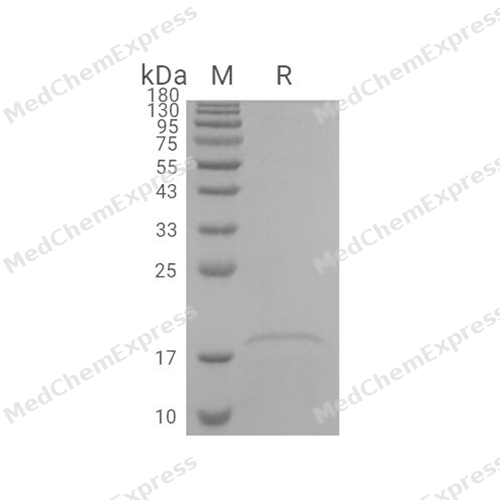
Purity - SDS-PAGE


Technical Parameters
-
Species Human
-
Source E. coli
-
Tag Tag Free
-
Accession
P39900 (G106-N268)
-
Molecular Construction
-
N-term
-
MMP-12 (G106-N268)
Accession # P39900 -
C-term
-
-
Protein Length
Partial
-
Synonyms
MMP12; MMP-12; Matrix Metallopeptidase 12; MME; HME; ME; Matrix Metalloproteinase 12 (Macrophage Elastase); Matrix Metallopeptidase 12 (Macrophage Elastase); Macrophage Metalloelastase; Matrix Metalloproteinase-12; Macrophage Elastase
-
AA Sequence
GPVWRKHYITYRINNYTPDMNREDVDYAIRKAFQVWSNVTPLKFSKINTGMADILVVFARGAHGDFHAFDGKGGILAHAFGPGSGIGGDAHFDEDEFWTTHSGGTNLFLTAVHEIGHSLGLGHSSDPKAVMFPTYKYVDINTFRLSADDIRGIQSLYGDPKEN
-
Molecular Weight
Approximately 18 kDa, based on SDS-PAGE under reducing conditions.
-
Purity
≥ 90%, as determined by reducing SDS-PAGE.


Product Properties
Lyophilized powder
1.Lyophilized from a 0.22 μm filtered solution of 10 mM Hepes, 2 mM CaCl2, 250 mM NaCl, pH 7.0, 5% trehalose, 5% Mannitol, 0.01% Tween-80.
2.Lyophilized from a 0.22 μm filtered solution of 50 mM Tris, 2 mM CaCl2, 250 mM NaCl, pH 7, 5% trehalose, 5% Mannitol, 0.01% Tween-80.
Note: For SPR assay, please replace the buffer. Primary amine components (e.g., Tris, imidazole) can affect protein-coupled chips.
3.Lyophilized from a 0.22 μm filtered solution of 10 mM Hepes, 2 mM CaCl2, 250 mM NaCl, pH 7.0, 8% trehalose.
Please refer to the lot-specific COA for specific buffer information.
<1 EU/μg, determined by LAL method.
It is not recommended to reconstitute to a concentration less than 100 μg/mL in ddH2O.
Stored at -20°C for 2 years from date of receipt. After reconstitution, it is stable at 4°C for 1 week or -20°C for longer (with carrier protein). It is recommended to freeze aliquots at -20°C or -80°C for extended storage.
Room temperature in continental US; may vary elsewhere.


Documentation
-
Data Sheet (236 KB)
-
SDS (251 KB)
- English - EN (251 KB)
- Français - FR (251 KB)
- Deutsch - DE (251 KB)
- Norwegian - NO (251 KB)
- Español - ES (251 KB)
- Swedish - SV (251 KB)
- Italian - IT (251 KB)
- Korean - KR (251 KB)
- Portuguese - PT (251 KB)
-
Handling Instructions (2659 KB)

Calculators
Concentration (start) × Volume (start) = Concentration (final) × Volume (final)


 Powered by Bioz

