



NMI Protein, Mouse (His)

Based on 1 Customer Validation
NMI proteins are signaling pathway regulators in the innate immune system, interacting with STATs in the presence of IL2 and IFN-γ to activate downstream genes. It enhances the recruitment of STAT1 and STAT5 by CBP/p300 coactivators, thereby increasing the transcription of dependent genes. NMI Protein, Mouse (His) is the recombinant mouse-derived NMI protein, expressed by E. coli , with C-6*His labeled tag.
- Species: Mouse
- Source: E. coli
-
Storage:Stored at -20°C for 2 years from date of receipt. After reconstitution, it is stable at 4°C for 1 week or -20°C for longer (with carrier protein). It is recommended to freeze aliquots at -20°C or -80°C for extended storage.


To place orders, for customer services and technical support, please contact: MedChemExpress USA
Tel: 609-228-6898 E-mail: [email protected] [email protected]


-
 Biological Activity
-
Technical Parameters
-
Product Properties
- Documentation
- Help & FAQs




Biological Activity
Description
NMI proteins are signaling pathway regulators in the innate immune system, interacting with STATs in the presence of IL2 and IFN-γ to activate downstream genes. It enhances the recruitment of STAT1 and STAT5 by CBP/p300 coactivators, thereby increasing the transcription of dependent genes. NMI Protein, Mouse (His) is the recombinant mouse-derived NMI protein, expressed by E. coli , with C-6*His labeled tag.
Background
NMI Protein serves as a signaling pathway regulator involved in the innate immune system response. In the presence of interleukin 2 (IL2) and interferon IFN-gamma (IFNG), NMI interacts with signal transducer and activator of transcription (STAT), activating downstream genes crucial for development and homeostasis. It enhances the recruitment of CBP/p300 coactivators to STAT1 and STAT5, resulting in increased transcription of STAT1- and STAT5-dependent genes. In response to interferon IFN-alpha, NMI forms a complex with the transcriptional regulator IFI35, preventing the proteasome-mediated degradation of IFI35 and regulating immune response. Additionally, NMI negatively regulates nuclear factor NF-kappa-B signaling by inhibiting the nuclear translocation and activation of NF-kappa-B subunit p65/RELA, impacting endothelial cell processes. It also plays a role in limiting virus-triggered type I interferon production by inducing the degradation of IRF7. Extracellularly, NMI functions as damage-associated molecular patterns (DAMPs), promoting inflammation when released by macrophages during injury or pathogen invasion. Macrophage-secreted NMI activates NF-kappa-B signaling in adjacent macrophages through Toll-like receptor 4 (TLR4) binding, inducing the release of pro-inflammatory cytokines. NMI interacts with various transcription factors, including MYCN, MYC, and STAT proteins, and undergoes ubiquitination mediated by TRIM21.
MCE Validation Data
-
Purity - SDS-PAGE
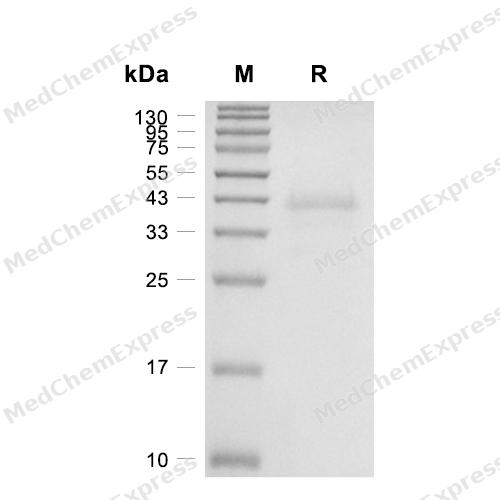
Purity - SDS-PAGE


Technical Parameters
-
Species Mouse
-
Source E. coli
-
Tag C-6*His
-
Accession
O35309 (M1-I314)
-
Gene ID64685
-
Molecular Construction
-
N-term
-
NMI (M1-I314)
Accession # O35309 -
6*His
-
C-term
-
-
Protein Length
Full Length
-
Synonyms
NMI; N-Myc (And STAT) Interactor; N-Myc And STAT Interactor; Nmi; N-Myc-Interactor
-
AA Sequence
MDADKDNIKQACDERSAEMDDMRGEQSMGLVHEIMSENKELDEEIKKLEAELQSDAREFQIKENVPEKKLKLTSVESPKDGCHFSNSSCSFQVSSQILYELQEGQALITFEKEEVAQNVISMGNHVVQMEGTPVKVSAHPVPLNTGVRFQVHVDISKMKINVTGIPDELSEEQTRDKLELSFCKSRNGGGEVESVDYDRKSRSAVITFVETGVVDKILKKKTYPLYMNQKCHSVAVSPCIERCLEKYQVFSAVSKKTVLLTGLEGIPVDEETGEDLLNIHFQRKNNGGGEVEVVKCSLDQSFAAYFKEEARETI
-
Predicted Molecular Mass
35.2 kDa
-
Molecular Weight
Approximately 40 kDa, based on SDS-PAGE under reducing conditions.
-
Purity
≥ 95%, as determined by reducing SDS-PAGE.


Product Properties
Lyophilized powder
Lyophilized from a 0.22 μm filtered solution of 50 mM Tris-HCl, 200 mM NaCl, 1mM DTT, pH 8.0, 8% trehalose.
Note: For SPR assay, please replace the buffer. Primary amine components (e.g., Tris, imidazole) can affect protein-coupled chips.
<1 EU/μg, determined by LAL method.
It is not recommended to reconstitute to a concentration less than 100 μg/mL in ddH2O. For long term storage it is recommended to add a carrier protein (0.1% BSA, 5% HSA, 10% FBS or 5% Trehalose).
Stored at -20°C for 2 years from date of receipt. After reconstitution, it is stable at 4°C for 1 week or -20°C for longer (with carrier protein). It is recommended to freeze aliquots at -20°C or -80°C for extended storage.
Room temperature in continental US; may vary elsewhere.


Documentation
-
Data Sheet (237 KB)
-
SDS (251 KB)
- English - EN (251 KB)
- Français - FR (251 KB)
- Deutsch - DE (251 KB)
- Norwegian - NO (251 KB)
- Español - ES (251 KB)
- Swedish - SV (251 KB)
- Italian - IT (251 KB)
- Korean - KR (251 KB)
- Portuguese - PT (251 KB)
-
Handling Instructions (2659 KB)

Calculators
Concentration (start) × Volume (start) = Concentration (final) × Volume (final)


 Powered by Bioz

