



PDGF-AA Protein, Human (His)

Based on 1 Customer Validation
PDGF-AA Protein, Human (His) is a member of PDGF family, binds to FDGFR, and may has the potential to enhance wound healing.
- Species: Human
- Source: E. coli
-
Storage:Stored at -20°C for 2 years from date of receipt. After reconstitution, it is stable at 4°C for 1 week or -20°C for longer (with carrier protein). It is recommended to freeze aliquots at -20°C or -80°C for extended storage.


To place orders, for customer services and technical support, please contact: MedChemExpress USA
Tel: 609-228-6898 E-mail: [email protected] [email protected]


-
 Biological Activity
-
Technical Parameters
-
Product Properties
- Documentation
- References
- Help & FAQs




Biological Activity
Description
PDGF-AA Protein, Human (His) is a member of PDGF family, binds to FDGFR, and may has the potential to enhance wound healing.
Background
Platelet-Derived Growth Factor-AA is a member of PDGF family, which promotes cell proliferation, survival and migration, through binding to the tyrosine kinase PDGF receptor[1]. PDGF-AA may play a crucial role in the ability of ASCs and EPCs to enhance wound healing, especially in animal models with wound-healing deficits[2].
Verified Bioactivity
Measured in a cell proliferation assay using NIH-3T3 mouse fibroblast cells. The ED50 for this effect is 53.43 ng/mL, corresponding to a specific activity is 1.87×10⁴ units/mg.
MCE Validation Data
-
Purity - SDS-PAGE
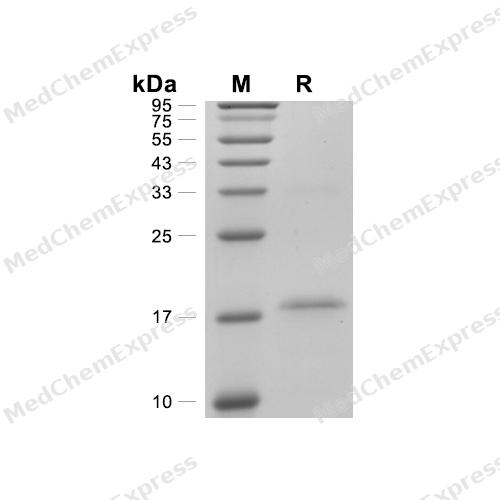
Purity - SDS-PAGE
-
Bioactivity - Cell-Based Assay
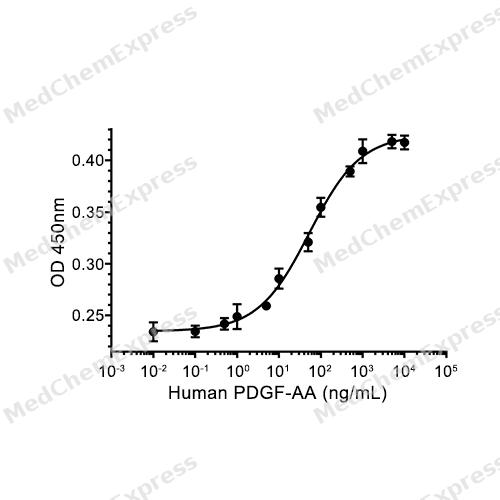
Bioactivity - Cell-Based Assay


Technical Parameters
-
Species Human
-
Source E. coli
-
Tag N-6*His
-
Accession
P04085-1 (S87-T211)
-
Molecular Construction
-
N-term
-
6*His
-
PDGF-AA (S87-T211)
Accession # P04085-1 -
C-term
-
-
Protein Length
Full Length of Isoform-1 Mature Protein
-
Synonyms
PDGFA; Platelet-Derived Growth Factor Alpha Chain; Platelet Derived Growth Factor Subunit A; Platelet-Derived Growth Factor A Chain; Platelet-Derived Growth Factor Alpha Polypeptide; PDGF Subunit A; PDGF1; PDGF A-Chain; Platelet-Derived Growth Factor Subu
-
AA Sequence
SIEEAVPAVCKTRTVIYEIPRSQVDPTSANFLIWPPCVEVKRCTGCCNTSSVKCQPSRVHHRSVKVAKVEYVRKKPKLKEVQVRLEEHLECACATTSLNPDYREEDTGRPRESGKKRKRKRLKPT
-
Predicted Molecular Mass
15.9 kDa
-
Molecular Weight
Approximately 15-18 kDa, based on SDS-PAGE under reducing conditions.
-
Purity
≥ 90%, as determined by reducing SDS-PAGE.


Product Properties
Lyophilized powder.
1.Lyophilized from a 0.22 μm filtered solution of 4 mM HCl.
2.Lyophilized from a 0.22 μm filtered solution of 50 mM Tris-HCl, 300 mM NaCl, 200 mM arginine, pH 8.0.
Please refer to the lot-specific COA for specific buffer information.
Note: For SPR assay, please replace the buffer. Primary amine components (e.g., Tris, imidazole) can affect protein-coupled chips.
<1 EU/μg, determined by LAL method.
It is not recommended to reconstitute to a concentration less than 100 μg/mL in ddH2O. For long term storage it is recommended to add a carrier protein (0.1% BSA, 5% HSA, 10% FBS or 5% Trehalose).
Stored at -20°C for 2 years from date of receipt. After reconstitution, it is stable at 4°C for 1 week or -20°C for longer (with carrier protein). It is recommended to freeze aliquots at -20°C or -80°C for extended storage.
Room temperature in continental US; may vary elsewhere.


Documentation
-
Data Sheet (262 KB)
-
SDS (251 KB)
- English - EN (251 KB)
- Français - FR (251 KB)
- Deutsch - DE (251 KB)
- Norwegian - NO (251 KB)
- Español - ES (251 KB)
- Swedish - SV (251 KB)
- Italian - IT (251 KB)
- Korean - KR (251 KB)
- Portuguese - PT (251 KB)
-
Handling Instructions (2659 KB)


References
[1]. Zhao F, et, al. Effect of platelet-derived growth factor-BB on gap junction and connexin43 in rat penile corpus cavernosum smooth muscle cells. Andrologia. 2019 Apr;51(3):e13200. [Content Brief]
[2]. Wu LW, et, al. Platelet-derived growth factor-AA is a substantial factor in the ability of adipose-derived stem cells and endothelial progenitor cells to enhance wound healing. FASEB J. 2019 Feb;33(2):2388-2395. [Content Brief]

Calculators
Concentration (start) × Volume (start) = Concentration (final) × Volume (final)


 Powered by Bioz

