



PKA/PRKACA Protein, Canine (His)

Based on 1 Customer Validation
PKA/PRKACA Protein, Canine (His) is the recombinant canine-derived PKA/PRKACA protein, expressed by E. coli, with N-His labeled tag.
- Species: Canine
- Source: E. coli
-
Storage:Stored at -80°C for 1 year from date of receipt. It is stable at -20°C for 3 months after opening. It is recommended to freeze aliquots at -80°C for extended storage. Avoid repeated freeze-thaw cycles.


To place orders, for customer services and technical support, please contact: MedChemExpress USA
Tel: 609-228-6898 E-mail: [email protected] [email protected]


-
 Biological Activity
-
Technical Parameters
-
Product Properties
- Documentation
- Help & FAQs




Biological Activity
Description
PKA/PRKACA Protein, Canine (His) is the recombinant canine-derived PKA/PRKACA protein, expressed by E. coli, with N-His labeled tag.
Background
PKA/PRKACA is a kinase that phosphorylates a large number of substrates in the cytoplasm and nucleus (by similarity). It phosphorylates CDC25B, ABL1, NFKB1, CLDN3, PSMC5/RPT6, PJA2, RYR2, RORA, SOX9, and VASP (by similarity). By phosphorylating PJA2, PKA/PRKACA regulates the abundance of its regulatory subunits, as PJA2 binds and ubiquitinates these subunits, leading to their proteolysis. RORA is activated through phosphorylation. It plays a critical role in glucose-mediated adipogenic differentiation increase and osteogenic differentiation inhibition in osteoblasts (by similarity). It contributes to chondrogenesis by mediating SOX9 phosphorylation (by similarity). In platelet regulation, PKA/PRKACA maintains platelets in a resting state by phosphorylating inhibitory pathway proteins when complexed with NF-kappa-B (NFKB1 and NFKB2) and I-kappa-B-alpha (NFKBIA). However, thrombin and collagen disrupt these complexes, releasing active PRKACA, which stimulates platelets and promotes aggregation via VASP phosphorylation. RYR2 channel activity is enhanced by phosphorylation in the presence of luminal Ca2+, reducing the amplitude but increasing the frequency of store overload-induced Ca2+ release (SOICR), characterized by faster Ca2+ release and Ca2+ wave propagation despite lower wave amplitude and resting cytosolic Ca2+. PSMC5/RPT6 phosphorylation activates the proteasome. It negatively regulates tight junctions (TJs) in ovarian cancer cells via CLDN3 phosphorylation. NFKB1 phosphorylation promotes NF-kappa-B p50-p50 DNA binding. PKA/PRKACA inhibits GLI transcription factors via phosphorylation, preventing Hedgehog signaling target gene activation (by similarity). GLI phosphorylation is suppressed when PRKACA interacts with SMO, sequestering PRKACA at the membrane (by similarity). It regulates embryonic development by downregulating Hedgehog (Hh) signaling, likely through OFD1 in ciliogenesis (by similarity). It prevents meiosis resumption in prophase-arrested oocytes by inactivating CDC25B via phosphorylation (by similarity). It may also modulate rapid eye movement (REM) sleep in the pedunculopontine tegmental (PPT) (by similarity). Additionally, PKA/PRKACA phosphorylates APOBEC3G and AICDA and enhances HSF1 nuclear localization and transcriptional activity upon heat shock (by similarity). It acts as a negative regulator of mTORC1 by phosphorylating RPTOR (by similarity).
Verified Bioactivity
The kinase activity of this recombinant protein is testing in progress, we cannot offer a guarantee yet.
MCE Validation Data
-
Purity - SDS-PAGE
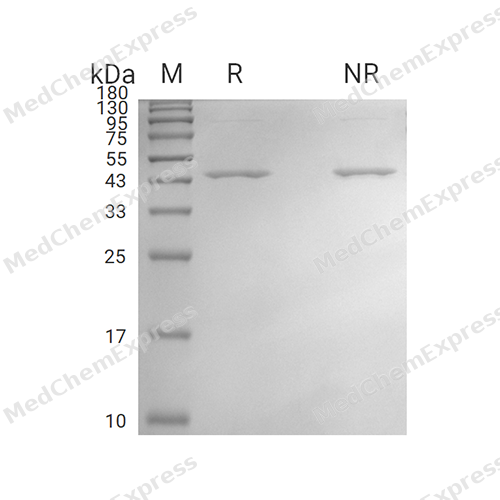
Purity - SDS-PAGE


Technical Parameters
-
Species Canine
-
Source E. coli
-
Tag N-8*His
-
Accession
Q8MJ44/NP_001003032.1 (G2-F350)
-
Molecular Construction
-
N-term
-
8*His
-
PKA (G2-F350)
Accession # Q8MJ44/NP_001003032.1 -
C-term
-
-
Protein Length
Full Length
-
Synonyms
PRKACA; CDNA FLJ58698, Highly Similar To CAMP-Dependent Protein Kinase, Alpha-Catalytic Subunit; Protein Kinase CAMP-Activated Catalytic Subunit Alpha; Protein Kinase A Catalytic Subunit; CAMP-Dependent Protein Kinase Catalytic Subunit Alpha; Protein Kina
-
AA Sequence
GNAAAKKGSEQESVKEFLAKAKEDFLKKWENPAQNTAHLDQFERIKTLGTGSFGRVMLVKHKETGNHFAMKILDKQKVVKLKQIEHTLNEKRILQAVNFPFLVKLEFSFKDNSNLYMVMEYVPGGEMFSHLRRIGRFSEPHARFYAAQIVLTFEYLHSLDLIYRDLKPENLLIDQQGYIQVTDFGFAKRVKGRTWTLCGTPEYLAPEIILSKGYNKAVDWWALGVLIYEMAAGYPPFFADQPIQIYEKIVSGKVRFPSHFSSDLKDLLRNLLQVDLTKRFGNLKNGVNDIKNHKWFATTDWIAIYQRKVEAPFIPKFKGPGDTSNFDDYEEEEIRVSINEKCGKEFCEF
-
Predicted Molecular Mass
41.5 kDa
-
Molecular Weight
Approximately 42 kDa, based on SDS-PAGE under reducing conditions.
-
Purity
≥ 95%, as determined by reducing SDS-PAGE.


Product Properties
Solution.
Supplied as a 0.22 μm filtered solution of PBS, 200 mM NaCl, pH 7.4.
<1 EU/μg, determined by LAL method.
Please use rapid thawing with running water to thaw the protein.
Stored at -80°C for 1 year from date of receipt. It is stable at -20°C for 3 months after opening. It is recommended to freeze aliquots at -80°C for extended storage. Avoid repeated freeze-thaw cycles.
Shipping with dry ice.


Documentation
-
Data Sheet (238 KB)
-
SDS (252 KB)
- English - EN (252 KB)
- Français - FR (252 KB)
- Deutsch - DE (252 KB)
- Norwegian - NO (252 KB)
- Español - ES (252 KB)
- Swedish - SV (252 KB)
- Italian - IT (252 KB)
- Korean - KR (252 KB)
- Portuguese - PT (252 KB)
-
Handling Instructions (2659 KB)

Calculators
Concentration (start) × Volume (start) = Concentration (final) × Volume (final)


 Powered by Bioz

