



PSAP/Prosaposin Protein, Human (HEK293, His)
Based on 1 publication(s) in Google Scholar
Frizzled-7 protein is a transmembrane receptor that plays a crucial role in the Wnt signaling pathway. It is involved in cellular processes such as cell proliferation, differentiation, and migration. PSAP/Prosaposin Protein, Human (HEK293, His) is the recombinant human-derived PSAP/Prosaposin protein, expressed by HEK293 , with C-10*His labeled tag.
- Species: Human
- Source: HEK293
-
Storage:Stored at -20°C for 2 years from date of receipt. After reconstitution, it is stable at 4°C for 1 week or -20°C for longer (with carrier protein). It is recommended to freeze aliquots at -20°C or -80°C for extended storage.


To place orders, for customer services and technical support, please contact: MedChemExpress USA
Tel: 609-228-6898 E-mail: [email protected] [email protected]


-
 Biological Activity
-
Technical Parameters
-
Product Properties
- Documentation
- Help & FAQs




Biological Activity
Description
Frizzled-7 protein is a transmembrane receptor that plays a crucial role in the Wnt signaling pathway. It is involved in cellular processes such as cell proliferation, differentiation, and migration. PSAP/Prosaposin Protein, Human (HEK293, His) is the recombinant human-derived PSAP/Prosaposin protein, expressed by HEK293 , with C-10*His labeled tag.
Background
The PSAP/Prosaposin Protein, encoded by this gene, is a highly conserved preproprotein that undergoes proteolytic processing to yield four main cleavage products—saposins A, B, C, and D. Each domain of the precursor protein, approximately 80 amino acid residues long, exhibits nearly identical placement of cysteine residues and glycosylation sites. Saposins A-D primarily localize to the lysosomal compartment, where they play a crucial role in facilitating the catabolism of glycosphingolipids with short oligosaccharide groups. The precursor protein exists in both secretory and integral membrane forms and possesses neurotrophic activities. Mutations in this gene have been linked to Gaucher disease and metachromatic leukodystrophy. Alternative splicing yields multiple transcript variants, with at least one encoding an isoform that undergoes proteolytic processing. The gene displays ubiquitous expression, with elevated levels detected in the spleen (RPKM 523.6), gall bladder (RPKM 491.5), and 25 other tissues, emphasizing its essential role across various physiological contexts in multiple organs.
MCE Validation Data
-
Purity - SDS-PAGE
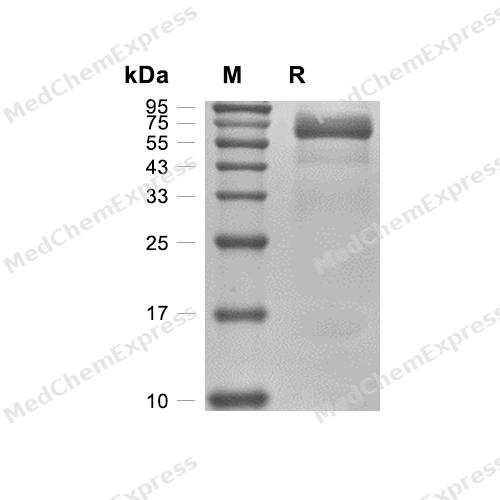
Purity - SDS-PAGE


Publications (1)
-
Journal Impact Factor
-
Most Recent
-
Cell Stem Cell
Human PSC-derived sinoatrial node-cardiac plexus assembloids model innervation-associated maturation of pacemaker systems. [Abstract]2026 May 15:S1934-5909(26)00158-X. PMID: 42143017


Technical Parameters
-
Species Human
-
Source HEK293
-
Tag C-10*His
-
Accession
NP_002769.1 (G17-N524)
-
Molecular Construction
-
N-term
-
PSAP (G17-N524)
Accession # NP_002769.1 -
His
-
C-term
-
-
Protein Length
Full Length of Mature Protein
-
Synonyms
PSAP; Saposin-A; Prev. GLBA; Saposin-C; Prev. SAP1; Saposin-D; Prev. SAP2; Variant Gaucher Disease And Variant Metachromatic Leukodystrophy; Sphingolipid Activator Protein-1; Alternative Protein PSAP; Sphingolipid Activator Protein-2; PARK24; Proactivator
-
AA Sequence
GPVLGLKECTRGSAVWCQNVKTASDCGAVKHCLQTVWNKPTVKSLPCDICKDVVTAAGDMLKDNATEEEILVYLEKTCDWLPKPNMSASCKEIVDSYLPVILDIIKGEMSRPGEVCSALNLCESLQKHLAELNHQKQLESNKIPELDMTEVVAPFMANIPLLLYPQDGPRSKPQPKDNGDVCQDCIQMVTDIQTAVRTNSTFVQALVEHVKEECDRLGPGMADICKNYISQYSEIAIQMMMHMQPKEICALVGFCDEVKEMPMQTLVPAKVASKNVIPALELVEPIKKHEVPAKSDVYCEVCEFLVKEVTKLIDNNKTEKEILDAFDKMCSKLPKSLSEECQEVVDTYGSSILSILLEEVSPELVCSMLHLCSGTRLPALTVHVTQPKDGGFCEVCKKLVGYLDRNLEKNSTKQEILAALEKGCSFLPDPYQKQCDQFVAEYEPVLIEILVEVMDPSFVCLKIGACPSAHKPLLGTEKCIWGPSYWCQNTETAAQCNAVEHCKRHVWN
-
Molecular Weight
Approximately 60-85 kDa, based on SDS-PAGE under reducing conditions, due to the glycosylation.
-
Glycosylation
Yes
-
Purity
≥ 95%, as determined by reducing SDS-PAGE.


Product Properties
Lyophilized powder.
Lyophilized from a 0.2 μm filtered solution of PBS, pH 7.4.
<1 EU/μg, determined by LAL method.
It is not recommended to reconstitute to a concentration less than 100 μg/mL in ddH2O. For long term storage it is recommended to add a carrier protein (0.1% BSA, 5% HSA, 10% FBS or 5% Trehalose).
Stored at -20°C for 2 years from date of receipt. After reconstitution, it is stable at 4°C for 1 week or -20°C for longer (with carrier protein). It is recommended to freeze aliquots at -20°C or -80°C for extended storage.
Room temperature in continental US; may vary elsewhere.


Documentation
-
Data Sheet (263 KB)
-
SDS (251 KB)
- English - EN (251 KB)
- Français - FR (251 KB)
- Deutsch - DE (251 KB)
- Norwegian - NO (251 KB)
- Español - ES (251 KB)
- Swedish - SV (251 KB)
- Italian - IT (251 KB)
- Korean - KR (251 KB)
- Portuguese - PT (251 KB)
-
Handling Instructions (2659 KB)

Calculators
Concentration (start) × Volume (start) = Concentration (final) × Volume (final)


 Powered by Bioz

