



PTK7 Protein, Mouse (HEK293, His)
Based on 1 publication(s) in Google Scholar
Ptk7 Protein is a cell surface receptor that plays a crucial role in regulating cell migration and tissue development. Dysregulation of Ptk7 Protein has been associated with various diseases, including cancer and developmental disorders. Targeting Ptk7 Protein may offer potential therapeutic interventions in these conditions by modulating cell migration, inhibiting tumor growth, and promoting normal tissue development. PTK7 Protein, Mouse (HEK293, His) is the recombinant mouse-derived PTK7 protein, expressed by HEK293 , with C-10*His labeled tag.
- Species: Mouse
- Source: HEK293
-
Storage:Stored at -20°C for 2 years from date of receipt. After reconstitution, it is stable at 4°C for 1 week or -20°C for longer (with carrier protein). It is recommended to freeze aliquots at -20°C or -80°C for extended storage.


To place orders, for customer services and technical support, please contact: MedChemExpress USA
Tel: 609-228-6898 E-mail: [email protected] [email protected]


-
 Biological Activity
-
Technical Parameters
-
Product Properties
- Documentation
- Help & FAQs




Biological Activity
Description
Ptk7 Protein is a cell surface receptor that plays a crucial role in regulating cell migration and tissue development. Dysregulation of Ptk7 Protein has been associated with various diseases, including cancer and developmental disorders. Targeting Ptk7 Protein may offer potential therapeutic interventions in these conditions by modulating cell migration, inhibiting tumor growth, and promoting normal tissue development. PTK7 Protein, Mouse (HEK293, His) is the recombinant mouse-derived PTK7 protein, expressed by HEK293 , with C-10*His labeled tag.
Background
Ptk7 Protein is an inactive tyrosine kinase that plays a crucial role in the Wnt signaling pathway, specifically in both the non-canonical (Wnt/planar cell polarity signaling) and canonical Wnt signaling pathways. It is involved in various cellular processes, including cell adhesion, migration, polarity, proliferation, actin cytoskeleton reorganization, and apoptosis. Ptk7 Protein also contributes to embryogenesis, epithelial tissue organization, and angiogenesis. Additionally, it interacts with CTNNB1, further highlighting its significance in Wnt signaling.
Verified Bioactivity
1.This product does not contain protein kinase domain.
2.Measured by its binding ability in a functional ELISA. Recombinant Mouse PTK7/CCK4 binds Biotinylated Recombinant Mouse Wnt-3a. The ED50 for this effect is 7.183 μg/mL.
MCE Validation Data
-
Purity - SDS-PAGE
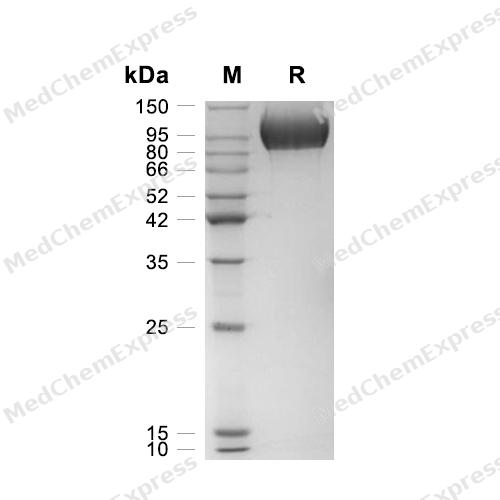
Purity - SDS-PAGE
-
Bioactivity - ELISA
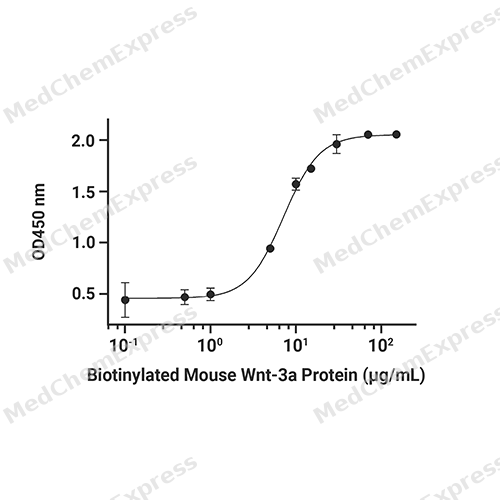
Bioactivity - ELISA


Publications (1)
-
Journal Impact Factor
-
Most Recent
-
Signal Transduct Target Ther
An aptamer-drug conjugate for promising cancer therapy with comprehensive evaluation from rodents to non-human primates. [Abstract]2025 Sep 24;10(1):316. PMID: 40987771


Technical Parameters
-
Species Mouse
-
Source HEK293
-
Tag C-10*His
-
Accession
Q8BKG3 (A23-T696)
-
Molecular Construction
-
N-term
-
PTK7 (A23-T696)
Accession # Q8BKG3 -
10*His
-
C-term
-
-
Protein Length
Extracellular Domain
-
Synonyms
PTK7; PTK7 Protein Tyrosine Kinase 7; Protein Tyrosine Kinase 7 (Inactive); Tyrosine-Protein Kinase-Like 7; CCK4; CCK-4; Colon Carcinoma Kinase 4; Protein Tyrosine Kinase 7; Inactive Tyrosine-Protein Kinase 7; Protein-Tyrosine Kinase 7; Pseudo Tyrosine Ki
-
AA Sequence
AIVFIKEPSSQDALQGRRALLRCEVEAPDPVHVYWLLNGVPVQDTERRFAQGSSLSFAAVDRLQDSGAFQCVARDNVTGEEVRSTNASFNIKWIEAGPVVLKHPASEAEIQPQTQVTLRCHIDGHPRPTYQWFRDGTPLSDDQSTHTVSSRERNLTLRPASPEHSGLYSCCAHNAFGQACSSQNFTLSVADESFARVVLAPQDVVVARNEEAMFHCQFSAQPPPSLQWVFEDETPITNRSRPPHLRRAVVFANGSLLLTQVRPRNAGVYRCIGQGQRGPPIVLEATLHLAEIEDMLPFEPRVFIAGDEERVTCPAPQGLPTPSVWWEHAGVPLPAHGRVHQKGLELVFVTIAESDTGVYTCHASNLAGQRRQDVNITVATVPTWLRKPQDSQLEEGKPGYLHCLTQATPKPTVIWYRNQMLISEDSRFEVSKNGTLRINSVEVYDGTLYRCVSSTPAGSIEAQARVQVLEKLKFTPPPQPQQCMEFDKEATVPCSATGREKPTVKWVRADGSSLPEWVTDNAGTLHFARVTRDDAGNYTCIASNEPQGQIRAHVQLTVAVFITFKVEPERTTVYQGHTALLRCEAQGDPKPLIQWKGKDRILDPTKLGPRMHIFQNGSLVIHDVAPEDSGSYTCIAGNSCNIRHTEAPLLVVDKPVMEDSEGPGSPPPYKMIQT
-
Molecular Weight
Approximately 100-115 kDa, based on SDS-PAGE under reducing conditions, due to the glycosylation.
-
Glycosylation
Yes
-
Purity
≥ 95%, as determined by reducing SDS-PAGE.


Product Properties
Lyophilized powder.
Lyophilized a 0.22 μm filtered solution of 20 mM PB, 150 mM NaCl, pH 7.4.
<1 EU/μg, determined by LAL method.
It is not recommended to reconstitute to a concentration less than 100 μg/mL in ddH2O. For long term storage it is recommended to add a carrier protein (0.1% BSA, 5% HSA, 10% FBS or 5% Trehalose).
Stored at -20°C for 2 years from date of receipt. After reconstitution, it is stable at 4°C for 1 week or -20°C for longer (with carrier protein). It is recommended to freeze aliquots at -20°C or -80°C for extended storage.
Room temperature in continental US; may vary elsewhere.


Documentation
-
Data Sheet (239 KB)
-
SDS (254 KB)
- English - EN (254 KB)
- Français - FR (254 KB)
- Deutsch - DE (254 KB)
- Norwegian - NO (254 KB)
- Español - ES (254 KB)
- Swedish - SV (254 KB)
- Italian - IT (254 KB)
- Korean - KR (254 KB)
- Portuguese - PT (254 KB)
-
Handling Instructions (2659 KB)

Calculators
Concentration (start) × Volume (start) = Concentration (final) × Volume (final)


 Powered by Bioz

