



SFRP1 Protein, Human (HEK293, His)
Based on 2 publication(s) in Google Scholar
SFRP1 protein is a soluble Frizzled-related protein (sFRP) that regulates Wnt signaling by directly interacting with Wnt, affecting cell growth and differentiation. Notably, it reduces intracellular β-catenin levels and affects Wnt pathway components. SFRP1 Protein, Human (HEK293, His) is the recombinant human-derived SFRP1 protein, expressed by HEK293 , with C-His labeled tag.
- Species: Human
- Source: HEK293
-
Storage:Stored at -20°C for 2 years from date of receipt. After reconstitution, it is stable at 4°C for 1 week or -20°C for longer (with carrier protein). It is recommended to freeze aliquots at -20°C or -80°C for extended storage.


To place orders, for customer services and technical support, please contact: MedChemExpress USA
Tel: 609-228-6898 E-mail: [email protected] [email protected]


-
 Biological Activity
-
Technical Parameters
-
Product Properties
- Documentation
- Help & FAQs




Biological Activity
Description
SFRP1 protein is a soluble Frizzled-related protein (sFRP) that regulates Wnt signaling by directly interacting with Wnt, affecting cell growth and differentiation. Notably, it reduces intracellular β-catenin levels and affects Wnt pathway components. SFRP1 Protein, Human (HEK293, His) is the recombinant human-derived SFRP1 protein, expressed by HEK293 , with C-His labeled tag.
Background
SFRP1, a soluble frizzled-related protein (sFRP), functions as a modulator of Wnt signaling through its direct interaction with Wnts, contributing to the regulation of cell growth and differentiation in specific cell types. Notably, SFRP1 plays a role in decreasing intracellular beta-catenin levels, indicative of its influence on Wnt pathway components. Beyond its involvement in Wnt signaling, SFRP1 exhibits antiproliferative effects on vascular cells both in vitro and in vivo, inducing an angiogenic response in vivo. In the vascular cell cycle, it delays the G1 phase and entry into the S phase. In the context of kidney development, SFRP1 inhibits tubule formation and bud growth in metanephroi. Additionally, it hinders WNT1/WNT4-mediated TCF-dependent transcription and interacts with WNT1, WNT2, FRZD6, WNT4, WNT8, and MYOC, emphasizing its multifaceted role in cellular processes and molecular interactions.
Verified Bioactivity
Measured by its ability to inhibit proliferation of HeLa human cervical epithelial carcinoma cells and the ED50 is typically 5-30 μg/mL.
MCE Validation Data
-
Purity - SDS-PAGE
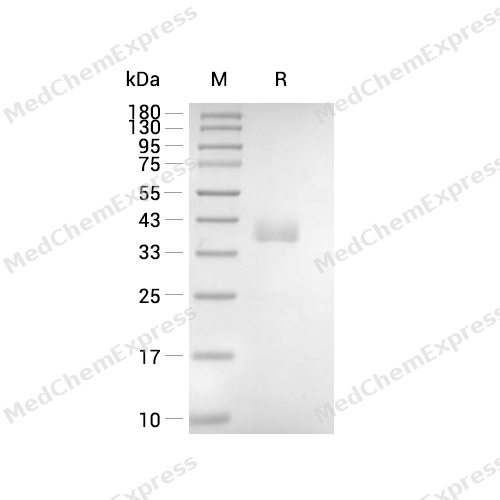
Purity - SDS-PAGE


Publications (2)
-
Journal Impact Factor
-
Most Recent
-
J Mol Cell Biol
Canonical Wnt signaling affects calcium homeostasis in serum-treated AC16 cells through MLN-mediated SERCA2a regulation. [Abstract]2025 Dec 5:mjaf050. PMID: 41348974 -
ACS Chem Neurosci
Vitamin D Ameliorates Doxorubicin-Induced Cognitive Dysfunction via Modulation of the SFRP1/β-Catenin Axis. [Abstract]2025 Oct 26. PMID: 41139396


Technical Parameters
-
Species Human
-
Source HEK293
-
Tag C-His
-
Accession
Q8N474 (S32-K314)
-
Molecular Construction
-
N-term
-
SFRP1 (S32-K314)
Accession # Q8N474 -
His
-
C-term
-
-
Protein Length
Full Length of Mature Protein
-
Synonyms
SFRP1; SARP-2; Secreted Frizzled Related Protein 1; SFRP-1; SARP2; FRP1; FRP-1; Frizzled-Related Protein; FRP; SFRP1 Protein; Secreted Frizzled-Related Protein 1; FrzA; Secreted Apoptosis-Related Protein 2
-
AA Sequence
SEYDYVSFQSDIGPYQSGRFYTKPPQCVDIPADLRLCHNVGYKKMVLPNLLEHETMAEVKQQASSWVPLLNKNCHAGTQVFLCSLFAPVCLDRPIYPCRWLCEAVRDSCEPVMQFFGFYWPEMLKCDKFPEGDVCIAMTPPNATEASKPQGTTVCPPCDNELKSEAIIEHLCASEFALRMKIKEVKKENGDKKIVPKKKKPLKLGPIKKKDLKKLVLYLKNGADCPCHQLDNLSHHFLIMGRKVKSQYLLTAIHKWDKKNKEFKNFMKKMKNHECPTFQSVFK
-
Molecular Weight
Approximately 38 kDa, based on SDS-PAGE under reducing conditions, due to the glycosylation.
-
Glycosylation
Yes
-
Purity
≥ 95%, as determined by reducing SDS-PAGE.


Product Properties
Lyophilized powder.
Lyophilized from a 0.2 μm filtered solution of PBS, pH 7.4.
<1 EU/μg, determined by LAL method.
It is not recommended to reconstitute to a concentration less than 100 μg/mL in ddH2O. For long term storage it is recommended to add a carrier protein (0.1% BSA, 5% HSA, 10% FBS or 5% Trehalose).
Stored at -20°C for 2 years from date of receipt. After reconstitution, it is stable at 4°C for 1 week or -20°C for longer (with carrier protein). It is recommended to freeze aliquots at -20°C or -80°C for extended storage.
Room temperature in continental US; may vary elsewhere.


Documentation
-
Data Sheet (237 KB)
-
SDS (252 KB)
- English - EN (252 KB)
- Français - FR (252 KB)
- Deutsch - DE (252 KB)
- Norwegian - NO (252 KB)
- Español - ES (252 KB)
- Swedish - SV (252 KB)
- Italian - IT (252 KB)
- Korean - KR (252 KB)
- Portuguese - PT (252 KB)
-
Handling Instructions (2659 KB)

Calculators
Concentration (start) × Volume (start) = Concentration (final) × Volume (final)


 Powered by Bioz

