



Siglec-10 Protein, Human (HEK293, His)

Based on 1 Customer Validation
Siglec-10 protein is thought to be a putative adhesion molecule that mediates sialic acid-dependent cell binding, preferentially selecting α-2,3- or α-2,6-linked sialic acid. Its sialic acid recognition site may be masked by cis interactions. Siglec-10 Protein, Human (HEK293, His) is the recombinant human-derived Siglec-10 protein, expressed by HEK293 , with C-His labeled tag.
- Species: Human
- Source: HEK293
-
Storage:Stored at -20°C for 2 years from date of receipt. After reconstitution, it is stable at 4°C for 1 week or -20°C for longer (with carrier protein). It is recommended to freeze aliquots at -20°C or -80°C for extended storage.


To place orders, for customer services and technical support, please contact: MedChemExpress USA
Tel: 609-228-6898 E-mail: [email protected] [email protected]


-
 Biological Activity
-
Technical Parameters
-
Product Properties
- Documentation
- Help & FAQs




Biological Activity
Description
Siglec-10 protein is thought to be a putative adhesion molecule that mediates sialic acid-dependent cell binding, preferentially selecting α-2,3- or α-2,6-linked sialic acid. Its sialic acid recognition site may be masked by cis interactions. Siglec-10 Protein, Human (HEK293, His) is the recombinant human-derived Siglec-10 protein, expressed by HEK293 , with C-His labeled tag.
Background
Siglec-10 protein, recognized as a putative adhesion molecule, functions in sialic-acid dependent cellular binding, displaying a preference for alpha-2,3- or alpha-2,6-linked sialic acid. The sialic acid recognition site of Siglec-10 may undergo masking due to cis interactions with sialic acids on the same cell surface. In immune responses, it appears to act as an inhibitory receptor, inducing ligand-induced tyrosine phosphorylation and recruiting cytoplasmic phosphatases via their SH2 domains, blocking signal transduction through dephosphorylation of signaling molecules. Siglec-10 is involved in the negative regulation of B-cell antigen receptor signaling, dependent on PTPN6/SHP-1. In association with CD24, it may participate in the selective suppression of the immune response to danger-associated molecular patterns (DAMPs) such as HMGB1, HSP70, and HSP90. Siglec-10, in collaboration with CD24, regulates the immune response of natural killer (NK) cells and plays a role in the control of autoimmunity. During the initiation of adaptive immune responses by CD8-alpha(+) dendritic cells, Siglec-10 inhibits cross-presentation by impairing the formation of MHC class I-peptide complexes, implicating the recruitment of PTPN6/SHP-1 and promoting phagosomal acidification. Siglec-10 interacts with various proteins, including PTPN6/SHP-1, NCF1, CD24, HMGB1, RIGI, CBL, and PTPN11.
Verified Bioactivity
1.Immobilized Human Siglec-10 at 2 μg/mL (100 μL/well) can bind Anti-Siglec-10 Antibody, the ED50 for this effectis 21.31 ng/mL.
2.Immobilized Human Siglec-10 Protein at 5 μg/mL (100 μL/well) can bind ONC-841. The ED50 for this effect is 6.296 ng/mL.
MCE Validation Data
-
Purity - SDS-PAGE
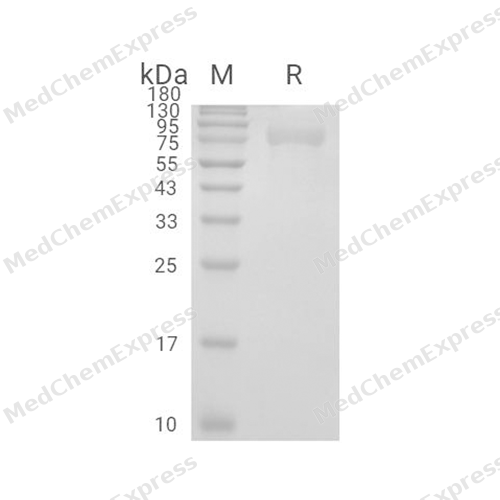
Purity - SDS-PAGE
-
Bioactivity - ELISA
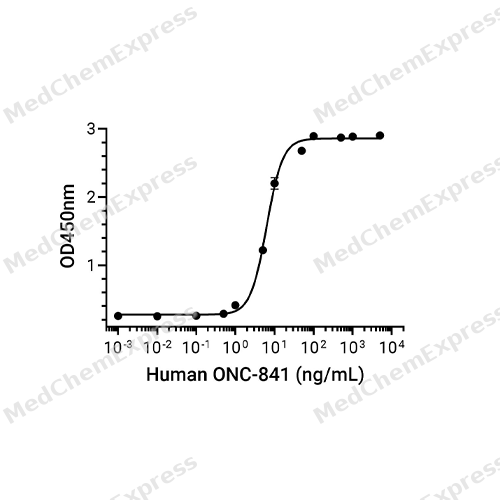
Bioactivity - ELISA


Technical Parameters
-
Species Human
-
Source HEK293
-
Tag C-His
-
Accession
AAI01726.1 (M17-N550)
-
Molecular Construction
-
N-term
-
Siglec-10 (M17-N550)
Accession # AAI01726.1 -
His
-
C-term
-
-
Protein Length
Extracellular Domain
-
Synonyms
SIGLEC10; Siglec-Like Protein 2; Sialic Acid Binding Ig Like Lectin 10; Siglec-Like Gene 2; SLG2; MGC126774; SIGLEC-10; Sialic Acid Binding Ig-Like Lectin 10; PRO940; SIGLEC10 Protein; Sialic Acid Binding Ig-Like Lectin 10 Ig-Like Lectin 7; Siglec-10; Sia
-
AA Sequence
MDGRFWIRVQESVMVPEGLCISVPCSFSYPRQDWTGSTPAYGYWFKAVTETTKGAPVATNHQSREVEMSTRGRFQLTGDPAKGNCSLVIRDAQMQDESQYFFRVERGSYVRYNFMNDGFFLKVTALTQKPDVYIPETLEPGQPVTVICVFNWAFEECPPPSFSWTGAALSSQGTKPTTSHFSVLSFTPRPQDHNTDLTCHVDFSRKGVSVQRTVRLRVAYAPRDLVISISRDNTPALEPQPQGNVPYLEAQKGQFLRLLCAADSQPPATLSWVLQNRVLSSSHPWGPRPLGLELPGVKAGDSGRYTCRAENRLGSQQRALDLSVQYPPENLRVMVSQANRTVLENLGNGTSLPVLEGQSLCLVCVTHSSPPARLSWTQRGQVLSPSQPSDPGVLELPRVQVEHEGEFTCHARHPLGSQHVSLSLSVHYSPKLLGPSCSWEAEGLHCSCSSQASPAPSLRWWLGEELLEGNSSQDSFEVTPSSAGPWANSSLSLHGGLSSGLRLRCEAWNVHGAQSGSILQLPDKKGLISTAFSN
-
Molecular Weight
Approximately 87.43 kDa
-
Glycosylation
Yes
-
Purity
≥ 95%, as determined by reducing SDS-PAGE.


Product Properties
Lyophilized powder.
1.Lyophilized from a 0.22 μm filtered solution of 20 mM Tris, 500 mM NaCl, pH 8.0.
2.Lyophilized from a 0.22 μm filtered solution of 20 mM Tris-HCL, 500 mM NaCl, 0.2% CHAPS, 10% trehalose,100 mM Arginine, pH 8.0.
Note: For SPR assay, please replace the buffer. Primary amine components (e.g., Tris, imidazole) can affect protein-coupled chips.
Please refer to the lot-specific COA for specific buffer information.
<1 EU/μg, determined by LAL method.
It is not recommended to reconstitute to a concentration less than 100 μg/mL in ddH2O. For long term storage it is recommended to add a carrier protein (0.1% BSA, 5% HSA, 10% FBS or 5% Trehalose).
Stored at -20°C for 2 years from date of receipt. After reconstitution, it is stable at 4°C for 1 week or -20°C for longer (with carrier protein). It is recommended to freeze aliquots at -20°C or -80°C for extended storage.
Room temperature in continental US; may vary elsewhere.


Documentation
-
Data Sheet (240 KB)
-
SDS (252 KB)
- English - EN (252 KB)
- Français - FR (252 KB)
- Deutsch - DE (252 KB)
- Norwegian - NO (252 KB)
- Español - ES (252 KB)
- Swedish - SV (252 KB)
- Italian - IT (252 KB)
- Korean - KR (252 KB)
- Portuguese - PT (252 KB)
-
Handling Instructions (2659 KB)

Calculators
Concentration (start) × Volume (start) = Concentration (final) × Volume (final)


 Powered by Bioz

