



TARDBP Protein, Human (His)
Based on 1 publication(s) in Google Scholar
TARDBP protein is an RNA-binding factor with RRM1 and RRM2 that binds GU repeats and regulates RNA splicing in long introns and 3'UTRs.It affects proteins critical for neuronal survival and neurodegenerative diseases.TARDBP Protein, Human (His) is the recombinant human-derived TARDBP protein, expressed by E. coli , with N-6*His labeled tag.
- Species: Human
- Source: E. coli
-
Storage:Stored at -80°C for 1 year from date of receipt. It is stable at -20°C for 3 months after opening. It is recommended to freeze aliquots at -80°C for extended storage. Avoid repeated freeze-thaw cycles.


To place orders, for customer services and technical support, please contact: MedChemExpress USA
Tel: 609-228-6898 E-mail: [email protected] [email protected]


-
 Biological Activity
-
Technical Parameters
-
Product Properties
- Documentation
- Help & FAQs




Biological Activity
Description
TARDBP protein is an RNA-binding factor with RRM1 and RRM2 that binds GU repeats and regulates RNA splicing in long introns and 3'UTRs.It affects proteins critical for neuronal survival and neurodegenerative diseases.TARDBP Protein, Human (His) is the recombinant human-derived TARDBP protein, expressed by E. coli , with N-6*His labeled tag.
Background
The TARDBP protein, an RNA-binding factor, plays a multifaceted role in various steps of RNA biogenesis and processing. Utilizing its two RNA recognition motifs, RRM1 and RRM2, TARDBP preferentially binds GU-repeats on RNA molecules, predominantly localized within long introns and the 3'UTR of mRNAs. This binding activity regulates the splicing of numerous non-coding and protein-coding RNAs, impacting proteins crucial for neuronal survival and those relevant to neurodegenerative diseases. TARDBP also contributes to mitochondrial homeostasis by regulating the processing of mitochondrial transcripts and modulates mRNA stability by recruiting CNOT7/CAF1 deadenylase to mRNA 3'UTR, leading to poly(A) tail deadenylation. In response to oxidative insult, TARDBP associates with stalled ribosomes in stress granules, contributing to cell survival. Moreover, it participates in skeletal muscle formation and regeneration by forming cytoplasmic myo-granules and binding mRNAs encoding sarcomeric proteins. Additionally, TARDBP is involved in the maintenance of circadian clock periodicity by stabilizing CRY1 and CRY2 proteins in a FBXL3-dependent manner and negatively regulates the expression of CDK6. Interactions with various proteins, including BRDT, ATXN2, MATR3, UBQLN2, HNRNPA2B1, ZNF106, CNOT7/CAF1, CRY2, and PPIA/CYPA, highlight the diverse roles of TARDBP in RNA regulation and cellular processes.
Verified Bioactivity
Measured by its binding ability in a functional ELISA.Immobilized Human TARDBP, His Tag at 1 μg/mL (100 μL/well) can bind Anti-TARDBP Antibody with a linear range of 0.2-3 ng/mL.
MCE Validation Data
-
Purity - SDS-PAGE
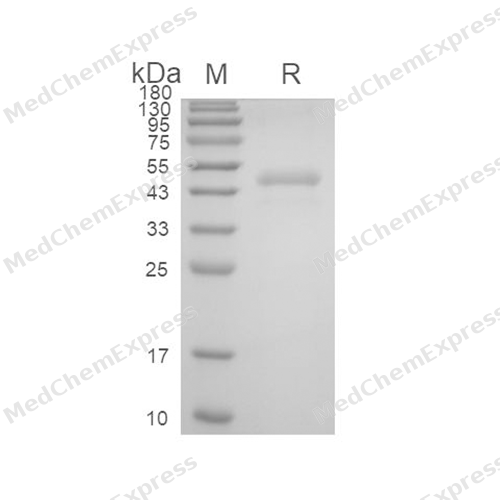
Purity - SDS-PAGE
-
Bioactivity - ELISA
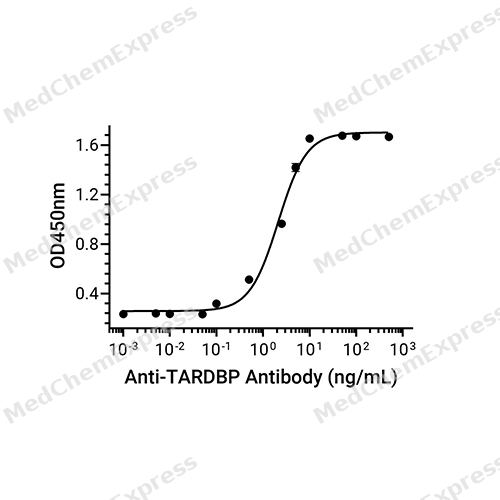
Bioactivity - ELISA


Publications (1)
-
Journal Impact Factor
-
Most Recent
-
Nat Commun
2026 Feb 20;17(1):2963. PMID: 41720774


Technical Parameters
-
Species Human
-
Source E. coli
-
Tag N-10*His
-
Accession
Q13148-1 (M1-M414)
-
Molecular Construction
-
N-term
-
His
-
TARDBP (M1-M414)
Accession # Q13148-1 -
C-term
-
-
Protein Length
Full Length
-
Synonyms
TARDBP; TDP43; TAR DNA Binding Protein; TAR DNA Binding Protein, Isoform CRA_c; TDP-43; TAR DNA-Binding Protein-43; TAR DNA-Binding Protein 43; TDP43 Isoform F; ALS10
-
AA Sequence
MSEYIRVTEDENDEPIEIPSEDDGTVLLSTVTAQFPGACGLRYRNPVSQCMRGVRLVEGILHAPDAGWGNLVYVVNYPKDNKRKMDETDASSAVKVKRAVQKTSDLIVLGLPWKTTEQDLKEYFSTFGEVLMVQVKKDLKTGHSKGFGFVRFTEYETQVKVMSQRHMIDGRWCDCKLPNSKQSQDEPLRSRKVFVGRCTEDMTEDELREFFSQYGDVMDVFIPKPFRAFAFVTFADDQIAQSLCGEDLIIKGISVHISNAEPKHNSNRQLERSGRFGGNPGGFGNQGGFGNSRGGGAGLGNNQGSNMGGGMNFGAFSINPAMMAAAQAALQSSWGMMGMLASQQNQSGPSGNNQNQGNMQREPNQAFGSGNNSYSGSNSGAAIGWGSASNAGSGSGFNGGFGSSMDSKSSGWGM
-
Predicted Molecular Mass
46.8 kDa
-
Molecular Weight
Approximately 54-56 kDa, based on SDS-PAGE under reducing conditions.
-
Purity
≥ 90%, as determined by reducing SDS-PAGE.


Product Properties
Solution
Supplied as a 0.22 μm filtered solution of 50 mM HEPES, 500 mM NaCl, 0.4 M Arginine, pH 8.0 with 20% glycerol as protectant.
<1 EU/μg, determined by LAL method.
Stored at -80°C for 1 year from date of receipt. It is stable at -20°C for 3 months after opening. It is recommended to freeze aliquots at -80°C for extended storage. Avoid repeated freeze-thaw cycles.
Shipping with dry ice.


Documentation
-
Data Sheet (237 KB)
-
SDS (252 KB)
- English - EN (252 KB)
- Français - FR (252 KB)
- Deutsch - DE (252 KB)
- Norwegian - NO (252 KB)
- Español - ES (252 KB)
- Swedish - SV (252 KB)
- Italian - IT (252 KB)
- Korean - KR (252 KB)
- Portuguese - PT (252 KB)
-
Handling Instructions (2659 KB)

Calculators
Concentration (start) × Volume (start) = Concentration (final) × Volume (final)


 Powered by Bioz

