



TGF beta 1/TGFB1 LAP Protein, Human (HEK293, N-His)
Based on 3 publication(s) in Google Scholar
TGF beta 1 is a secreted ligand of the TGF-beta superfamily that binds to receptors and activates SMAD transcription factors. Preproprotein is proteolytically processed to produce latency-associated peptide (LAP) and mature peptide. TGF beta 1/TGFB1 LAP Protein, Human (HEK293, N-His) is the recombinant human-derived TGF beta 1/TGFB1 Latency-associated peptide protein, expressed by HEK293 , with N-6*His labeled tag and C33S mutation.
- Species: Human
- Source: HEK293
-
Storage:Stored at -20°C for 2 years from date of receipt. After reconstitution, it is stable at 4°C for 1 week or -20°C for longer (with carrier protein). It is recommended to freeze aliquots at -20°C or -80°C for extended storage.


To place orders, for customer services and technical support, please contact: MedChemExpress USA
Tel: 609-228-6898 E-mail: [email protected] [email protected]


-
 Biological Activity
-
Technical Parameters
-
Product Properties
- Documentation
- Help & FAQs




Biological Activity
Description
TGF beta 1 is a secreted ligand of the TGF-beta superfamily that binds to receptors and activates SMAD transcription factors. Preproprotein is proteolytically processed to produce latency-associated peptide (LAP) and mature peptide. TGF beta 1/TGFB1 LAP Protein, Human (HEK293, N-His) is the recombinant human-derived TGF beta 1/TGFB1 Latency-associated peptide protein, expressed by HEK293 , with N-6*His labeled tag and C33S mutation.
Background
TGF beta 1 Protein, the product of this gene, encodes a secreted ligand belonging to the TGF-beta superfamily, known for its role in regulating various cellular processes. As a ligand, it binds to different TGF-beta receptors, initiating the recruitment and activation of SMAD family transcription factors that govern gene expression. The encoded preproprotein undergoes proteolytic processing, yielding a latency-associated peptide (LAP) and a mature peptide. It exists in either a latent form, comprising a mature peptide homodimer, a LAP homodimer, and a latent TGF-beta binding protein, or in an active form consisting solely of the mature peptide homodimer. This protein, which can form heterodimers with other TGFB family members, plays a pivotal role in regulating cell proliferation, differentiation, and growth. Additionally, it has the capacity to modulate the expression and activation of other growth factors, including interferon gamma and tumor necrosis factor alpha. Frequently upregulated in tumor cells, mutations in this gene lead to Camurati-Engelmann disease. Its expression is broadly observed in various tissues, with prominent levels in the spleen (RPKM 38.0), bone marrow (RPKM 32.1), and 23 other tissues, highlighting its widespread involvement in physiological processes.
Verified Bioactivity
Measured by its ability to inhibit TGf-beta 1 activity on HT-2 mouse T cell. The ED50 for this effect is 50-200 ng/ml in the presence of 1 ng/mL of Recombinant Human TGf- beta 1 (HY-P70543).
MCE Validation Data
-
Purity - SDS-PAGE
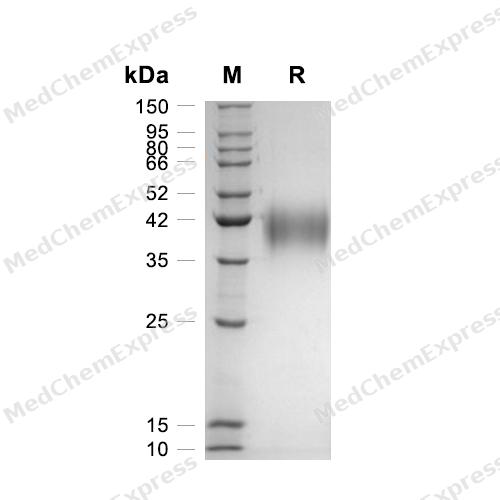
Purity - SDS-PAGE
-
Bioactivity - Cell-Based Assay
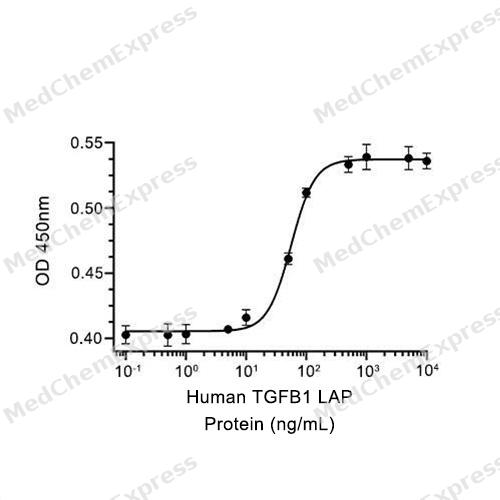
Bioactivity - Cell-Based Assay


Publications (3)
-
Journal Impact Factor
-
Most Recent
-
Life Sci
PFKFB3 functions as a metabolic checkpoint in corneal fibrosis by coordinating glycolytic reprogramming, fibrotic activation, and inflammation. [Abstract]2026 Jul 15:397:124382. PMID: 41956419 -
Biol Reprod
Microfibrillar-associated protein 5 promotes TGF-β1-induced endometrial epithelial fibrosis in intrauterine adhesion. [Abstract]2025 Oct 27:ioaf242. PMID: 41143502 -
Exp Eye Res
Lycium barbarum glycopeptide reduces inflammation and fibrosis in corneal injury by modulating the NF-κB/NLRP3/IL-1 β signaling pathway and microRNA-21a-5p/SMAD7. [Abstract]2025 Aug:257:110438. PMID: 40398709


Technical Parameters
-
Species Human
-
Source HEK293
-
Tag N-6*His
-
Accession
P01137/NP_000651.3 (L30-R278, C33S)
-
Molecular Construction
-
N-term
-
6*His
-
TGF beta 1 (L30-R278, C33S)
Accession # NP_000651.3 -
C-term
-
-
Protein Length
Full Length of Latency-associated Peptide
-
Synonyms
TGFB1; Transforming Growth Factor Beta1; Prev. TGFB; Camurati-Engelmann Disease; Prev. DPD1; Latency-Associated Peptide; TGFbeta; TGF-Beta-1; CED; TGF-Beta1; Transforming Growth Factor Beta-1 Proprotein; IBDIMDE; Prepro-Transforming Growth Factor Beta-1;
-
AA Sequence
LSTSKTIDMELVKRKRIEAIRGQILSKLRLASPPSQGEVPPGPLPEAVLALYNSTRDRVAGESAEPEPEPEADYYAKEVTRVLMVETHNEIYDKFKQSTHSIYMFFNTSELREAVPEPVLLSRAELRLLRLKLKVEQHVELYQKYSNNSWRYLSNRLLAPSDSPEWLSFDVTGVVRQWLSRGGEIEGFRLSAHCSCDSRDNTLQVDINGFTTGRRGDLATIHGMNRPFLLLMATPLERAQHLQSSRHRR
-
Predicted Molecular Mass
30.4 kDa
-
Molecular Weight
Approximately 37-48 kDa, based on SDS-PAGE under reducing conditions, due to the glycosylation.
-
Glycosylation
Yes
-
Purity
≥ 95%, as determined by reducing SDS-PAGE.


Product Properties
Lyophilized powder.
Lyophilized a 0.22 μm filtered solution of 20 mM PB, 150 mM NaCl, pH 7.4, 8% trehalose.
<1 EU/μg, determined by LAL method.
It is not recommended to reconstitute to a concentration less than 100 μg/mL in ddH2O. For long term storage it is recommended to add a carrier protein (0.1% BSA, 5% HSA, 10% FBS or 5% Trehalose).
Stored at -20°C for 2 years from date of receipt. After reconstitution, it is stable at 4°C for 1 week or -20°C for longer (with carrier protein). It is recommended to freeze aliquots at -20°C or -80°C for extended storage.
Room temperature in continental US; may vary elsewhere.


Documentation
-
Data Sheet (237 KB)
-
SDS (252 KB)
- English - EN (252 KB)
- Français - FR (252 KB)
- Deutsch - DE (252 KB)
- Norwegian - NO (252 KB)
- Español - ES (252 KB)
- Swedish - SV (252 KB)
- Italian - IT (252 KB)
- Korean - KR (252 KB)
- Portuguese - PT (252 KB)
-
Handling Instructions (2659 KB)

Calculators
Concentration (start) × Volume (start) = Concentration (final) × Volume (final)


 Powered by Bioz

