



Sting1/TMEM173 Protein, Human (N-His-Sumo)
Based on 4 publication(s) in Google Scholar
The TMEM173 protein acts as a promoter of innate immune signaling, acting as a sensor of bacterial and viral cytoplasmic DNA, ultimately promoting the production of type I interferons (IFN-α and IFN-β). This innate immune response is triggered in response to the delivery of non-CpG double-stranded DNA from viruses and bacteria into the cytoplasm. Sting1/TMEM173 Protein, Human (N-His-Sumo) is the recombinant human-derived TMEM173 protein, expressed by E. coli , with N-6*His, N-SUMO labeled tag.
- Species: Human
- Source: E. coli
-
Storage:Stored at -20°C for 2 years from date of receipt. After reconstitution, it is stable at 4°C for 1 week or -20°C for longer (with carrier protein). It is recommended to freeze aliquots at -20°C or -80°C for extended storage.


To place orders, for customer services and technical support, please contact: MedChemExpress USA
Tel: 609-228-6898 E-mail: [email protected] [email protected]


-
 Biological Activity
-
Technical Parameters
-
Product Properties
- Documentation
- Help & FAQs


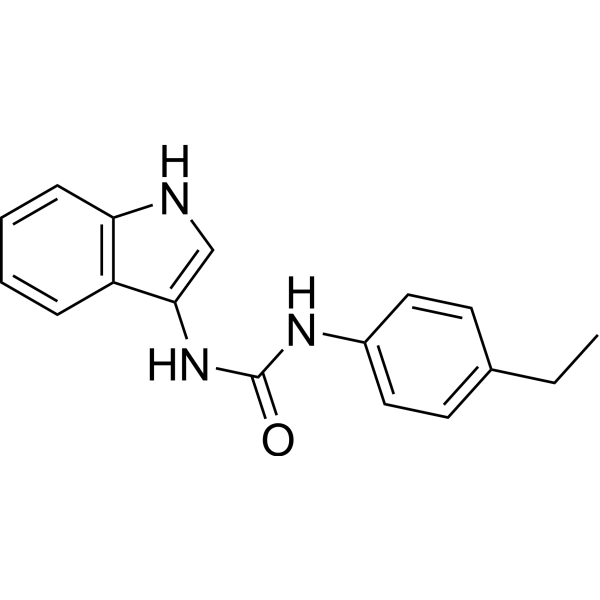
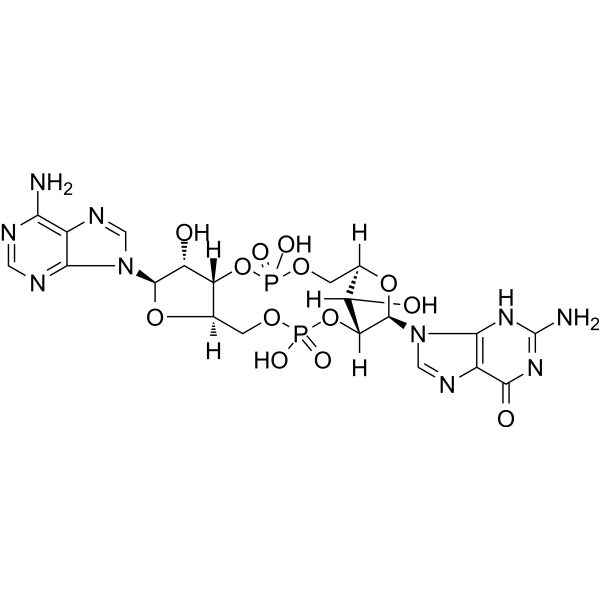


Biological Activity
Description
The TMEM173 protein acts as a promoter of innate immune signaling, acting as a sensor of bacterial and viral cytoplasmic DNA, ultimately promoting the production of type I interferons (IFN-α and IFN-β). This innate immune response is triggered in response to the delivery of non-CpG double-stranded DNA from viruses and bacteria into the cytoplasm. Sting1/TMEM173 Protein, Human (N-His-Sumo) is the recombinant human-derived TMEM173 protein, expressed by E. coli , with N-6*His, N-SUMO labeled tag.
Background
The TMEM173 protein acts as a facilitator of innate immune signaling, functioning as a sensor for cytosolic DNA from bacteria and viruses, ultimately promoting the production of type I interferon (IFN-alpha and IFN-beta). This innate immune response is triggered in response to non-CpG double-stranded DNA from viruses and bacteria delivered to the cytoplasm. TMEM173 recognizes and binds cyclic dinucleotides, specifically cyclic di-GMP (c-di-GMP), a second messenger produced by bacteria, and cyclic GMP-AMP (cGAMP), a messenger produced by CGAS in response to DNA virus in the cytosol. Upon binding to c-di-GMP or cGAMP, TMEM173 oligomerizes, translocates from the endoplasmic reticulum, and is phosphorylated by TBK1, leading to the recruitment and activation of the transcription factor IRF3. This induces the expression of type I interferon, establishing a potent anti-viral state. Additionally, TMEM173 plays a direct role in autophagy, with cGAMP-binding initiating ERGIC formation, which serves as the membrane source for autophagosome formation, targeting cytosolic DNA or DNA viruses for lysosomal degradation. The multifaceted activities of TMEM173 highlight its central role in orchestrating innate immune responses and autophagic processes, contributing to the cell's defense against viral and bacterial threats.
Verified Bioactivity
Immobilized TMEM173 at 2 μg/mL (100 μl/well) can bind TMEM173 antibody, The ED50 for this effect is 0.0337-0.08063 μg/mL.
MCE Validation Data
-
Purity - SDS-PAGE
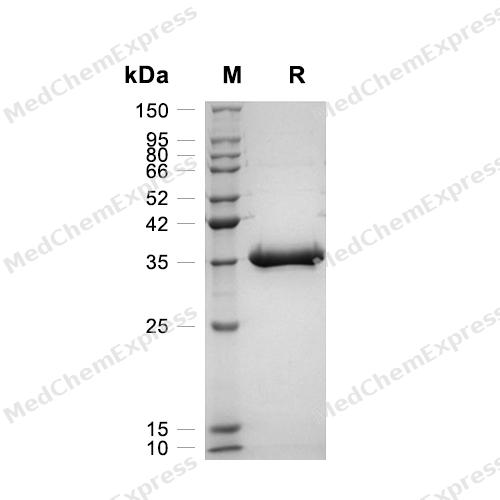
Purity - SDS-PAGE
-
Bioactivity - ELISA
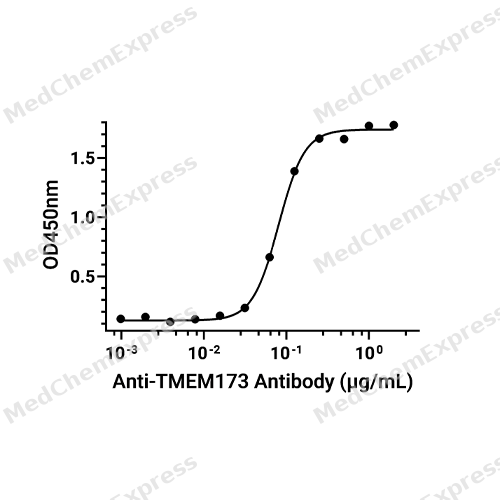
Bioactivity - ELISA


Publications (4)
-
Journal Impact Factor
-
Most Recent
-
Adv Sci (Weinh)
A Frog Skin-Derived Peptide Targeting SCD1 Exerts Radioprotective Effects Against Skin Injury by Inhibiting STING-Mediated Inflammation. [Abstract]2024 Jul;11(25):e2306253. PMID: 38582510 -
Br J Pharmacol
Glycyrrhetinic acid blocks SARS-CoV-2 infection by activating the cGAS-STING signalling pathway. [Abstract]2024 Oct;181(20):3976-3992. PMID: 38922702 -
Ecotoxicol Environ Saf
2026 Jun 24:321:120405. PMID: 42341724 -
Sci Rep
Potential antiviral activity of rhamnocitrin against influenza virus H3N2 by inhibiting cGAS/STING pathway in vitro. [Abstract]2024 Nov 16;14(1):28287. PMID: 39550441


Technical Parameters
-
Species Human
-
Source E. coli
-
Tag N-SUMO;N-6*His
-
Accession
Q86WV6 (V155-V341)
-
Protein Length
Full Length of Cyclic dinucleotide-binding domain (CBD) Region
-
Synonyms
STING1; HSTING; Prev. TMEM173; N-Terminal Methionine-Proline-Tyrosine-Serine Plasma Membrane Tetraspanner; Transmembrane Protein 173; Stimulator Of Interferon Response CGAMP Interactor-DeltaC; STING; Stimulator Of Interferon Response CGAMP Interactor-Delt
-
AA Sequence
VAHGLAWSYYIGYLRLILPELQARIRTYNQHYNNLLRGAVSQRLYILLPLDCGVPDNLSMADPNIRFLDKLPQQTGDHAGIKDRVYSNSIYELLENGQRAGTCVLEYATPLQTLFAMSQYSQAGFSREDRLEQAKLFCRTLEDILADAPESQNNCRLIAYQEPADDSSFSLSQEVLRHLRQEEKEEV
-
Predicted Molecular Mass
32.7 kDa
-
Molecular Weight
Approximately 35 kDa, based on SDS-PAGE under reducing conditions.
-
Purity
≥ 95%, as determined by reducing SDS-PAGE.


Product Properties
Lyophilized powder
Lyophilized from a 0.22 μm filtered solution of 20 mM PB, 150 mM NaCl, pH 7.4 or PBS, pH 7.4
<1 EU/μg, determined by LAL method.
It is not recommended to reconstitute to a concentration less than 100 μg/mL in ddH2O. For long term storage it is recommended to add a carrier protein (0.1% BSA, 5% HSA, 10% FBS or 5% Trehalose).
Stored at -20°C for 2 years from date of receipt. After reconstitution, it is stable at 4°C for 1 week or -20°C for longer (with carrier protein). It is recommended to freeze aliquots at -20°C or -80°C for extended storage.
Room temperature in continental US; may vary elsewhere.


Documentation
-
Data Sheet (237 KB)
-
SDS (254 KB)
- English - EN (254 KB)
- Français - FR (254 KB)
- Deutsch - DE (254 KB)
- Norwegian - NO (254 KB)
- Español - ES (254 KB)
- Swedish - SV (254 KB)
- Italian - IT (254 KB)
- Korean - KR (254 KB)
- Portuguese - PT (254 KB)
-
Handling Instructions (2659 KB)

Calculators
Concentration (start) × Volume (start) = Concentration (final) × Volume (final)


 Powered by Bioz

