



TMPRSS2 Protein, Human (P.pastoris, His)
Based on 1 publication(s) in Google Scholar
The TMPRSS2 protein is a plasma membrane-anchored serine protease that plays critical roles in prostate physiology, cancer metastasis, pain modulation, and viral infection. Its lytic activity affects proteolytic cascades involved in prostate function, and androgen-induced activation contributes to cancer progression. TMPRSS2 Protein, Human (P.pastoris, His) is the recombinant human-derived TMPRSS2 protein, expressed by P. pastoris , with N-6*His labeled tag.
- Species: Human
- Source: P. pastoris
-
Storage:Stored at -20°C for 2 years from date of receipt. After reconstitution, it is stable at 4°C for 1 week or -20°C for longer (with carrier protein). It is recommended to freeze aliquots at -20°C or -80°C for extended storage.

To place orders, for customer services and technical support, please contact: MedChemExpress USA
Tel: 609-228-6898 E-mail: [email protected] [email protected]


-
 Biological Activity
-
Technical Parameters
-
Product Properties
- Documentation
- Help & FAQs


-

HY-P78747
Furin/PCSK3 Protein, Human (HEK293, His) -
HY-100941
CCCP -
HY-15142
Doxorubicin hydrochloride -
HY-P7754A
Cathepsin L1 Protein, Human (HEK293, His) -
HY-134432B
Boc-Gln-Ala-Arg-AMC acetate -

HY-D1056
Lipopolysaccharides, from E. coli O55:B5 -
HY-13512
Camostat mesylate -
HY-P7754
Cathepsin L1 Protein, Human (HEK293, His, solution)


Biological Activity
Description
The TMPRSS2 protein is a plasma membrane-anchored serine protease that plays critical roles in prostate physiology, cancer metastasis, pain modulation, and viral infection. Its lytic activity affects proteolytic cascades involved in prostate function, and androgen-induced activation contributes to cancer progression. TMPRSS2 Protein, Human (P.pastoris, His) is the recombinant human-derived TMPRSS2 protein, expressed by P. pastoris , with N-6*His labeled tag.
Background
TMPRSS2 Protein, a plasma membrane-anchored serine protease, exhibits a distinct role in various physiological and pathological processes. Known for its cleavage activity at arginine residues, TMPRSS2 plays a pivotal role in proteolytic cascades crucial for the normal physiological function of the prostate. In the context of prostate cancer, androgen-induced TMPRSS2 activation leads to the cleavage of substrates like pro-hepatocyte growth factor/HGF, protease-activated receptor-2/F2RL1, and matriptase/ST14, promoting extracellular matrix disruption and metastasis. Additionally, TMPRSS2 contributes to the modulation of pain sensitivity by activating trigeminal neurons, influencing both spontaneous pain and mechanical allodynia. In the realm of microbial infection, TMPRSS2 plays a critical role in facilitating infections by human coronaviruses SARS-CoV and SARS-CoV-2 through two independent mechanisms: the proteolytic cleavage of the ACE2 receptor, promoting viral uptake, and the cleavage of coronavirus spike glycoproteins, activating the glycoprotein for host cell entry. This protease is also essential for the spread and pathogenesis of influenza A virus, participating in the proteolytic cleavage and activation of the hemagglutinin (HA) protein, which is indispensable for viral infectivity. The diverse functions of TMPRSS2 underscore its significance in both normal physiological processes and disease pathogenesis.
Verified Bioactivity
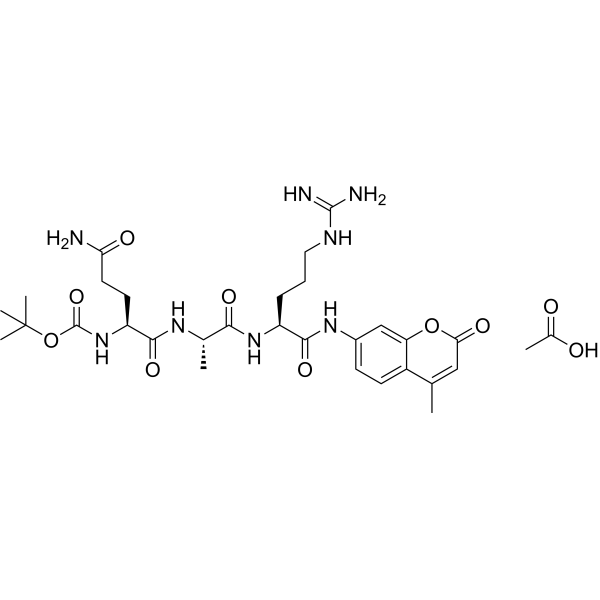
Recombinant Human TMPRSS2 His tag protein enzyme activity is measured by its ability to cleave fluorogenic peptide substrate(Boc-Gln-Ala-Arg-AMC), The Km is 50-80 μM.


Publications (1)
-
Journal Impact Factor
-
Most Recent
-
Int J Biol Macromol
Danshensu inhibits SARS-CoV-2 by targeting its main protease as a specific covalent inhibitor and discovery of bifunctional compounds eliciting antiviral and anti-inflammatory activity. [Abstract]2024 Feb;257(Pt 2):128623. PMID: 38070810


Technical Parameters
-
Species Human
-
Source P. pastoris
-
Tag N-6*His
-
Accession
O15393-1 (W106-G492)
-
Molecular Construction
-
N-term
-
6*His
-
TMPRSS2 (W106-G492)
Accession # O15393-1 -
C-term
-
-
Protein Length
Extracellular Domain
-
Synonyms
TMPRSS2; Transmembrane Protease, Serine 2; Transmembrane Serine Protease 2; Serine Protease 10; PRSS10; Epitheliasin; Transmembrane Protease Serine 2
-
AA Sequence
WKFMGSKCSNSGIECDSSGTCINPSNWCDGVSHCPGGEDENRCVRLYGPNFILQVYSSQRKSWHPVCQDDWNENYGRAACRDMGYKNNFYSSQGIVDDSGSTSFMKLNTSAGNVDIYKKLYHSDACSSKAVVSLRCIACGVNLNSSRQSRIVGGESALPGAWPWQVSLHVQNVHVCGGSIITPEWIVTAAHCVEKPLNNPWHWTAFAGILRQSFMFYGAGYQVEKVISHPNYDSKTKNNDIALMKLQKPLTFNDLVKPVCLPNPGMMLQPEQLCWISGWGATEEKGKTSEVLNAAKVLLIETQRCNSRYVYDNLITPAMICAGFLQGNVDSCQGDSGGPLVTSKNNIWWLIGDTSWGSGCAKAYRPGVYGNVMVFTDWIYRQMRADG
-
Predicted Molecular Mass
44.8 kDa
-
Molecular Weight
Approximately 45 kDa, based on SDS-PAGE under reducing conditions.
-
Glycosylation
Yes
-
Purity
≥ 90%, as determined by reducing SDS-PAGE.


Product Properties
Lyophilized powder
1.Lyophilized from a 0.22 μm sterile filtered of 20 mM Tris-HCl, 0.5 M NaCl, 6% trehalose,
pH 8.0.
2.Lyophilized from a 0.22 μm sterile filtered of PBS, 6% trehalose, pH 7.4.
Please refer to the lot-specific COA for specific buffer information.
Note: For SPR assay, please replace the buffer. Primary amine components (e.g., Tris, imidazole) can affect protein-coupled chips.
<1 EU/μg, determined by LAL method.
It is not recommended to reconstitute to a concentration less than 100 μg/mL in ddH2O.
Stored at -20°C for 2 years from date of receipt. After reconstitution, it is stable at 4°C for 1 week or -20°C for longer (with carrier protein). It is recommended to freeze aliquots at -20°C or -80°C for extended storage.
Room temperature in continental US; may vary elsewhere.


Documentation
-
Data Sheet (238 KB)
-
SDS (251 KB)
- English - EN (251 KB)
- Français - FR (251 KB)
- Deutsch - DE (251 KB)
- Norwegian - NO (251 KB)
- Español - ES (251 KB)
- Swedish - SV (251 KB)
- Italian - IT (251 KB)
- Korean - KR (251 KB)
- Portuguese - PT (251 KB)
-
Handling Instructions (2659 KB)

Calculators
Concentration (start) × Volume (start) = Concentration (final) × Volume (final)


 Powered by Bioz

