



VEGF-C Protein, Human (116a.a, HEK293)
Based on 3 publication(s) in Google Scholar
VEGF-C Protein, Human (116a.a, HEK293) functions in lymphangiogenesis, where it acts on lymphatic endothelial cells (LECs) primarily via its receptor VEGFR-3 promoting survival, growth and migration.
- Species: Human
- Source: HEK293
-
Storage:Stored at -20°C for 2 years from date of receipt. After reconstitution, it is stable at 4°C for 1 week or -20°C for longer (with carrier protein). It is recommended to freeze aliquots at -20°C or -80°C for extended storage.


To place orders, for customer services and technical support, please contact: MedChemExpress USA
Tel: 609-228-6898 E-mail: [email protected] [email protected]


-
 Biological Activity
-
Technical Parameters
-
Product Properties
- Documentation
- References
- Help & FAQs


-

HY-P7110A
VEGF165 Protein, Human (HEK293) -
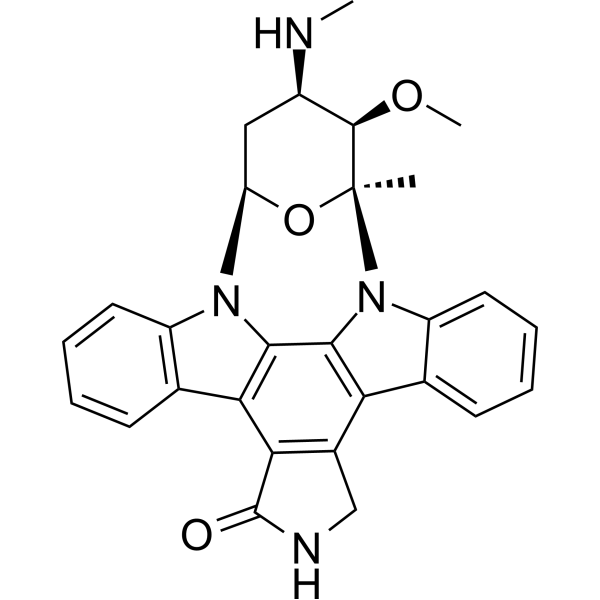
HY-15141
Staurosporine -
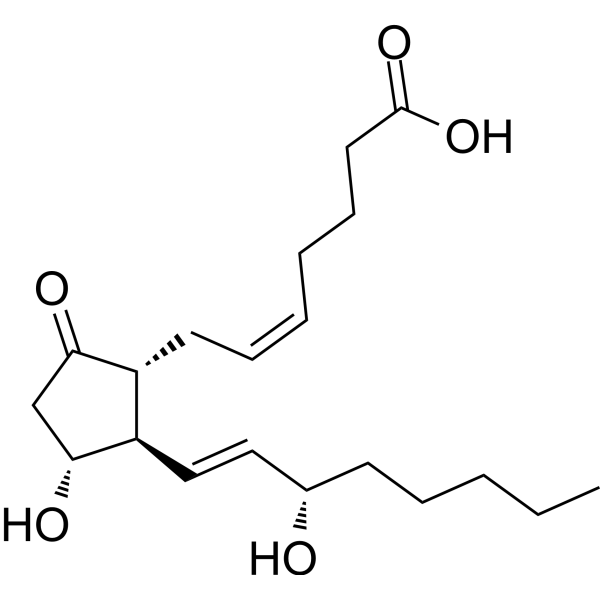
HY-101952
Prostaglandin E2 -
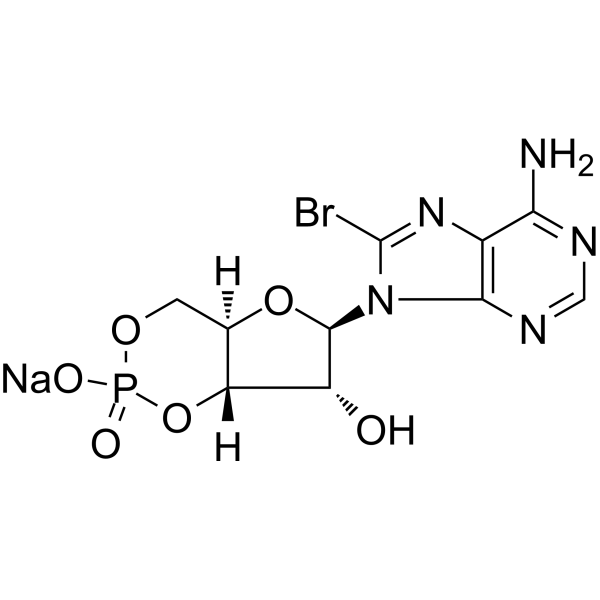
HY-12306
8-Bromo-cAMP sodium salt -
HY-P7058
TNF-alpha/TNFSF2 Protein, Human -
HY-P74474
VEGF-C Protein, Mouse/Rat (HEK293, His) -
HY-P72431
VEGF-B Protein, Human (HEK293, Fc) -
HY-P7420
VEGF121 Protein, Human (120 a.a)


Biological Activity
Description
VEGF-C Protein, Human (116a.a, HEK293) functions in lymphangiogenesis, where it acts on lymphatic endothelial cells (LECs) primarily via its receptor VEGFR-3 promoting survival, growth and migration.
Background
The main function of VEGF-C is in lymphangiogenesis, where it acts on lymphatic endothelial cells (LECs) primarily via its receptor VEGFR-3 promoting survival, growth and migration[1]. However, in addition to its effect on lymphatic vessels, it can also promote the growth of blood vessels and regulate their permeability. The effect on blood vessels can be mediated via its primary receptor VEGFR-3 or its secondary receptor VEGFR-2[2]. Apart from vascular targets, VEGF-C is also important for neural development and blood pressure regulation[3][4].
Verified Bioactivity
Measured in a cell proliferation assay using HUVEC human microvascular endothelial cells. The ED50 for this effect is ≤6.554 µg/mL, corresponding to a specific activity is ≥ 152.5 U/mg.


Publications (3)
-
Journal Impact Factor
-
Most Recent
-
Front Biosci (Landmark Ed)
Aldosterone-Induced Renal Lymphangiogenesis and Endothelial-To-Mesenchymal Transformation to Promote Renal Interstitial Fibrosis Through the MR/TGF-β1 Pathway in Mice. [Abstract]2025 Nov 27;30(11):45591. PMID: 41351406 -
Gene
MiR-214-3p targets RIPK1 to regulate pyroptosis and vascular endothelial function in diabetic ketoacidosis: mechanistic insights. [Abstract]2025 Aug 20:962:149555. PMID: 40339772 -


Technical Parameters
-
Species Human
-
Source HEK293
-
Tag Tag Free
-
Accession
P49767 (A112-R227)
-
Molecular Construction
-
N-term
-
VEGF-CC (A112-R227)
Accession # P49767 -
C-term
-
-
Protein Length
Full Length of Mature Protein
-
Synonyms
VEGFC; Vascular Endothelial Growth Factor C; Vascular Endothelial Growth Factor-Related Protein; VRP; VEGF-C; Flt4 Ligand; Flt4-L; FLT4 Ligand DHM; LMPH1D; LMPHM4
-
AA Sequence
AHYNTEILKSIDNEWRKTQCMPREVCIDVGKEFGVATNTFFKPPCVSVYRCGGCCNSEGLQCMNTSTSYLSKTLFEITVPLSQGPKPVTISFANHTSCRCMSKLDVYRQVHSIIRR
-
Predicted Molecular Mass
13.1 kDa
-
Molecular Weight
Approximately 16-19 kDa, based on SDS-PAGE under reducing conditions.
-
Glycosylation
Yes
-
Purity
≥ 95%, as determined by reducing SDS-PAGE.


Product Properties
Lyophilized powder
1.Lyophilized from a 0.22 μm filtered solution of PBS.
2.Lyophilized from a 0.22 μm filtered solution of 20 mM PB, 150 mM NaCl, pH 7.4.
3.Lyophilized from a 0.22 μm filtered solution of PBS, pH 7.4.
Please refer to the lot-specific COA for specific buffer information.
<0.2 EU/μg, determined by LAL method.
It is not recommended to reconstitute to a concentration less than 100 μg/mL in ddH2O. For long term storage it is recommended to add a carrier protein (0.1% BSA, 5% HSA, 10% FBS or 5% Trehalose).
Stored at -20°C for 2 years from date of receipt. After reconstitution, it is stable at 4°C for 1 week or -20°C for longer (with carrier protein). It is recommended to freeze aliquots at -20°C or -80°C for extended storage.
Room temperature in continental US; may vary elsewhere.


Documentation
-
Data Sheet (263 KB)
-
SDS (252 KB)
- English - EN (252 KB)
- Français - FR (252 KB)
- Deutsch - DE (252 KB)
- Norwegian - NO (252 KB)
- Español - ES (252 KB)
- Swedish - SV (252 KB)
- Italian - IT (252 KB)
- Korean - KR (252 KB)
- Portuguese - PT (252 KB)
-
Handling Instructions (2659 KB)


References
[1]. Joukov V, et al. A novel vascular endothelial growth factor, VEGF-C, is a ligand for the Flt4 (VEGFR-3) and KDR (VEGFR-2) receptor tyrosine kinases. EMBO J. 1996 Jan 15;15(2):290-98. [Content Brief]
[2]. Tammela T, et al. Blocking VEGFR-3 suppresses angiogenic sprouting and vascular network formation Nature. 2008 Jul 31;454(7204):656-60. [Content Brief]
[3]. Le Bras B, et al. VEGF-C is a trophic factor for neural progenitors in the vertebrate embryonic brain. Nat Neurosci. 2006 Mar;9(3):340-8. [Content Brief]
[4]. Machnik A, et al. Macrophages regulate salt-dependent volume and blood pressure by a vascular endothelial growth factor-C-dependent buffering mechanism. Nat Med. 2009 May;15(5):545-52. [Content Brief]

Calculators
Concentration (start) × Volume (start) = Concentration (final) × Volume (final)


 Powered by Bioz

