29 Results for "

Anionic surfactant

" in MedChemExpress (MCE) Product Catalog:
Products (29)

29 Results for "Anionic surfactant" in MCE Product Catalog:

Cat. No.: HY-W411837
CAS No.: 75902-86-2
Research Areas:  

Others

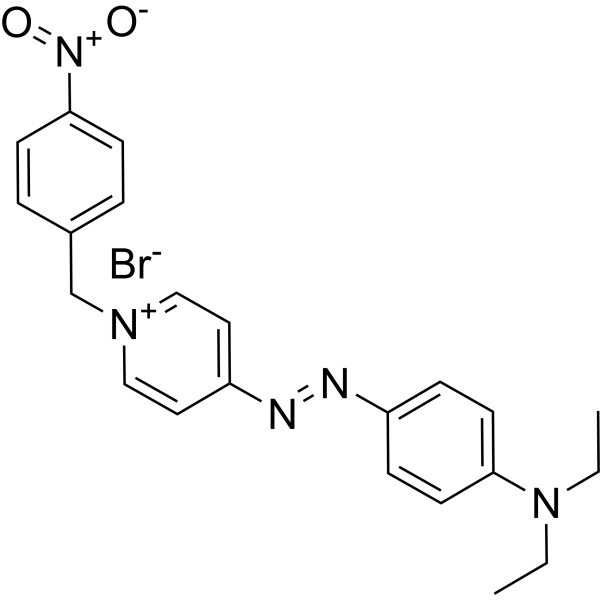
4-(4-Diethylaminophenylazo)-1-(4-nitrobenzyl)pyridinium bromide is a very stable compound that can be used in the determination of anionic surfactants .
loading...
    loading...
Cat. No.: HY-W289064
CAS No.: 15015-81-3
Synonyms: Sodium Cetylsulfonate
1-Hexadecanesulfonic acid sodium salt, 98% is an anionic surfactant.
loading...
    loading...
Cat. No.: HY-W009545R
CAS No.: 13419-61-9
Synonyms: 1-Decanesulfonic acid sodium (Standard)
Sodium decane-1-sulfonate (Standard) is the analytical standard of Sodium decane-1-sulfonate. This product is intended for research and analytical applications. Sodium decane-1-sulfonate is an anionic surfactant used for the analysis of organic small molecule compounds by HPLC and ion-pair liquid chromatography.
loading...
    loading...
Cat. No.: HY-W838254
CAS No.: 322647-32-5
Research Areas:  

Others

1,2-Dipentadecanoyl-sn-glycero-3-phospho-(1'-rac-glycerol) sodium functions as an activator for the protein kinase C family and is an anionic phospholipid found in mitochondrial and microsomal membranes, playing a crucial role in the composition of lung surfactant, particularly within the membranes of lamellar bodies in the lungs.
loading...
    loading...
Cat. No.: HY-W284558S
CAS No.: 2708287-31-2
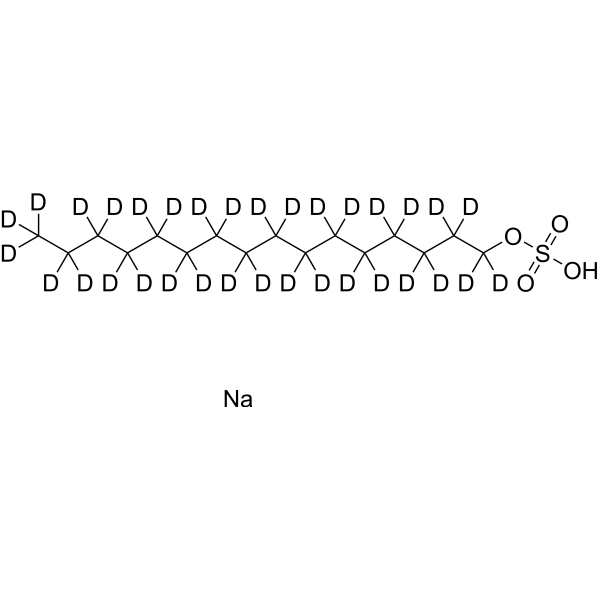
Sodium hexadecyl sulfate-d33 is the deuterium labeled Sodium hexadecyl sulfate. Sodium hexadecyl sulfate is a long-chain anionic surfactant. Sodium hexadecyl sulfate can act as an interface-regulating substance to form a soft layer on the surface of carbon nanotubes, guide proteins to adsorb in the correct orientation with active sites facing outward through electrostatic interactions, and significantly enhance the activity of immobilized enzymes. Sodium hexadecyl sulfate can replace or supplement SDS (HY-Y0316) in capillary gel electrophoresis (CGE) .
loading...
    loading...
Cat. No.: HY-W096997S
CAS No.: 1219802-16-0
Synonyms: Sodium capryl sulfate-d17
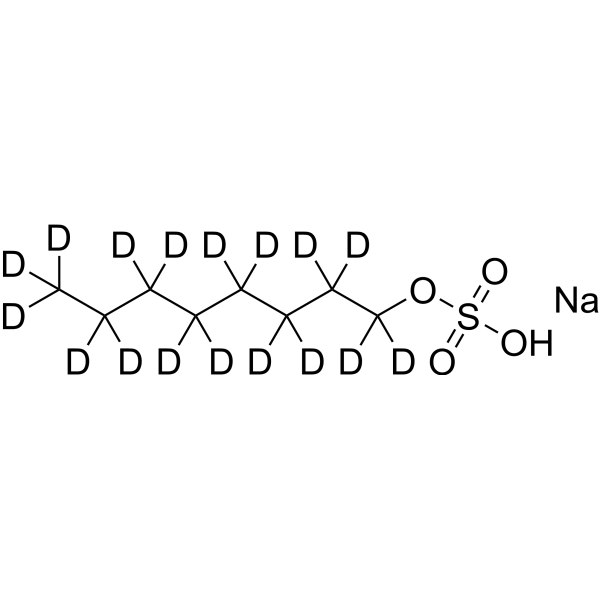
Sodium octyl sulfate (SOS)-d17 (Sodium capryl sulfate-d17) is the deuterated analogue of Sodium octyl sulfate (SOS). Sodium octyl sulfate (Sodium capryl sulfate; SOS) is a medium‑chain anionic surfactant. Sodium octyl sulfate (SOS) can undergo strong hydrophobic interactions with serum albumins (such as human serum albumin (HSA) and bovine serum albumin (BSA)), while exhibiting weak interactions with other proteins including myoglobin and hemoglobin. As an environmental pollutant in freshwater ecosystems, Sodium octyl sulfate (SOS) can mimic interspecific pheromones released by Daphnia magna and induce the formation of multicellular colonies in green algae.
loading...
    loading...
Cat. No.: HY-N17984
CAS No.: 96158-11-1
Hemsloside Ma3 is an anionic surfactant and solubilizer. Hemsloside Ma3 is an oleanolic acid bisdesmosidic saponin that can be isolated from the rhizomes of Hemsleya macrosperma and Hemsleya chinensis. Hemsloside Ma3 improves the water solubility of saikosaponin a, a poorly water-soluble monodesmosidic saponin, and its solubilizing effect appears near the critical micelle concentration. At a constant ionic strength, Hemsloside Ma3 exhibits the property of reduced surface tension with the increase in hydrogen ion concentration .
loading...
    loading...
Cat. No.: HY-187154
CAS No.: 20283-21-0
Target:  

PAI-1

Research Areas:  

Others

1-Decanesulfonic acid is an alkanesulfonate anionic surfactant that acts as a neutralizer of plasminogen activator inhibitor-1 (PAI-1). 1-Decanesulfonic acid binds to the hydrophobic region in the flexible linker domain of active PAI-1. 1-Decanesulfonic acid induces PAI-1 polymerization via a two-step neutralization mechanism .
loading...
    loading...
Cat. No.: HY-184852
CAS No.: 151-41-7
Synonyms: Dodecyl hydrogen sulphate; Dodecyl sulfate
Lauryl sulfate (Dodecyl hydrogen sulphate) is an anionic chaotropic surfactant. Lauryl sulfate dissolves viral envelopes, denatures viral proteins, inhibits viral infectivity and HIV-1 syncytium formation. Lauryl sulfate potently inhibits the infectivity of HSV-1 strain F (ED50 = 17.9 μM) and HSV-2 strain 333 (ED50 = 32.7 μM). Lauryl sulfate induces environmental toxicity, disrupting environmental balance and physiological processes of organisms. As a contaminant, Lauryl sulfate is toxic to aquatic and terrestrial organisms. Lauryl sulfate can be used in studies related to sexually transmitted infections .
loading...
    loading...

