44 Results for "

dermatologic

" in MedChemExpress (MCE) Product Catalog:
Products (44)

44 Results for "dermatologic" in MCE Product Catalog:

Cat. No.: HY-B0715R
CAS No.: 6493-05-6
Synonyms: BL-191 (Standard); Oxpentifylline (Standard)
Pentoxifylline (Standard) is the analytical standard of Pentoxifylline. This product is intended for research and analytical applications. Pentoxifylline (BL-191), a haemorheological agent, is an orally active non-selective phosphodiesterase (PDE) inhibitor, with immune modulation, anti-inflammatory, hemorheological, anti-fibrinolytic and anti-proliferation effects. Pentoxifylline can be used for the research of peripheral vascular disease, cerebrovascular disease and a number of other conditions involving a defective regional microcirculation .
loading...
    loading...
Cat. No.: HY-W020755R
CAS No.: 95-33-0
Research Areas:  

Others

Thiohexam (Standard) is the analytical standard of Thiohexam. This product is intended for research and analytical applications. Thiohexam is a rubber cure accelerator. Thiohexam is also a known allergen and dermatological sensitizer .
loading...
    loading...
Cat. No.: HY-113840
CAS No.: 105687-93-2
Synonyms: Ro 14-9706
Sumarotene (Ro 14-9706), an arotinoid methyl sulfone, is a potent dermatologic agent for the repair of photodamage, antikeratinization, and antiproliferation. Sumarotene exhibits in rats a prolactin-suppressive activity which affects lactation .
loading...
    loading...
Cat. No.: HY-B0688R
CAS No.: 80-08-0
Synonyms: 4,4′-Diaminodiphenyl sulfone (Standard); DDS (Standard)
Dapsone (Standard) is the analytical standard of Dapsone. This product is intended for research and analytical applications. Dapsone (4,4′-Diaminodiphenyl sulfone) is an orally active and blood-brain penetrant sulfonamide antibiotic with bacteriostatic, antimycobacterial and antiprotozoal activities . Dapsone exerts effective antileprosy activity and inhibits folate synthesis in cell extracts of M. leprae. Dapsone is used for dermatologic disorder research, including leprosy, dermatitis herpetiformis, acne vulgaris et al .
loading...
    loading...
Cat. No.: HY-W560402
CAS No.: 79-69-6
Target:  

Others

Research Areas:  

Others

α-Irone is a compound used as a fragrance ingredient that was evaluated toxicologically and dermatologically.
loading...
    loading...
Cat. No.: HY-116939
CAS No.: 22393-62-0
Target:  

Estrogen Receptor/ERR

Research Areas:  

Cancer

(E)-Broparestrol is a biologically active tetrasubstituted olefin, which is used as an estrogen in dermatology .
loading...
    loading...
Cat. No.: HY-150125
CAS No.: 1111078-63-7
Research Areas:  

Inflammation/Immunology

SCD1-IN-1 is a SCD1 inhibitor (IC50: 5.8 nM). SCD1-IN-1 can be used in the research of dermatologic condition .
loading...
    loading...
Cat. No.: HY-119928
CAS No.: 479-68-5
Research Areas:  

Cancer

Broparestrol is a biologically active tetrasubstituted olefin can be achieved via palladium-catalyzed cross-coupling to form a C-C bond followed by bromination. Broparestrol inhibits mammary carcinogenesis in mouse model. Broparestrol can be used in dermatology and cancer research .
loading...
    loading...
Cat. No.: HY-168436
Target:  

Tyrosinase

Research Areas:  

Endocrinology

Tyrosinase-IN-40 (Compound 9r) is a competitive-type tyrosinase inhibitor, with an IC50 value of 17.02  µM, a Ki value of 14.87 µM. Tyrosinase-IN-40 displays antioxidant activity. Tyrosinase-IN-40 can be used in melanin-related studies .
loading...
    loading...
Cat. No.: HY-136642R
CAS No.: 807-38-5
Fluocinolone (Standard) is the analytical standard of Fluocinolone (HY-136642). This product is intended for research and analytical applications. Fluocinolone is a potent steroid with highly selective glucocorticoid receptor agonist activity. Fluocinolone stabilizes the blood-retinal barrier by enhancing endothelial tight junctions, inhibiting the VEGF pathway and inflammatory factors. Fluocinolone has high lipophilicity, enabling long-term sustained release in the vitreous. Fluocinolone is used in research related to dermatological diseases, diabetic macular edema, uveitis and oral lichen planus .
loading...
    loading...
Cat. No.: HY-B0688S3
CAS No.: 287476-19-1
Synonyms: 4,4′-Diaminodiphenyl sulfone-15N2; DDS-15N2
Dapsone- 15N2 (4,4′-Diaminodiphenyl sulfone- 15N2) is 15N labeled Dapsone. Dapsone (4,4′-Diaminodiphenyl sulfone) is an orally active and blood-brain penetrant sulfonamide antibiotic with bacteriostatic, antimycobacterial and antiprotozoal activities . Dapsone?exerts effective antileprosy activity?and inhibits folate synthesis in cell extracts of?M. leprae. Dapsone is used for dermatologic disorder research, including leprosy, dermatitis herpetiformis, acne vulgaris et al .
loading...
    loading...
Cat. No.: HY-185145
CAS No.: 3104330-35-7
Target:  

CCR

Research Areas:  

Inflammation/Immunology

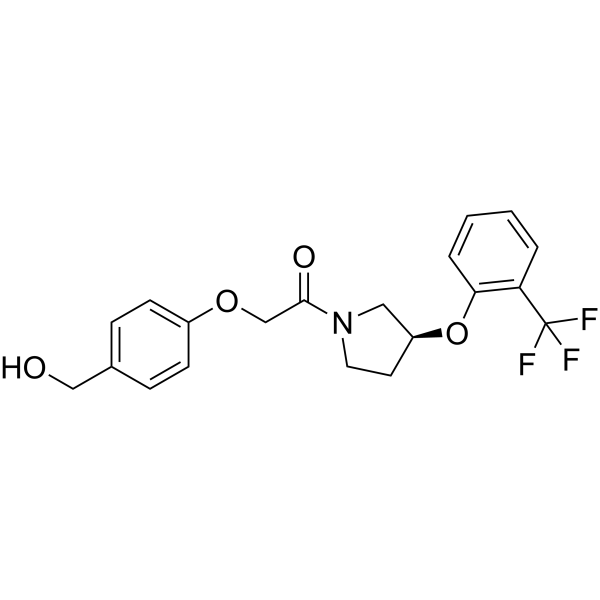
CCL17-IN-2 (Compound Ex.128) is a CCL17 secretion inhibitor with an EC50 of 0.3 nM. CCL17-IN-1 can be used in the research of autoimmune diseases, dermatological conditions, and respiratory disorders .
loading...
    loading...
Cat. No.: HY-185073
CAS No.: 3092076-12-2
Target:  

STAT

Research Areas:  

Inflammation/Immunology

STAT6-IN-11 is a STAT6 inhibitor with an EC50 of 0.006 μM. STAT6-IN-11 can be used for the research of dermatological condition or respiratory conditions .
loading...
    loading...
Cat. No.: HY-N18789
CAS No.: 8016-84-0
Category:  

Extract

Target:  

Bacterial

Tagetes oil is an organic essential oil extracted from the Tagetes plant exhibiting inherent anti-inflammatory and antimicrobial attributes. Its employment in the research of diverse skin infections, wounds and dermatological conditions has been extensively recognized.
loading...
    loading...
Cat. No.: HY-185144
CAS No.: 3104330-39-1
Target:  

CCR

Research Areas:  

Inflammation/Immunology

CCL17-IN-1 (Compound Ex.132) is a CCL17 secretion inhibitor with an EC50 of 0.2 nM. CCL17-IN-1 can be used in the research of autoimmune diseases, dermatological conditions, and respiratory disorders .
loading...
    loading...
Cat. No.: HY-W1060179
CAS No.: 2302-93-4
Target:  

Tyrosinase

Research Areas:  

Inflammation/Immunology

Tyrosinase-IN-51 is a tyrosinase inhibitor with an IC50 value of 340 nM. Tyrosinase-IN-51 can be used in studies related to pigmented skin diseases such as melasma, melanosis, freckles, and senile plaques .
loading...
    loading...
Cat. No.: HY-L141
2,921 compounds

Drug repurposing (also called drug repositioning, reprofiling, or re‑tasking) offers various advantages over developing an entirely new drug for a given indication, for example, lower risk of failure, less investment, and shorter development timelines. But drug repositioning projects are also subject to several risks, including regulatory and intellectual property issues. So the off-patent drugs are optimal for repositioning because of their immediate availability for clinical studies, with high feasibility and relatively low risk.

MCE carefully prepared a unique collection of 2,921 off-patent drugs, which is a good choice for drug repurposing.

Cat. No.: HY-L035P
6,142 compounds

New drug development is a time-consuming and high-cost process. Drug repurposing (also called drug repositioning, reprofiling or re‑tasking) offers various advantages over developing an entirely new drug for a given indication. First, the risk of failure is lower. Second, the time frame for drug development can be reduced. Third, less investment is needed. Approved and clinical drugs, especially after phase I drugs, have identified bioactivities, good pharmacokinetic characteristics and safety, which are suitable for drug repurposing.

MCE Drug Repurposing Compound Library plus contains 6,142 approved and passed phase I clinical drugs, which have been completed extensive preclinical and clinical studies and have well-characterized bioactivities, safety and bioavailability properties.

MCE Drug Repurposing Compound Library plus, with more powerful screening capability, further complement MCE Drug Repurposing Compound Library (HY-L035) by adding some compounds with low solubility or stability (Part B) to this library. All those supplementary compounds are supplied in powder form.

Cat. No.: HY-L035
5,148 compounds

New drug development is a time-consuming and high-cost process. Drug repurposing (also called drug repositioning, reprofiling or re‑tasking) offers various advantages over developing an entirely new drug for a given indication. First, the risk of failure is lower. Second, the time frame for drug development can be reduced. Third, less investment is needed. Approved and clinical drugs, especially after phase I drugs, have identified bioactivities, good pharmacokinetic characteristics and safety which are suitable for drug repurposing.

MCE Drug Repurposing Compound Library contains 5,148 approved drugs and passed phase Ⅰclinical drugs, which have been completed extensive preclinical and clinical studies and have well-characterized bioactivities, safety and bioavailability properties.

Cat. No.: HY-L053
1,534 compounds

From target identification to clinical research, traditional drug discovery and development is a time-consuming and costly process, which also bears high risk. Compared with traditional drug discovery, drug repositioning or repurposing, also known as old drugs for new uses can greatly shorten the development cycle and reduce development cost, which has become a new trend of drug development. After undergoing clinical trials, approved drugs have identified bioactivities, good pharmacokinetic characteristics and safety, which can greatly improve the success rate of drug discovery. A number of successes have been achieved, such as metformin for type 2 diabetes and thalidomide for leprosy and multiple myeloma, etc.

MCE provides a unique collection of 1,534 China NMPA (National Medical Products Administration) approved compounds, which have undergone extensive preclinical and clinical studies and have well-characterized bioactivities, safety and bioavailability properties. MCE NMPA-Approved Drug Library is a good tool for drug repurposing which could dramatically accelerate drug development.

