

64 Results for "

random

" in MedChemExpress (MCE) Product Catalog:
Products (64)

64 Results for "random" in MCE Product Catalog:

Cat. No.: HY-P4114
Target:  

HIV

Research Areas:  

Others

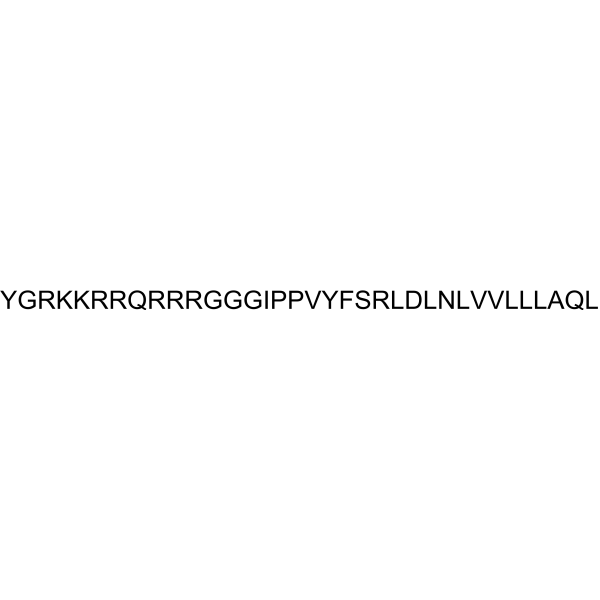
TAT-NSF700scr consists the intact TAT domain and glycine linker, followed by the NSF amino acids in a random order. TAT-NSF700scr is used as a control peptide that does not inhibit SNAREmediated exocytosis .
loading...
    loading...
Cat. No.: HY-132582D
Synonyms: IONIS-MAPTRx scramble control
Target:  

Tau Protein

Research Areas:  

Neurological Disease

Scrambled IONIS-MAPTRx (sodium) is a scrambled sequence of IONIS-MAPTRx sodium (HY-132582C). Scrambled IONIS-MAPTRx (sodium) has the same amino acid composition as the active IONIS-MAPTRx sodium fragment, but the sequence is randomly scrambled. Scrambled IONIS-MAPTRx (sodium) is typically used as a negative control. Scrambled IONIS-MAPTRx (sodium) has potential for studying Alzheimer's disease.
loading...
    loading...
Cat. No.: HY-B0178AS
CAS No.: 285977-73-3
Synonyms: Guanidinium-13C,15N3 chloride; Aminoformamidine-13C,15N3 hydrochloride
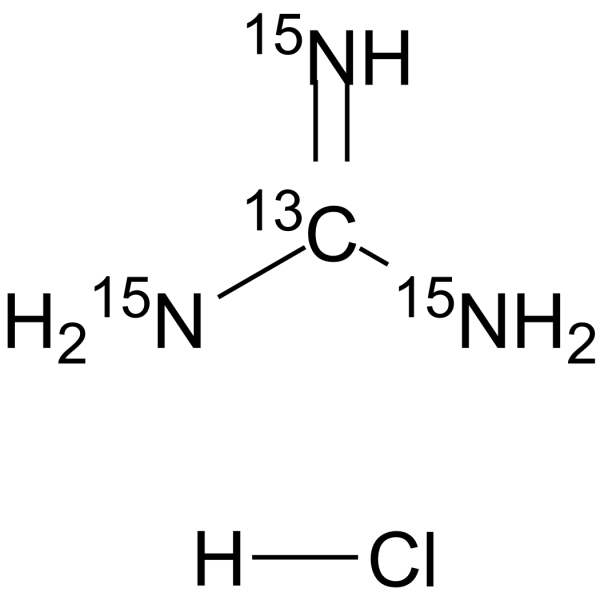
Guanidine- 13C, 15N3 hydrochloride (Guanidinium- 13C, 15N3 (chloride)) is the 15N, 13C-labeled Guanidine hydrochloride (HY-B0178A). Guanidine hydrochloride is a strong protein denaturant. Guanidine hydrochloride causes proteins to assume a random coil conformation .
loading...
    loading...
Cat. No.: HY-153840
CAS No.: 1934318-43-0
Research Areas:  

Inflammation/Immunology

ODN INH-18 is a linear 24-mer class B INH-ODN in which the 5' INH-ODN 4084-F sequence was followed by a random stretch of 12 nucleotides lacking the ability to form significant secondary structures. ODN INH-18 showes inhibitory potency for TLR9 ligand-induced IFN-α production.
loading...
    loading...
Cat. No.: HY-P1849
CAS No.: 402941-23-5
Synonyms: scJag-1
Target:  

Inhibitory Antibodies

Research Areas:  

Cardiovascular Disease

JAG-1, scrambled (scJag-1) is a scrambled sequence of JAG-1 (Jagged-1 protein). JAG-1, scrambled has a random sequence of the amino acids that are the same as the active fragment. JAG-1, scrambled is usually used as a negative control .
loading...
    loading...
Cat. No.: HY-P2517
CAS No.: 1348418-97-2
Target:  

Inhibitory Antibodies

Research Areas:  

Others

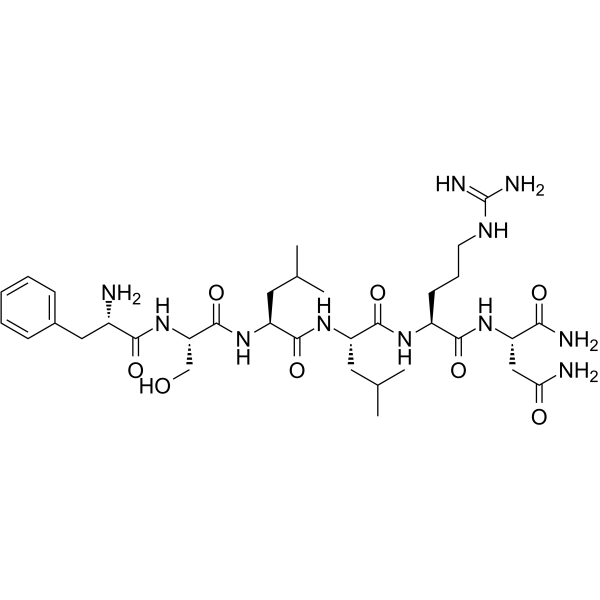
Scrambled TRAP Fragment is a scrambled sequence of TRAP Fragment. Scrambled TRAP Fragment with a random sequence of the amino acids that are the same as the active fragment. Scrambled TRAP Fragment usually used as a negative control.
loading...
    loading...
Cat. No.: HY-B0178AR
CAS No.: 50-01-1
Synonyms: Guanidinium chloride (Standard); Aminoformamidine hydrochloride (Standard)
Guanidine hydrochloride (Standard) (Guanidinium chloride (Standard)) is the analytical standard of Guanidine hydrochloride (HY-B0178A). This product is intended for research and analytical applications. Guanidine hydrochloride (Guanidinium chloride) is a strong protein denaturant. Guanidine hydrochloride causes proteins to assume a random coil conformation .
loading...
    loading...
Cat. No.: HY-B0178AS1
CAS No.: 108694-93-5
Synonyms: Guanidinium-d5 chloride; Aminoformamidine-d5 hydrochloride
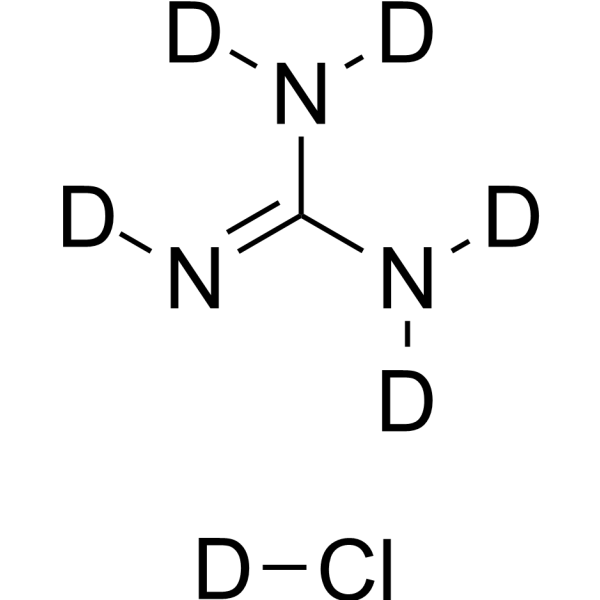
Guanidine-d5 hydrochloride (Guanidinium-d5 chloride) is the d5-labeled Guanidine hydrochloride (HY-B0178A). Guanidine hydrochloride is a strong protein denaturant. Guanidine hydrochloride causes proteins to assume a random coil conformation .
loading...
    loading...
Cat. No.: HY-123016
CAS No.: 143442-54-0
Target:  

Endogenous Metabolite

Research Areas:  

Cardiovascular Disease

9(S)-HODE cholesteryl ester is originally extracted from atherosclerotic lesions. It remains uncertain whether the oxidized fatty acid portion of the molecule results from enzymatic lipoxygenation or from random lipid peroxidation.2 9(S)-HODE cholesteryl ester can be used as a standard for analysis of chiral HODE cholesteryl esters.
loading...
    loading...
Cat. No.: HY-125394
CAS No.: 330800-93-6
Target:  

Endogenous Metabolite

Research Areas:  

Cardiovascular Disease

9(R)-HODE cholesteryl ester is originally extracted from atherosclerotic lesions. It remains uncertain whether the oxidized fatty acid portion of the molecule results from enzymatic lipoxygenation or from random lipid peroxidation.2 9(R)-HODE cholesteryl ester can be used as a standard for analysis of chiral HODE cholesteryl esters.
loading...
    loading...
Cat. No.: HY-169823
CAS No.: 218936-13-1
Research Areas:  

Infection

BAS-118 is a benzamide derivative with antibacterial activity. The MIC50, MIC90 and MIC ranges of BAS-118 for 100 randomly selected isolates of Helicobacter pylori are ≤0.003, 0.013 and ≤0.003-0.025 mg/L, respectively. BAS-118 is promising for research of anti-H. pylori agent .
loading...
    loading...
Cat. No.: HY-153840B
Research Areas:  

Inflammation/Immunology

ODN INH-18 triethylamine is a linear 24-mer class B INH-ODN in which the 5' INH-ODN 4084-F sequence was followed by a random stretch of 12 nucleotides lacking the ability to form significant secondary structures. ODN INH-18 triethylamine showes inhibitory potency for TLR9 ligand-induced IFN-α production.
loading...
    loading...
Cat. No.: HY-125316
CAS No.: 1138669-65-4
Synonyms: ARRY-403
Target:  

Endogenous Metabolite

Research Areas:  

Metabolic Disease

AMG-151 (ARRY-403) is a glucokinase agonist with fasting plasma glucose (FPG) lowering activity. AMG-151 showed a significant linear dose-response trend compared with placebo in a randomized, placebo-controlled Phase IIa study. The use of AMG-151 was associated with a higher incidence of hypoglycemia and hypertriglyceridemia. AMG-151 may serve as a potential compound for the inhibition of type 1 diabetes .
loading...
    loading...
Cat. No.: HY-169115A
CAS No.: 313651-02-4
Target:  

Calcium Channel

Research Areas:  

Inflammation/Immunology

(Rac)-PD0299685 is a Ca(2+) channel α2δ ligand that was investigated for relieving interstitial cystitis pain in a randomized, double-blind, placebo-controlled phase IIa study. (Rac)-PD0299685 demonstrated a clinically significant reduction in daily worst pain severity scores at the 60 mg dose compared to placebo. (Rac)-PD0299685 is also a potent voltage-dependent calcium channel inhibitor for the study of retina-related diseases.
loading...
    loading...
Cat. No.: HY-106991
CAS No.: 878189-87-8
Synonyms: S-303
Research Areas:  

Infection

Amustaline (S-303) is a compound used for inactivating pathogens in blood components and belongs to the category of nucleic acid-targeted chemical decontaminants. Amustaline has the ability to inactivate viruses and is effective against mosquito-borne viruses such as Chikungunya virus (CHIKV), Dengue virus (DENV), and Zika virus (ZIKV). When combined with glutathione (Glutathione, GSH), which acts as a neutralizer to counteract adverse reactions, Amustaline ensures the stability of red blood cell membranes. Amustaline is mainly used for inactivating pathogens in red blood cell concentrates (RBCC) to reduce the risk of transfusion-transmitted infections (TTI) .
loading...
    loading...
Cat. No.: HY-P11353
CAS No.: 117138-19-9
Research Areas:  

Infection Cancer

HA2 peptide is a potent pH-responsive fusion peptide derived from hemagglutinin (HA), corresponding to the N-terminal fusion peptide domain consisting of 23 amino acid residues of HIV-1 gp41 envelope glycoprotein. HA2 peptide adopts a random coil structure under physiological pH conditions; in acidic endosomes, protonation of carboxyl groups reduces negative charge, inducing a transition to an α-helical conformation that can fuse with and destabilize the endosomal membrane. After binding to membranes, the N-terminal and middle regions of HA2 peptide mainly adopt a β-strand conformation, while the C-terminal region remains unstructured. HA2 peptide induces lipid mixing and promotes aqueous content leakage from large unilamellar vesicles whose lipid composition matches that of HIV-1 viruses and target T cells. HA2 peptide is anionic and can bind to cationic peptides to achieve siRNA condensation. HA2 peptide can be used in studies related to cancer and human immunodeficiency virus (HIV) infection .
loading...
    loading...
Cat. No.: HY-P2858D
Research Areas:  

Metabolic Disease

β-Mannanase, Clostridium thermocellum (EC 3.2.1.78) catalyses the following chemical reaction: Random hydrolysis of (1->4)-beta-D-mannosidic linkages in mannans, galactomannans and glucomannans.
loading...
    loading...
Cat. No.: HY-E71316A
Target:  

Glycosidase

Research Areas:  

Others

β-Mannanase 26A, Celvibrio japonicas is an enzyme with system name 4-beta-D-mannan mannanohydrolase. This enzyme catalyses the following chemical reaction: Random hydrolysis of (1->4)-beta-D-mannosidic linkages in mannans, galactomannans and glucomannans.
loading...
    loading...
Cat. No.: HY-108903B
Target:  

Glycosidase

Research Areas:  

Metabolic Disease

Hyaluronidase, Streptomyces hyalurolyticus (EC 3.2.1.35) degrades hyaluronan and has been found to be inappropriately regulated during cancer progression. Hyaluronidase randomly cleaves β-N-acetylhexosamine-[1→4] glycosidic bonds in hyaluronic acid, chondroitin, and chondroitin sulfates.
loading...
    loading...
Cat. No.: HY-E71310
Research Areas:  

Others

β-Mannanase 26A, Cellvibrio japonicus (EC 3.2.1.78) is an enzyme with system name 4-beta-D-mannan mannanohydrolase. This enzyme catalyses the following chemical reaction: Random hydrolysis of (1->4)-beta-D-mannosidic linkages in mannans, galactomannans and glucomannans.
loading...
    loading...

