
37 Results for "

Affective Disorder

" in MedChemExpress (MCE) Product Catalog:
Products (37)

37 Results for "Affective Disorder" in MCE Product Catalog:

Cat. No.: HY-B1033R
CAS No.: 17692-51-2
Metergoline (Standard) is the analytical standard of Metergoline. This product is intended for research and analytical applications. Metergoline is a serotonin (5-HT) receptor and dopamine receptors antagonist, with pKis of 8.64, 8.75 and 8.75 for 5-HT2A, 5-HT2B and 5-HT2C, respectively. Metergoline is a high-affinity ligand for the h5-HT7 receptor, with a Ki of 16 nM. Metergoline is also a reversible neural Na+ channels inhibitor. Metergoline is commonly used for the research of seasonal affective disorder, prolactin hormone regulation .
loading...
    loading...
Cat. No.: HY-100703R
CAS No.: 1893-33-0
Synonyms: Floropipamide (Standard); McN-JR 3345 (Standard); R 3345 (Standard)
Pipamperone (Standard) is the analytical standard of Pipamperone (HY-100703). This product is intended for research and analytical applications. Pipamperone (Floropipamide) is a butyrophenone derivative and high-affinity antagonist of 5-HT2A receptor (pKi=8.2) and D4 receptor (pKi=8.0). Pipamperone is also a low-affinity antagonist of D2 receptor (pKi=6.7). Pipamperone affects neurotransmitter functions and exerts antipsychotic activity. Pipamperone is used in the research of mental disorders such as autism-related behavioral disorders and Alzheimer's disease .
loading...
    loading...
Cat. No.: HY-100703S
Synonyms: Floropipamide-d10 dihydrochloride; McN-JR 3345-d10 dihydrochloride; R 3345-d10 dihydrochloride
Pipamperone-d10 (Floropipamide-d10) dihydrochloride is a deuterated Pipamperone dihydrochloride (HY-100703A). Pipamperone dihydrochloride (Floropipamide dihydrochloride) is a butyrophenone derivative and high-affinity antagonist of 5-HT2A receptor (pKi=8.2) and D4 receptor (pKi=8.0). Pipamperone dihydrochloride is also a low-affinity antagonist of D2 receptor (pKi=6.7). Pipamperone dihydrochloride affects neurotransmitter functions and exerts antipsychotic activity. Pipamperone dihydrochloride is used in the research of mental disorders such as autism-related behavioral disorders and Alzheimer's disease .
loading...
    loading...
Cat. No.: HY-106644
CAS No.: 59859-58-4
Synonyms: FG4963 free acid
Target:  

5-HT Receptor

Research Areas:  

Neurological Disease

Femoxetine is a serotonin (5-HT) inhibitor with antidepressant properties. Femoxetine increases serotonin levels in the brain by preventing serotonin from being reabsorbed by nerve cells, resulting in increased concentrations of the neurotransmitter in the synaptic gap, which enhances serotonin signaling. Femoxetine can be used to study the role of serotonin in depression and other emotional disorders, and how 5-HT reuptake inhibitors affect mood and behavior .
loading...
    loading...
Cat. No.: HY-106644A
CAS No.: 56222-04-9
Synonyms: FG4963
Target:  

5-HT Receptor

Research Areas:  

Neurological Disease

Femoxetine hydrochloride is a serotonin (5-HT) inhibitor with antidepressant properties. Femoxetine hydrochloride increases serotonin levels in the brain by preventing serotonin from being reabsorbed by nerve cells, resulting in increased concentrations of the neurotransmitter in the synaptic gap, which enhances serotonin signaling. Femoxetine hydrochloride can be used to study the role of serotonin in depression and other emotional disorders, and how 5-HT reuptake inhibitors affect mood and behavior .
loading...
    loading...
Cat. No.: HY-110010
CAS No.: 149649-22-9
Target:  

Dopamine Receptor

Research Areas:  

Neurological Disease

Nafadotride is a dopamine D3 receptor antagonist. Nafadotrode regulates dopamine signaling primarily by antagonizing dopamine D3 receptors. The dopamine D3 receptor plays an important role in regulating emotion, motivation, reward, and certain motor functions. By blocking these receptors, Nafadotrode may affect neurotransmission processes associated with these functions. Nafadotrode can be used to explore the role of dopamine D3 receptors in various behavioral and neuropsychiatric disorders .
loading...
    loading...
Cat. No.: HY-106964A
CAS No.: 734513-52-1
Target:  

5-HT Receptor

Research Areas:  

Neurological Disease

(Rac)-S 16924 is a partial agonist of the 5-HT1A receptor. (Rac)-S 16924 regulates signaling through its interaction with the 5-HT1A receptor, and (Rac)-S 16924 can stabilize the receptor in its G-protein-coupled conformation without fully activating it, which may affect intracellular signaling pathways associated with this receptor. (Rac)-S 16924 can be used to study the 5-HT1A receptor in mental disorders, especially schizophrenia .
loading...
    loading...
Cat. No.: HY-W550739
CAS No.: 33665-90-6
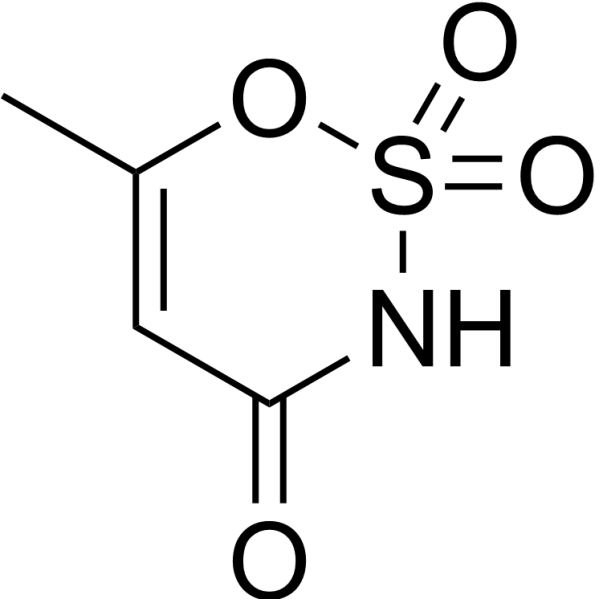
Acesulfame is a synthetic sweetener. Long-term use of Acesulfame can affect cognitive function. Acesulfame potassium can suppress autophagic degradation of PD-L1 in RIL-175 and SK-Hep1 cells through the ERK1/2-mTORC1-ULK1 pathway, which may be related to immune evasion in cancer cells. Acesulfame can be used in research on neurological diseases, metabolic disorders, cancer, and immune evasion .
loading...
    loading...
Cat. No.: HY-D0195R
CAS No.: 55589-62-3
Acesulfame potassium (Standard) is the analytical standard of Acesulfame potassium (HY-D0195). This product is intended for research and analytical applications. Acesulfame potassium is a synthetic sweetener. Long-term use of Acesulfame potassium can affect cognitive function, possibly by altering the neurometabolic functions in mice. Acesulfame potassium can suppress autophagic degradation of PD-L1 in RIL-175 and SK-Hep1 cells through the ERK1/2-mTORC1-ULK1 pathway, which may be related to immune evasion in cancer cells. Acesulfame potassium can be used in research on neurological diseases, metabolic disorders, cancer, and immune evasion .
loading...
    loading...
Cat. No.: HY-101324AR
CAS No.: 61655-58-1
Synonyms: CPP monohydrochloride (Standard)
Research Areas:  

Neurological Disease

MK-212 (monohydrochloride) (Standard) is the analytical standard of MK-212 (monohydrochloride). This product is intended for research and analytical applications. MK-212 monohydrochloride (CPP monohydrochloride) is an orally active, blood-brain barrier permeable agonist of 5-HT1C, 5-HT2 and 5-HT1A receptors. MK-212 monohydrochloride induces hyperthermia, nausea, arousal, irritability and restlessness, inhibits the elevation of plasma cortisol and prolactin, and reduces feelings of calmness and overall positive affect. MK-212 monohydrochloride mediates anxiety-like behaviors and motor inhibition. MK-212 monohydrochloride is applicable to research related to schizophrenia and anxiety disorders .
loading...
    loading...
Cat. No.: HY-14197AR
CAS No.: 17780-75-5
Synonyms: M&B 9302 hydrochloride (Standard)
Clorgyline hydrochloride (Standard) (M&B 9302 hydrochloride (Standard)) is the analytical standard of Clorgyline hydrochloride (HY-14197A). This product is intended for research and analytical applications. Clorgyline hydrochloride (M&B 9302 hydrochloride) is a selective, irreversible monoamine oxidase A (MAO-A) inhibitor that can cross the blood-brain barrier and exhibits activity against the 5-HT Receptor at very high doses. Clorgyline hydrochloride regulates monoamine neurotransmitter levels, the release of dopamine and acetylcholine, the uptake and effects of Tyramine (HY-W007606), noradrenergic function, circadian locomotor activity rhythms, feeding behavior, and body weight. Clorgyline hydrochloride induces tumor-suppressive transcriptional programs, secretory differentiation, androgen signaling regulation, Bcl-2 expression, and radioprotective effects in non-malignant cells. Clorgyline hydrochloride is used in the research of high-grade prostate cancer, Huntington's disease, major affective disorder, radiation-induced normal tissue toxicity, and obesity .
loading...
    loading...
Cat. No.: HY-B1580B
CAS No.: 4075-81-4
Synonyms: Bioban-C (Pharmaceutical primary standard, USP)
Calcium propionate, United States Pharmacopeia (USP) Reference Standard (Bioban-C (Pharmaceutical primary standard, USP)) is a calcium salt of Propionic acid with oral activity, which can be hydrolyzed into propionate and calcium ions. Calcium propionate, United States Pharmacopeia (USP) Reference Standard elevates intracellular ROS levels in tumor cells, depletes GSH, reduces mitochondrial membrane potential, and thereby induces tumor cell apoptosis. In mouse colitis models, Calcium propionate, United States Pharmacopeia (USP) Reference Standard modulates inflammatory factors such as IFN-γ, calprotectin, and Pglyrp3, ameliorating intestinal inflammation and metabolic disorders. In ruminants, Calcium propionate, United States Pharmacopeia (USP) Reference Standard serves as a gluconeogenic precursor, regulating rumen fermentation and microbial diversity; in high-fat diet rats, it alters gut microbiota composition and affects blood biochemical parameters. Calcium propionate, United States Pharmacopeia (USP) Reference Standard is commonly used as a food and feed additive, and is also used in research related to hypocalcemia, dyslipidemia, colitis, and lung cancer .
loading...
    loading...
Cat. No.: HY-B1580AR
CAS No.: 4075-81-4
Synonyms: Bioban-C, meets analytical specification of E282 (Standard)
Calcium propionate, meets analytical specification of E282 (Standard) (Bioban-C, meets analytical specification of E282 (Standard)) is the analytical standard of Calcium propionate, meets analytical specification of E282 (HY-B1580A). This product is intended for research and analytical applications. Calcium propionate, meets analytical specification of E282 is a calcium salt of Propionic acid with oral activity, which can be hydrolyzed into propionate and calcium ions. Calcium propionate, meets analytical specification of E282 elevates intracellular ROS levels in tumor cells, depletes GSH, reduces mitochondrial membrane potential, and thereby induces tumor cell apoptosis. In mouse colitis models, Calcium propionate, meets analytical specification of E282 modulates inflammatory factors such as IFN-γ, calprotectin, and Pglyrp3, ameliorating intestinal inflammation and metabolic disorders. In ruminants, Calcium propionate, meets analytical specification of E282 serves as a gluconeogenic precursor, regulating rumen fermentation and microbial diversity; in high-fat diet rats, it alters gut microbiota composition and affects blood biochemical parameters. Calcium propionate, meets analytical specification of E282 is commonly used as a food and feed additive, and is also used in research related to hypocalcemia, dyslipidemia, colitis, and lung cancer .
loading...
    loading...
Cat. No.: HY-179397
Target:  

Acyltransferase

Research Areas:  

Neurological Disease

AANAT-IN-2 (Compound 5g) is a potent and selective AANAT inhibitor, with an IC50 of 1.1 μM. AANAT-IN-2 can be used for the study of seasonal affective disorder (SAD) .
loading...
    loading...
Cat. No.: HY-L108
3,059 compounds

Depression is a serious global affective disorder and one of the most common neurological diseases whose clinical manifestations are low mood, loss of interest, anhedonia, loss of energy, and fatigue, people with major depressive disorder (MDD) can even have suicidal thoughts and behaviors.

Currently available antidepressants have significant limitations, including a long time lag for a therapeutic response (weeks to months) and low response rates. This is particularly problematic for a disease with a high suicide rate. Therefore, the development of new antidepressant drugs is particularly urgent.

MCE offers a unique collection of 3,059 compounds with antidepressant activities or targeting the unique targets of depression. MCE Antidepressant Compound Library is a useful tool for exploring the mechanism of depression and discovering new drugs for depression.

Cat. No.: HY-L102
1,900 compounds

Rare diseases are an important public-health issue and a challenge for the medical community. Most rare diseases are genetic disorders, which are often severely disabling, substantially affect life expectancy, and impair physical and mental abilities. Currently, there are about 7,000 identified rare diseases, together affecting 10% of the population. However, fewer than 6% of all rare diseases have an approved treatment option, highlighting their tremendous unmet needs in drug development. The process of repurposing drugs for new indications, compared with the development of novel orphan drugs, is a time-saving and cost-efficient method resulting in higher success rates, which can therefore drastically reduce the risk of drug development for rare diseases.

MCE carefully collects a unique of 1,900 compounds studied in preclinical, clinical trials or approved used in rare diseases treatment. MCE rare diseases drug library is a useful tool for the research of rare diseases. All compounds can provide corresponding indications for rare diseases.

Cat. No.: HY-L250
61 compounds

In the progression of various diseases, metabolic reprogramming has emerged as a key hallmark. Lactate, as an important metabolic signaling molecule, is widely involved in tumorigenesis, immune regulation, and inflammatory responses. Particularly within the tumor microenvironment, the abnormal accumulation of lactate not only affects cellular energy metabolism but also promotes disease progression by modulating immune cell functions and mediating protein lactylation, thereby participating in epigenetic regulation and signaling networks. Therefore, systematic investigation of lactate metabolic pathways and their associated metabolites is of great significance for understanding disease mechanisms and developing novel therapeutic strategies.

The MCE lactic acid metabolite compound library contains 61 compounds and is constructed around key metabolic pathways involving lactate production, transport, and utilization. This library systematically includes core intermediates from glycolysis, the tricarboxylic acid (TCA) cycle, and the lactate cycle. Focusing on disease-associated metabolic reprogramming, it is suitable for research in oncology, inflammation, and metabolic disorders. The library can be used to elucidate the roles of lactate in tumor microenvironment regulation, immune evasion, and epigenetic modifications (such as protein lactylation). In addition, it provides high-quality small-molecule resources for drug screening, facilitating the discovery of potential modulators targeting key enzymes (such as LDH) or transporters (such as MCTs) involved in lactate metabolism.

