118 Results for "

5-HT4

" in MedChemExpress (MCE) Product Catalog:
Products (118)

118 Results for "5-HT4" in MCE Product Catalog:

Cat. No.: HY-12694R
CAS No.: 179474-85-2
Synonyms: R-108512 (Standard)
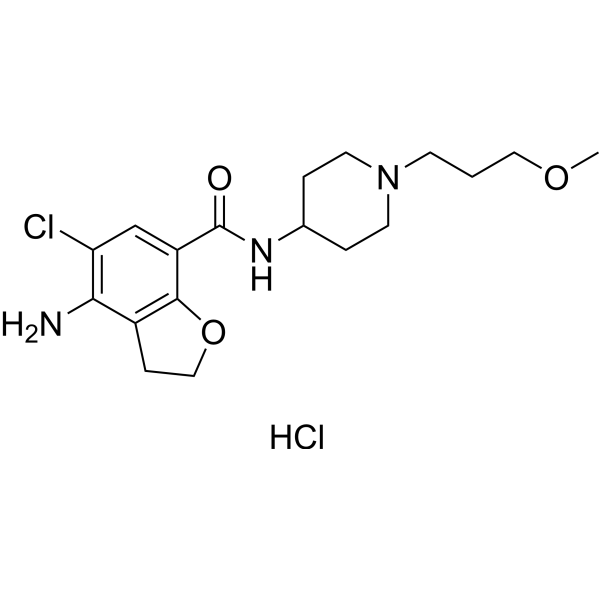
Prucalopride (succinate) (Standard) is the analytical standard of Prucalopride (succinate). This product is intended for research and analytical applications. Prucalopride succinate is an orally active, selective and specific 5-HT 4 receptor agonist (high affinity), with pKis of 8.6 and 8.1 for human 5-HT4a/4b receptors, respectively. Prucalopride succinate improves intestinal motility by promoting regeneration of the intestinal nervous system in rats. Prucalopride succinate also shows anticancer activity by blocking of the PI3K/AKT/mTor signaling pathway. Prucalopride succinate can be used in studies of chronic constipation, pseudo-intestinal obstruction and cancer .
loading...
    loading...
Cat. No.: HY-10564R
CAS No.: 135159-51-2
Synonyms: MCI-9042 (Standard)
Research Areas:  

Cardiovascular Disease

Sarpogrelate (hydrochloride) (Standard) is the analytical standard of Sarpogrelate (hydrochloride). This product is intended for research and analytical applications. Sarpogrelate hydrochloride (MCI-9042) is a selective 5-HT2R antagonist, with pKis of 8.52, 6.57, and 7.43 for 5-HT2A, 5-HT2B, and 5-HT2C receptors, respectively. Sarpogrelate hydrochloride displays selectivity over 5-HT1, 5-HT3, 5-HT4, α1-, α2- and β-adrenoreceptor, histamine H1, H2 and muscarinic M3 receptors. Sarpogrelate hydrochloride can be used for the research of vascular disease associated with thrombosis .
loading...
    loading...
Cat. No.: HY-103143
CAS No.: 1197334-02-3
Target:  

5-HT Receptor

Research Areas:  

Neurological Disease

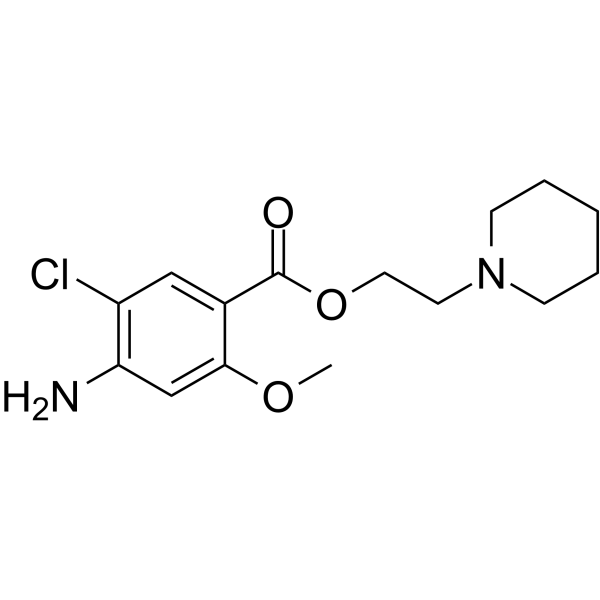
SDZ 205-557 hydrochloride is a selective 5-HT4 receptors antagonist. SDZ 205-557 hydrochloride can be used for neurological research .
loading...
    loading...
Cat. No.: HY-103143A
CAS No.: 137196-67-9
Target:  

5-HT Receptor

Research Areas:  

Neurological Disease

SDZ 205-557 is a selective 5-HT4 receptors antagonist. SDZ 205-557 can be used for neurological research .
loading...
    loading...
Cat. No.: HY-108173
CAS No.: 142228-17-9
Target:  

5-HT Receptor

Research Areas:  

Inflammation/Immunology

TKS 159 is a 5-HT4 receptor agonist. TKS 159 can promote gastrointestinal motility. TKS 159 can be used for research on gastrointestinal conditions .
loading...
    loading...
Cat. No.: HY-14441
CAS No.: 148868-55-7
Purity:  98.95%
Target:  

5-HT Receptor

Research Areas:  

Neurological Disease

ML 10302 is a potent agonist 5-HT4 receptor with Ki of 1.07 nM. 5-Hydroxytryptamine (5-HT4) receptor agonists stimulate gut motility through cholinergic pathways. ML10302 induces significant prokinesia both in the small bowel and colon through activation of cholinergic pathways. ML 10302 also has the potential for the research of neurology diseases .
loading...
    loading...
Cat. No.: HY-18138
CAS No.: 1400811-63-3
Target:  

5-HT Receptor

Research Areas:  

Neurological Disease

PF-03382792 is a potent 5-HT4 partial agonist with a Ki of 2.7 nM and an EC50 of 0.9 nM for 5-HT4d. PF-03382792 can penetrate the brain. PF-03382792 produces moderate increases in cortical Ach in the rat prefrontal cortex .
loading...
    loading...
Cat. No.: HY-108106
CAS No.: 213600-06-7
Target:  

5-HT Receptor

Research Areas:  

Inflammation/Immunology

Y-36912 is an orally active, highly selective and affinity 5-HT4 receptor agonist (Ki = 1.5 nM). Y-36912 can accelerate gastric emptying and increase bowel frequency and stool weight. Y-36912 can be used for research on gastrointestinal conditions .
loading...
    loading...
Cat. No.: HY-103134
CAS No.: 148688-01-1
Target:  

5-HT Receptor

Research Areas:  

Inflammation/Immunology

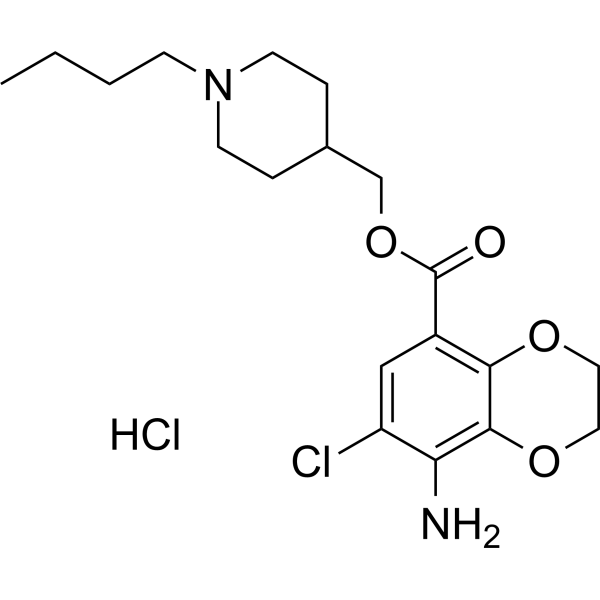
5-HT4 antagonist 3 hydrochloride is a highly selective 5-hydroxytryptamine receptor (5-HT4) antagonist. 5-HT4 antagonist 3 (hydrochloride) blocks muscarine receptors and sodium channels. 5-HT4 antagonist 3 (hydrochloride) can be used to evaluate function of 5-HT4 receptor .
loading...
    loading...
Cat. No.: HY-173131
Target:  

5-HT Receptor

Research Areas:  

Others

5-HT4R agonist-2 (Compound 4) is a selective 5-HT4R agonist with an EC50 value of 0.41 nM. 5-HT4R agonist-2 can significantly enhance whole gut and colonic transit, increase fecal output and water content, while maintaining minimal systemic absorption, and it shows promise for the research of chronic idiopathic constipation .
loading...
    loading...
Cat. No.: HY-W822786
CAS No.: 144625-67-2
Target:  

5-HT Receptor

Research Areas:  

Neurological Disease

GR125487 is a highly selective and potent 5-HT4 receptor (5-HT4 receptor) antagonist with a Kd value of 0.1 nM. GR125487 has an extremely low affinity for 5-HT3 receptors (Kd > 1 μM). GR125487 completely antagonizes the memory-promoting effect of BIMU1, and its administration alone has no significant effect on basic social memory. GR125487 can be used for the study of social olfactory memory .
loading...
    loading...
Cat. No.: HY-101342
CAS No.: 168986-61-6
Target:  

5-HT Receptor

Research Areas:  

Neurological Disease

RS 67506 hydrochloride is a 5-HT4 receptor agonist. The pKi value of RS 67506 hydrochloride for 5-HT4 in guinea pig striatum is 8.8. RS 67506 hydrochloride can be used in neuro-related research .
loading...
    loading...
Cat. No.: HY-15574R
CAS No.: 152811-62-6
Synonyms: SB-207266 (Standard)
Research Areas:  

Cardiovascular Disease

Piboserod (Standard) is the analytical standard of Piboserod. This product is intended for research and analytical applications. Piboserod is an orally available selective antagonist of the 5-HT4 receptor, with a Ki value of approximately 0.1 nM for human 5-HT4 receptors. Piboserod can competitively bind to the 5-HT4 receptor and block the activation of the 5-HT4 receptor. Piboserod can inhibit the enhancing effect of 5-HT on the nerve-mediated contraction response of the human bladder detrusor muscle. Piboserod is mainly used in the research of urinary system diseases (such as overactive bladder) and cardiovascular diseases (such as chronic heart failure) .
loading...
    loading...
Cat. No.: HY-14149R
CAS No.: 81098-60-4
Synonyms: R 51619 (Standard); (±)-Cisaprid (Standard)
Cisapride (R 51619) (Standard) is the analytical standard of Cisapride (HY-14149). This product is intended for research and analytical applications. Cisapride (R 51619) is an orally active, selective 5-HT4 receptor agonist with an EC50 of 140 nM. Cisapride also acts as an hERG potassium channel blocker with an IC50 of 9.4 nM. Cisapride exerts gastrointestinal prokinetic effects by activating 5-HT4 receptors, but it also blocks the hERG potassium channel responsible for the repolarization phase of cardiac action potentials, delaying repolarization and thus prolonging the action potential duration . Cisapride can be used in research related to gastrointestinal dysfunction, gastroesophageal reflux disease, functional dyspepsia, chronic gastritis, gastroparesis, ulcerative colitis and necrotizing enterocolitis .
loading...
    loading...
Cat. No.: HY-14149S
CAS No.: 2738376-71-9
Synonyms: R51619-d6; (±)-Cisaprid-d6
Cisapride-d6 (R51619-d6) is the deuterated-labeled Cisapride (HY-14149). Cisapride (R 51619) is an orally active, selective 5-HT4 receptor agonist with an EC50 of 140 nM. Cisapride also acts as an hERG potassium channel blocker with an IC50 of 9.4 nM. Cisapride exerts gastrointestinal prokinetic effects by activating 5-HT4 receptors, but it also blocks the hERG potassium channel responsible for the repolarization phase of cardiac action potentials, delaying repolarization and thus prolonging the action potential duration . Cisapride can be used in research related to gastrointestinal dysfunction, gastroesophageal reflux disease, functional dyspepsia, chronic gastritis, gastroparesis, ulcerative colitis and necrotizing enterocolitis .
loading...
    loading...
Cat. No.: HY-14152
CAS No.: 179474-80-7
Target:  

5-HT Receptor

Research Areas:  

Cancer

Prucalopride hydrochloride is an orally active, selective and specific 5-HT4 receptor agonist (high affinity), with pKis of 8.6 and 8.1 for human 5-HT4a/4b receptors, respectively. Prucalopride hydrochloride improves intestinal motility by promoting regeneration of the intestinal nervous system in rats. Prucalopride hydrochloride also shows anticancer activity by blocking of the PI3K/AKT/mTor signaling pathway. Prucalopride hydrochloride can be used in studies of chronic constipation, pseudo-intestinal obstruction and cancer .
loading...
    loading...
Cat. No.: HY-123747
CAS No.: 141196-99-8
Target:  

5-HT Receptor

Research Areas:  

Neurological Disease

SC-53116 is a selective 5-HT4 receptor agonist with EC50 at 23 nM .
loading...
    loading...
Cat. No.: HY-123747A
CAS No.: 879208-42-1
Target:  

5-HT Receptor

Research Areas:  

Neurological Disease

SC-53116 hydrochloride is a selective 5-HT4 receptor agonist with EC50 at 23 nM .
loading...
    loading...
Cat. No.: HY-W777120
CAS No.: 1285970-69-5
Synonyms: R 51619-13C,d3; (±)-Cisaprid-13C,d3
Cisapride- 13C,d3 (R 51619- 13C,d3) is the deuterated, 13C-labeled Cisapride (HY-14149). Cisapride (R 51619) is an orally active, selective 5-HT4 receptor agonist with an EC50 of 140 nM. Cisapride also acts as an hERG potassium channel blocker with an IC50 of 9.4 nM. Cisapride exerts gastrointestinal prokinetic effects by activating 5-HT4 receptors, but it also blocks the hERG potassium channel responsible for the repolarization phase of cardiac action potentials, delaying repolarization and thus prolonging the action potential duration . Cisapride can be used in research related to gastrointestinal dysfunction, gastroesophageal reflux disease, functional dyspepsia, chronic gastritis, gastroparesis, ulcerative colitis and necrotizing enterocolitis .
loading...
    loading...
Cat. No.: HY-19927A
CAS No.: 1645260-76-9
Target:  

5-HT Receptor

Research Areas:  

Neurological Disease Endocrinology

DA-6886 is a 5-Hydroxytryptamine receptor 4 (5-HT4) agonist. DA-6886 induces relaxation of the rat oesophagus preparation in a 5-HT4 receptor antagonist-sensitive manner. The evaluation of DA-6886 in CHO cells expressing hERG channels reveals that it inhibits hERG channel current with an pIC50 value of 4.3, indicating that the compound is 1000-fold more selective for the 5-HT4 receptor over hERG channels. DA-6886 can be used in the study of constipated irritable bowel syndrome .
loading...
    loading...

