




86 Results for "

Arg-Arg-Arg-Arg

" in MedChemExpress (MCE) Product Catalog:
Products (86)

86 Results for "Arg-Arg-Arg-Arg" in MCE Product Catalog:

Cat. No.: HY-P1586
CAS No.: 141237-50-5
Synonyms: HIV-1 rev Protein (34-50)
Target:  

HIV

Research Areas:  

Infection

HIV-1 Rev (34-50) is a 17-aa peptide derived from the Rev-responsive element (RRE)-binding domains of Rev in HIV-1, with anti-HIV-1 activity.
loading...
    loading...
Cat. No.: HY-P10360
CAS No.: 2816095-52-8
Target:  

α-synuclein

Research Areas:  

Neurological Disease

Tat-βsyn-degron is an α-synuclein knockdown peptide that effectively degrades α-synuclein protein via the proteasome pathway. Tat-βsyn-degron effectively reduces α-synuclein protein levels in primary rat cortical neuron cultures. In a Parkinson's mouse toxicity model, Tat-βsyn-degron can alleviate parkinsonian toxin-induced neuronal damage and movement disorders .
loading...
    loading...
Cat. No.: HY-P5754B
Target:  

Apoptosis

Research Areas:  

Neurological Disease

TAT-NEP1-40 acetate is a therapeutic candidate for axonal regeneration and functional recovery after stroke. TAT-NEP1-40 acetate can protect PC12 cells against oxygen and glucose deprivation (OGD) and promote neurite outgrowth. TAT-NEP1-40 acetate protects the brain against ischemia/reperfusion injury through inhibition of neuronal apoptosis. TAT-NEP1-40 acetate can be efficiently delivered into the rat brains .
loading...
    loading...
Cat. No.: HY-P11164
Research Areas:  

Endocrinology

PRKGGRRRRAWGRRRRRRRRRRRRRRAPRKRLTLA is a peptide. PRKGGRRRRAWGRRRRRRRRRRRRRRAPRKRLTLA has a higher affinity for CR3 and DNA binding domain than FOXO4 and DRI. PRKGGRRRRAWGRRRRRRRRRRRRRRAPRKRLTLA can be used in the research of aging .
loading...
    loading...
Cat. No.: HY-P0121A
Target:  

MDM-2/p53

Research Areas:  

Cancer

ReACp53 scrambled peptide is a negative control for ReACp53 (HY-P0121). ReACp53 scrambled peptide can be used in the study of ovarian cancer .
loading...
    loading...
Cat. No.: HY-P3193
Target:  

Inhibitory Antibodies

Research Areas:  

Others

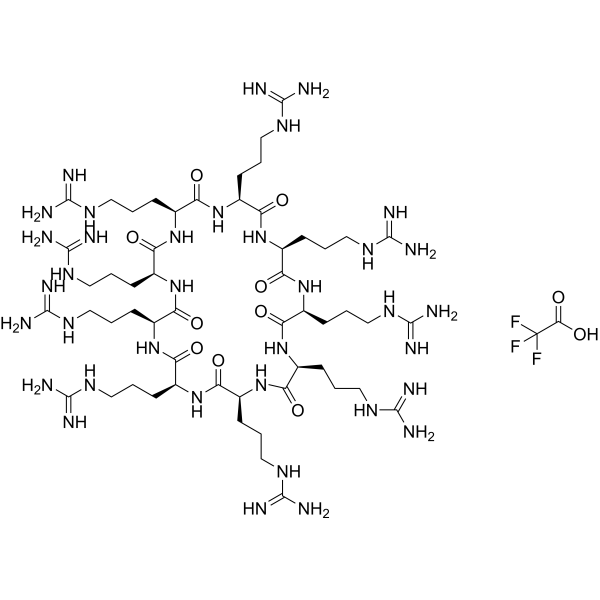
Cyclic nona-L-arginine TFA, a nonaarginine peptide used for drug delivery, translocates faster than their linear counterparts .
loading...
    loading...
Cat. No.: HY-P4099
Target:  

Inhibitory Antibodies

Research Areas:  

Others

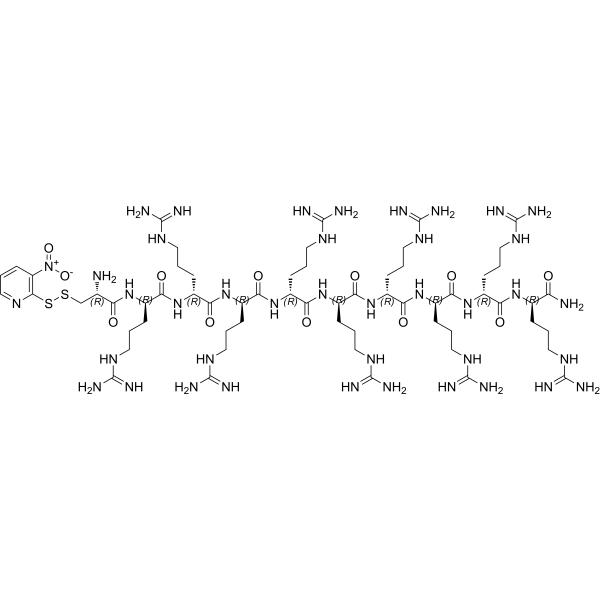
Cys(Npys)-(D-Arg)9 is an amphipathic R9 cell penetrating peptide (CPP). Cys(Npys)-(D-Arg)9 has cytotoxicity for microspore cells with the amount higher than 1 nmol .
loading...
    loading...
Cat. No.: HY-P10553A
Target:  

FOXM1 Apoptosis

Research Areas:  

Cancer

ARF(26-44), cell-permeable acetate is a cell-penetrating peptide derived from a specific amino acid sequence of the p14ARF tumor suppressor protein. As a functional inhibitor of FoxM1, ARF(26-44) cell-permeable acetate shows significant anti-tumor activity in the treatment of mouse hepatocellular carcinoma (HCC), significantly increasing tumor cell apoptosis and reducing tumor cell proliferation and angiogenesis. ARF(26-44), cell-permeable acetate can be used in research on tumor therapy .
loading...
    loading...
Cat. No.: HY-P5107A
Synonyms: LMWP acetate; TDSP5 acetate
Target:  

VEGFR

Research Areas:  

Cancer

Low molecular weight protamine acetate (LMWP acetate;TDSP5 acetate) is a truncated arginine-rich protamine peptide, which also acts as an antidote for heparin/low molecular weight heparin and a cell-penetrating delivery vector. Low molecular weight protamine acetate neutralizes heparin-induced anticoagulant activities, including aPTT, anti-Xa and anti-IIa activities. Low molecular weight protamine acetate translocates across mammalian cell membranes, delivers conjugated impermeable molecules through tumor tissues, enhances the skin permeability of conjugated epidermal growth factor, and accelerates wound healing when conjugated with epidermal growth factor. Low molecular weight protamine acetate retains the in vitro cell proliferation activity of conjugated EGF, and also enables site-specific conjugation with peptides or proteins via genetic recombination. Low molecular weight protamine acetate can be used in studies related to colon cancer, skin wounds and diabetic skin wounds .
loading...
    loading...
Cat. No.: HY-P11126
CAS No.: 1440511-91-0
Target:  

Bacterial

Research Areas:  

Infection

Mel4 is an antimicrobial peptide, exhibiting broad-spectrum antimicrobial activity. Mel4 can neutralize bacterial lipopolysaccharide in a dose-dependent manner. Mel4 can be used in the research and prevention of related bacterial infectious diseases (such as ocular infections) .
loading...
    loading...
Cat. No.: HY-P5552
CAS No.: 709611-59-6
Target:  

Bacterial Fungal

Research Areas:  

Infection

Melimine is an antimicrobial peptide with broad-spectrum antimicrobial activity against Gram-negative/Gram-positive bacteria, fungi and protozoa. Melimine neutralizes endotoxin activity by interacting with the phosphate groups of lipid A, depolarizes and permeabilizes the cytoplasmic membrane of *Pseudomonas aeruginosa*, and induces bacterial lysis. Melimine exerts additive antiviral effects against H1N1 and MHV-1 when used in combination with RK610. Melimine retains its antimicrobial activity when conjugated to polymer and titanium surfaces. Melimine can be used in infection-related research .
loading...
    loading...
Cat. No.: HY-P10600
CAS No.: 1105053-46-0
Target:  

Ras

Research Areas:  

Others

BIMAX2 is a high affinity nuclear localization signal (NLS) peptide. BIMAX2 can mimic the activity of the classical nuclear localization signal (cNLS) and competitively bind to importin α, thereby inhibiting the binding of cNLS-cargo proteins to importin α. BIMAX2 can be used to study the role of RBBP4 in regulating nuclear import efficiency and cell senescence .
loading...
    loading...
Cat. No.: HY-P10898
CAS No.: 2900996-95-2
Research Areas:  

Neurological Disease

GeX-2 is a truncated analogue of αO-conotoxin. GeX-2 activates GABAB receptor. GeX-2 inhibits α9α10 nAChR and CaV2.2 channels. GeX-2 alleviates pain in the rat model of chronic constriction injury .
loading...
    loading...
Cat. No.: HY-P10598
CAS No.: 1105053-45-9
Research Areas:  

Others

BIMAX1 is a tool peptide used in experiments to examine the interaction of RBBP4 with importin β1 and the effects on the nuclear import pathway. BIMAX1 can be used to study the role of RBBP4 in regulating nuclear import efficiency and cellular senescence .
loading...
    loading...
Cat. No.: HY-P5754
Target:  

Apoptosis

Research Areas:  

Neurological Disease

TAT-NEP1-40 is a BBB-penatrable peptide. TAT-NEP1-40 protects PC12 cells against oxygen and glucose deprivation (OGD), and promotes neurite outgrowth. TAT-NEP1-40 also improves ischemia-induced neurologic outcomes by inhibiting cell apoptosis in ischemic brains. TAT-NEP1-40 can be used for research of CNS injuries, such as axonal regeneration and functional recovery after stroke .
loading...
    loading...
Cat. No.: HY-187413A
Synonyms: DOPE-PEG2000-Mal-Cys-RRRRRRRR
Research Areas:  

Cancer

DOPE-PEG2000-R8 (DOPE-PEG2000-Mal-Cys-RRRRRRRR) is an amphiphilic lipid-PEG-peptide conjugate composed of DOPE (1,2-dioleoyl-sn-glycero-3-phosphoethanolamine), PEG2000, and the R8 peptide (octaarginine, Arg-Arg-Arg-Arg-Arg-Arg-Arg-Arg), a cell-penetrating peptide. DOPE-PEG2000-R8 is used for enhanced intracellular delivery of drugs, nucleic acids, and imaging agents.
loading...
    loading...
Cat. No.: HY-P4078
Target:  

Inhibitory Antibodies

Research Areas:  

Others

(Arg)9 biotin labeled is a cell-permeable peptide. (Arg)9 biotin labeled can be used for drug delivery. (Arg)9 biotin labeled can traverse the plasma membrane of eukaryotic cells .
loading...
    loading...
Cat. No.: HY-P11453
Research Areas:  

Cancer

R9H6 is a peptide containing nine arginine peptides and six histidine peptides. The LP(R9H6)m nanocomplex containing R9H6 exhibits high efficiency in mRNA delivery. R9H6 can be used in the research of anaplastic thyroid cancer .
loading...
    loading...
Cat. No.: HY-P2247
Target:  

JNK

Research Areas:  

Cancer

JTP10-△-R9 TFA is a selective JNK2 peptide inhibitor, with an IC50 of 89 nM, exhibiting 10-fold selectivity for JNK2 over JNK1 and JNK3 .
loading...
    loading...
Cat. No.: HY-P2483A
Target:  

Proteasome Bacterial

Research Areas:  

Infection Neurological Disease Cancer

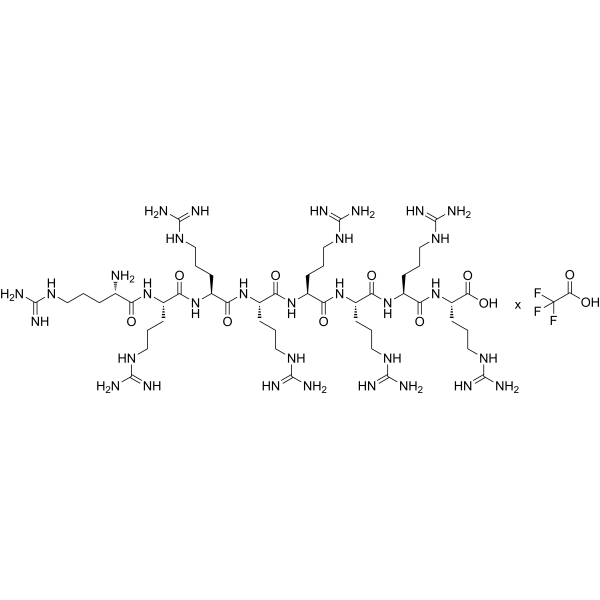
Octaarginine TFA is a cell-penetrating peptide and proteasome inhibitor. Octaarginine TFA exhibits mixed-type inhibition against 20S proteasome chymotrypsin-like, caspase-like, and trypsin-like activities, and inhibits 26S proteasome activity with decreased efficiency. Octaarginine TFA induces ubiquitin-conjugated protein accumulation, mediates HSPG-dependent cellular internalization via macropinocytosis, enhances liposomal cargo uptake and gene delivery. Octaarginine TFA can be used for the research of cervix carcinoma, collagen antibody-induced arthritis, and bacterial infections .
loading...
    loading...

