


86 Results for "

Arg-Arg-Arg-Arg

" in MedChemExpress (MCE) Product Catalog:
Products (86)

86 Results for "Arg-Arg-Arg-Arg" in MCE Product Catalog:

Cat. No.: HY-P10150
CAS No.: 749879-64-9
Target:  

Bacterial

Research Areas:  

Infection

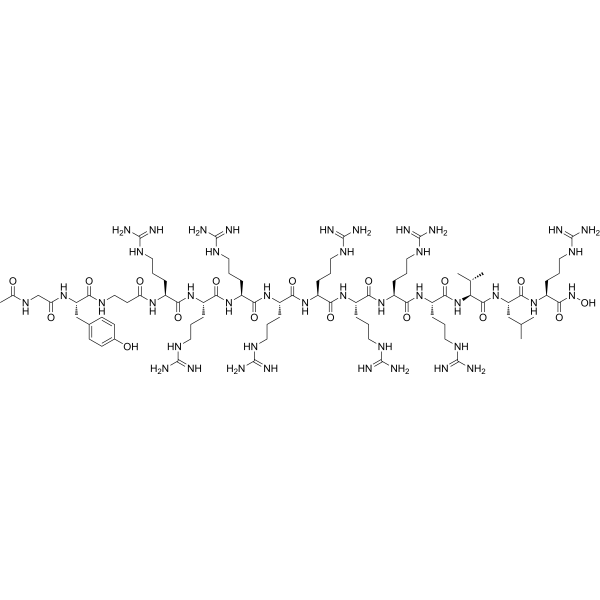
IN-2-LF is an inhibitor of lethal factor. IN-2-LF also inhibits furin with an IC50 of 2 μM. IN-2-LF enhances protection against anthrax lethal toxin when in combination with D6R .
loading...
    loading...
Cat. No.: HY-P10116
Synonyms: APTscr-9R
Target:  

STAT

Research Areas:  

Others

APTSTAT3-9R, scrambled (APTscr-9R) is a control peptide that forms a structure similar to that of APTSTAT3-9R (HY-P2282) but possesses a scrambled sequence in the target-binding region .
loading...
    loading...
Cat. No.: HY-P10028
CAS No.: 2388988-70-1
Target:  

Fluorescent Dye

Research Areas:  

Cancer

HCT116 is a peptidomimetic inhibitor of N-terminal methyltransferase 1/2 (NTMT1/2) with an IC50 of 54 nM. HCT116 can inhibit the N-terminal methylation level of NTMT1/2 substrates in HCT116 cells, and is used for the study of NTMT1/2 probes.
loading...
    loading...
Cat. No.: HY-P4869
Target:  

Ras

Research Areas:  

Others

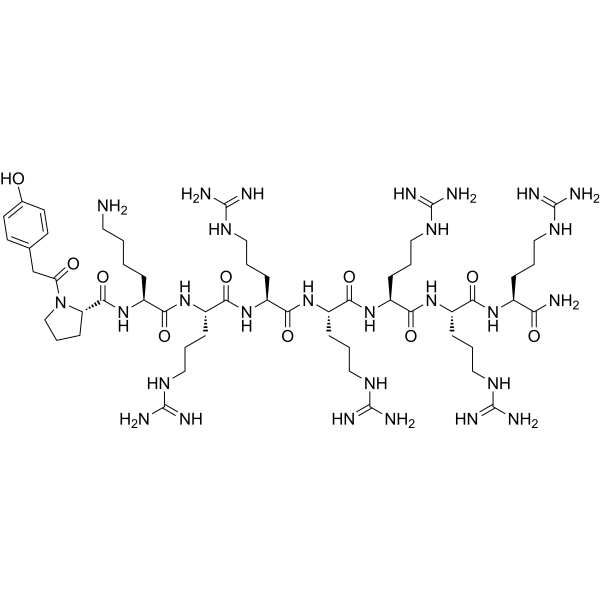
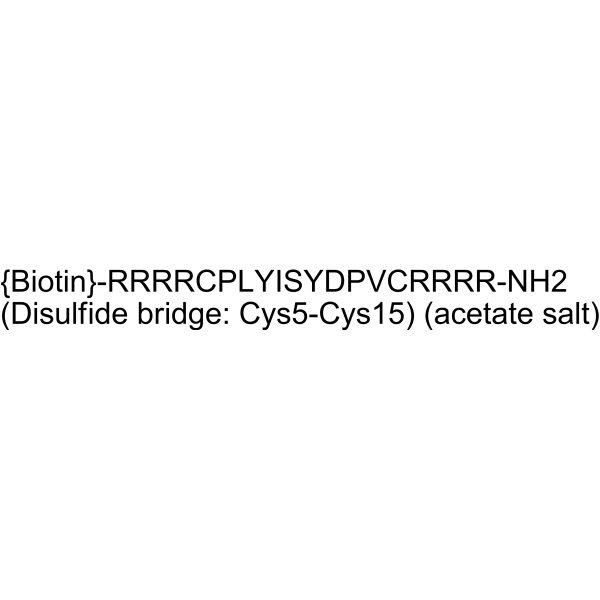
Biotin-KRpep-2d acetate is a biotin-labeled KRpep-2d (HY-P3277) .
loading...
    loading...
Cat. No.: HY-P1175A
Target:  

TRP Channel

Research Areas:  

Neurological Disease

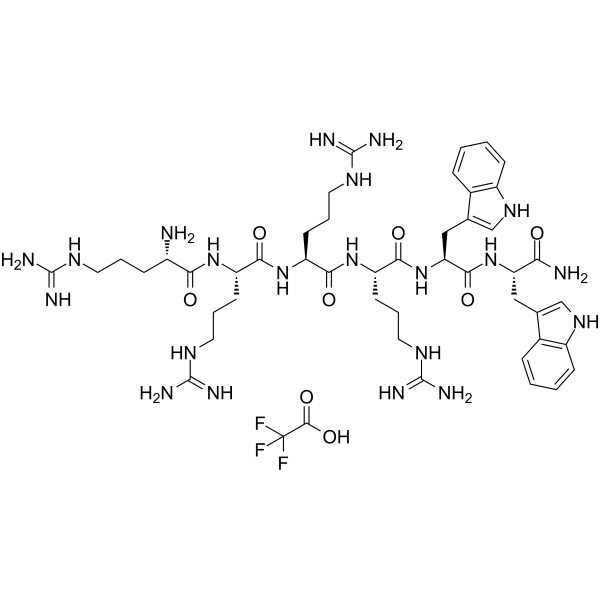
L-R4W2 TFA is a potent antagonist of vanilloid receptor 1 (VR1, TRPV1), with an IC50 of 0.1 μM. L-R4W2 TFA may act as a potent analgesic .
loading...
    loading...
Cat. No.: HY-P10669
CAS No.: 2999646-19-2
Target:  

Caspase Apoptosis

Research Areas:  

Cancer

NDI-Lyso is a lysosome-targeted anticancer agent that induces the formation of rigid long fibers in cancer cell lysosomes through an enzyme-instructed self-assembly (EISA) mechanism catalyzed by cathepsin B. This process triggers lysosomal swelling, membrane permeabilization (LMP), and membrane disruption, ultimately leading to cancer cell apoptosis via a non-classical caspase-independent pathway. NDI-Lyso exhibits significant selective anticancer activity in various cancer cell lines and drug-resistant cancer cells (IC50 ~10 μM) while showing low toxicity to normal cells (IC50 > 60 μM) .
loading...
    loading...
Cat. No.: HY-P6443
Target:  

Inhibitory Antibodies

Research Areas:  

Others

NTPA TFA is a polycarboxylic acid ligand that participates in the coordination reaction with metal ions to form complexes .
loading...
    loading...
Cat. No.: HY-P10843
Target:  

Estrogen Receptor/ERR

Research Areas:  

Cancer

R4K1 is a cell-permeable stapled peptide. R4K1 binds to the estrogen receptor (ER) α with high affinity and inhibits its interaction with coactivators. R4K1 can enter breast cancer cells to regulate gene transcription and inhibit cell proliferation. R4K1 can be used in the study of cancer .
loading...
    loading...
Cat. No.: HY-P10401
TAT-GluR6-9c is a GluR6-PSD95 interaction blocker. By regulating the GluR6 mediated signaling pathway, TAT-GluR6-9c inhibits the activation of JNK and phosphorylation of c-Jun, reduces the expression of Fas L and thus reduces the occurrence of apoptosis. TAT-GluR6-9c can be used to study cerebral ischemia and neuroprotective strategies .
loading...
    loading...
Cat. No.: HY-P10445
CAS No.: 3036046-03-1
Research Areas:  

Cancer

TAT-PiET is a cell-penetrating peptide targeting the extra-terminal (ET) domain of BRD4. TAT-PiET can reduce BRD4 and JMJD6 levels and inhibit cell proliferation. TAT-PiET also resists the endocrine resistance of ERα-positive breast cancer cells. TAT-PiET can be used for the research of cancer, such as breast cancer .
loading...
    loading...
Cat. No.: HY-P10048
CAS No.: 1623722-15-5
Target:  

JNK

Research Areas:  

Inflammation/Immunology

TAT-JIP inhibits the phosphorylation of endogenous c-jun activated by PHA–PMA .
loading...
    loading...
Cat. No.: HY-P10819
Research Areas:  

Cancer

S9-CMC1 TFA is a covalent peptide lysine-specific demethylase 1 (LSD1) inhibitor with an IC50 value of 2.53 μM. S9-CMC1 TFA specifically recognizes Cys360 in the enzyme-active region. S9-CMC1 TFA inhibits LSD1 activity, increasing H3K4me1 and H3K4me2 levels, leading to G1 cell cycle arrest and apoptosis and inhibiting cell proliferation. S9-CMC1 TFA significantly inhibits tumor growth in A549 xenograft animal models .
loading...
    loading...
Cat. No.: HY-P5754A
Target:  

Apoptosis

Research Areas:  

Neurological Disease

TAT-NEP1-40 TFA is a BBB-penatrable peptide. TAT-NEP1-40 TFA protects PC12 cells against oxygen and glucose deprivation (OGD), and promotes neurite outgrowth. TAT-NEP1-40 TFA also improves ischemia-induced neurologic outcomes by inhibiting cell apoptosis in ischemic brains. TAT-NEP1-40 TFA can be used for research of CNS injuries, such as axonal regeneration and functional recovery after stroke .
loading...
    loading...
Cat. No.: HY-P11671
CAS No.: 3062244-70-3
Target:  

Inhibitory Antibodies

Research Areas:  

Neurological Disease

Xaranetide is a polypeptide with neuroprotective effects .
loading...
    loading...
Cat. No.: HY-P11631
CAS No.: 105151-62-0
Target:  

Ligands for E3 Ligase

Research Areas:  

Cancer

Arg12, a 12-amino acid peptide sequence, is an E3 ubiquitin ligase ligand. Arg12 can be used to synthesize PROTACs, such as PROTAC PLK1 Degrader-2 (HY-180989). Arg12 can also act as a cell transmembrane peptide (CPP), facilitating the entire molecule to enter the cell .
loading...
    loading...
Cat. No.: HY-180991
Research Areas:  

Cancer

Arg12-AHX is a synthetic E3 ligase-ligand conjugate that can be used for the synthesis of PROTACs, such as PROTAC PLK1 Degrader-2 (HY-180989). PROTAC PLK1 Degrader-2 is a PLK1 PROTAC degrader with anti-tumor activity .
loading...
    loading...
Cat. No.: HY-180989
PROTAC PLK1 Degrader-2 is a peptide-based N-end rule PLK1 mini-PROTAC. PROTAC PLK1 Degrader-2 utilizes Arg12 as dual-function cell-permeable N-degron to recruit UBR1/UBR2 E3 ligases, mediates PLK1 ubiquitination and proteasome-dependent degradation. PROTAC PLK1 Degrader-2 suppresses cervical cancer cell proliferation, induces G2/M cell cycle arrest and tumor cell apoptosis, and exerts potent in vivo anti-tumor efficacy in mice and can be applied to research on PLK1-driven cervical carcinoma (PLK1 ligand: POI ligand-3 (HY-180990); E3 ligase ligand: Arg12 (HY-P11631); PROTAC linker: 6-Aminocaproic acid (HY-B0236)) .
loading...
    loading...
Cat. No.: HY-P4083A
Target:  

Fluorescent Dye

Research Areas:  

Others

(Arg)9,TAMRA-labeled acetate is a TAMRA-labeled, membrane-permeable cationic cell-penetrating polyarginine peptide. (Arg)9,TAMRA-labeled acetate acts as a cell-penetrating peptide for drug delivery .
loading...
    loading...
Cat. No.: HY-183488
CAS No.: 1207092-73-6
Synonyms: RRRRRRRRRCCLGIPEQEY
Target:  

Apoptosis PARP

Research Areas:  

Cancer

R9-caPep (RRRRRRRRRCCLGIPEQEY) is a cell-penetrating peptide derived from proliferating cell nuclear antigen (PCNA). R9-caPep selectively blocks the interactions between PCNA and FEN1, as well as between PCNA and LIGI, while preserving the binding of POLD3 to PCNA. R9-caPep interferes with DNA synthesis and homologous recombination-mediated double-strand DNA break repair, inducing S-phase arrest, DNA damage accumulation, and apoptosis. R9-caPep inhibits the growth of tumor volume and weight of neuroblastoma in nude mice . R9-caPep can be used in research related to neuroblastoma and triple-negative breast cancer .
loading...
    loading...
Cat. No.: HY-P11218
Target:  

Inhibitory Antibodies

Research Areas:  

Cancer

Lipo-PtIV-R8K is a nuclear targeting peptide containing R8K. Lipo-PtIV-R8K is a lipid PtIV prodrug amphiphilic molecule that can self assemble to form nanoparticles. Lipo-PtIV-R8K can be used in the research of cancer such as breast cancer .
loading...
    loading...

