


59 Results for "

complement activation

" in MedChemExpress (MCE) Product Catalog:
Products (59)

59 Results for "complement activation" in MCE Product Catalog:

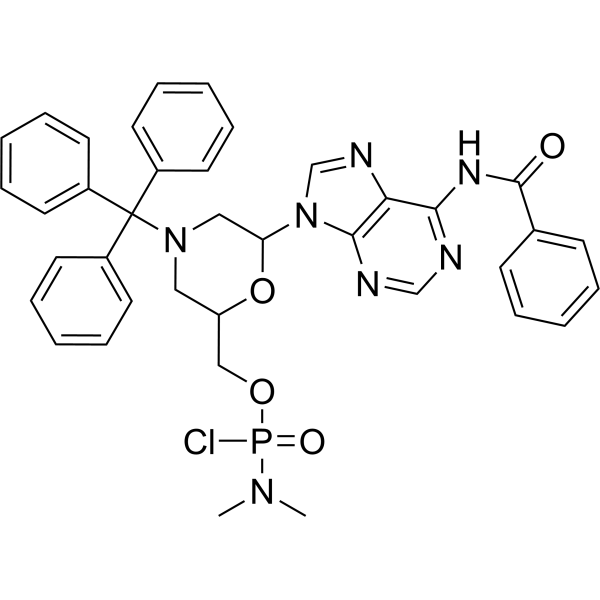
Cat. No.: HY-153403
CAS No.: 956139-18-7
Research Areas:  

Others

Activated A Subunit can be used in the synthesis of exon jumping oligomer conjugates. The oligomer conjugates complement selected target sites in the human anti-muscular atrophy protein gene and induce exon 51 jumping. It can be used for research of muscular dystrophy .
loading...
    loading...
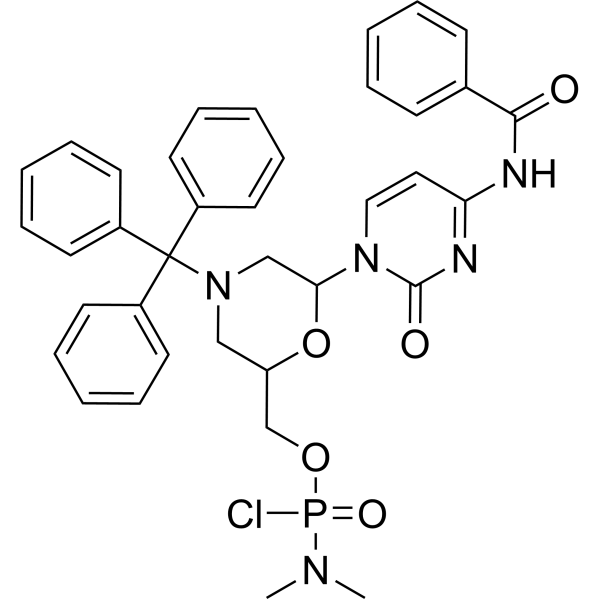
Cat. No.: HY-153404
CAS No.: 956139-21-2
Target:  

DNA/RNA Synthesis

Research Areas:  

Others

Activated C Subunit can be used in the synthesis of exon jumping oligomer conjugates. The oligomer conjugates complement selected target sites in the human anti-muscular atrophy protein gene and induce exon 51 jumping. It can be used for research of muscular dystrophy .
loading...
    loading...
Cat. No.: HY-153785
Purity:  92.50%
Target:  

Complement System

Research Areas:  

Inflammation/Immunology

NH2-C6-ARC186 sodium is a modified ARC186 (HY-153098) with NH2-C6 that can be coupled to other peptides or molecules. ARC186 is a aptamer and a highly potent complement inhibitor that function by blocking the convertase-catalyzed activation of C5 .
loading...
    loading...
Cat. No.: HY-P990753
CAS No.: 2763342-87-4
Synonyms: CAN-106

Target:  

Complement System

Research Areas:  

Inflammation/Immunology

Omoprubart is an anti-C5 complement recombinant humanized monoclonal antibody. Omolubat can prevent C5 from cleaving into C5a and C5b, thereby inhibiting the formation and activation of the C5b-dependent membrane attack complex (MAC) on the surface of susceptible cells, leading to cell lysis (destruction). Omoprubart can be used for the study of paroxysmal nocturnal hemoglobinuria (PNH).
loading...
    loading...
Cat. No.: HY-P990076
CAS No.: 2131168-99-3
Synonyms: APN-301; hu14.18-IL2; EMD 273063

Target:  

Inhibitory Antibodies

Research Areas:  

Cancer

Lorukafusp alfa (14.18 mAb; hu14.18-IL2) is an immunocytokine consisting of the humanized 14.18 anti-GD2 mAb linked to IL210. Lorukafusp alfa has activity mediated by activation of antibody-dependent cellular cytotoxicity (ADCC) and complement-dependent cytotoxicity via the binding of hu14.18-IL2 to GD2 on the tumor cell surface, followed by binding to Fc receptors on effector cells along with activation of NK and T cells via IL2 receptor binding. Lorukafusp alfa has anti-tumor activity .
loading...
    loading...
Cat. No.: HY-P990955
CAS No.: 2839652-75-2
Synonyms: ADX-097

Target:  

CD3 Complement System

Research Areas:  

Inflammation/Immunology

Ebribafusp alfa (ADX-097) comprising a humanized anti-C3d monoclonal antibody linked to two moieties of the first five consensus repeats of factor H (fH1-5). Ebribafusp alfa binds C3d and related fragments, catalyzes AP convertase dissociation, acts as a factor I co-factor for C3b cleavage, and delivers fH1-5 moieties to C3d-deposited tissues for local complement inhibition without systemic blockade. Ebribafusp alfa reduces glomerular C3 deposition, proteinuria, urine albumin-creatinine ratios, and urine soluble C5b-9 levels, preserves podocyte foot-process architecture, inhibits skin complement activation, and localizes to UVB-damaged primate skin. Ebribafusp alfa can be used for the research of membranous nephropathy, bullous pemphigoid, discoid lupus erythematosus, C3 glomerulopathy, IgA nephropathy, and lupus nephritis .
loading...
    loading...
Cat. No.: HY-P990954
CAS No.: 2850355-94-9
Synonyms: IMM-0306
Target:  

CD47 CD20

Research Areas:  

Cancer

Amulirafusp alfa (IMM-0306) is a fusion protein of CD20 monoclonal antibody (mAb) with the CD47 binding domain of SIRPα, with human CD20 Kd 2.45 nM and human CD47 Kd 4.91 nM. Amulirafusp alfa binds to CD20 and CD47 on B cells, engages FcɣR, blocks CD47-SIRPα interaction, activates macrophages, NK cells, and complement cascade, mediates phagocytosis and cytotoxicity, inhibits apoptosis of Jurkat-CSR cells, reverses IL-16 tumor-promoting effects, and binds human/cynomolgus CD47 but not mouse/rat CD47. Amulirafusp alfa can be used for the research of hematological malignancies, relapsed or refractory CD20-positive B-cell non-Hodgkin’s lymphoma, relapsed or refractory B-cell non-Hodgkin lymphoma, and activated B-cell-like diffuse large B-cell lymphoma .
loading...
    loading...
Cat. No.: HY-P992456
Target:  

Complement System

SAR-443809 is a monoclonal antibody targeting complement factor Bb that inhibits the alternative complement pathway. SAR-443809 blocks the cleavage of C3 and factor B via selective binding to the activated form factor Bb, with a KD of 7.3 nM for human factor Bb. SAR-443809 inhibits the amplification loop of the alternative complement pathway and C3 activation, reduces C3b deposition, and blocks the activation of pathways associated with intravascular and extravascular hemolysis. SAR-443809 can be used for research on hematological and renal disorders mediated by abnormal alternative complement pathway activity .
loading...
    loading...
Cat. No.: HY-184031
CAS No.: 133-65-3
Synonyms: Solapsone; Sulfetrone
Research Areas:  

Cancer

Solasulfone (Solapsone; Sulfetrone) is an inhibitor of complement protein C1q and β-lactamase. Solasulfone also acts as a chemotherapeutic agent and can be used in cancer research .
loading...
    loading...
Cat. No.: HY-P991954

Target:  

Complement System Syk

Research Areas:  

Inflammation/Immunology Cancer

GT103 is a human-derived monoclonal antibody targeting complement factor H (CFH). GT103 binds to a conformationally distinct epitope of CFH on tumor cells. GT103 activates the classical complement pathway, induces complement-dependent cytotoxicity, and triggers antibody-dependent cellular phagocytosis (ADCP) of tumor cells. GT103 increases calreticulin translocation to tumor cell plasma membranes. GT103 mediates B-cell activation via Syk kinase phosphorylation. GT103 inhibits tumor growth and metastasis in animal models. GT103 can be used for the research of non-small cell lung cancer .
loading...
    loading...
Cat. No.: HY-153406A
CAS No.: 1155373-34-4
Research Areas:  

Others

(rac)-Activated T subunit is the racemate of Activated T Subunit (HY-153406). Activated T Subunit can be used in the synthesis of exon jumping oligomer conjugates. The oligomer conjugates complement selected target sites in the human anti-muscular atrophy protein gene and induce exon 51 jumping. (rac)-Activated T subunit can be used for research of muscular dystrophy .
loading...
    loading...
Cat. No.: HY-P992463

Target:  

Ser/Thr Protease

Research Areas:  

Endocrinology

SHR-2010 is a fully humanized monoclonal antibody targeting MASP-2. SHR-2010 selectively inhibits lectin pathway activation without affecting classical or alternative complement pathways. SHR-2010 can be used for the research of IgA nephropathy .
loading...
    loading...
Cat. No.: HY-P992512
Target:  

Complement System

Research Areas:  

Neurological Disease

ANX-M1 Mouse IgG1 is a brain-penetrant C1q inhibitor. ANX-M1 Mouse IgG1 blocks classical complement pathway activation, reduces C1q concentrations in brain and plasma, and inhibits microglia-mediated synapse engulfment. ANX-M1 Mouse IgG1 can be used for the research of Huntington's disease, Alzheimer's disease, retinopathy and neuropathic pain .
loading...
    loading...
Cat. No.: HY-P992142
CAS No.: 3050549-24-8
Synonyms: ANX-007

Target:  

Complement System

Vonaprument (ANX-007) is an intravitreally injected C1q antibody fragment (with a molecular weight of approximately 48 kDa) and a human monoclonal antibody. Vonaprument inhibits the activation of the classical complement cascade by specifically recognizing the globular head of C1q and blocking substrate binding. After intravitreal injection, Vonaprument distributes to the retina, choroid and optic nerve, and achieves complete C1q target binding in the aqueous humor and retinal tissues. Vonaprument can be used in research related to neurodegenerative eye diseases such as age-related macular degeneration and glaucoma .
loading...
    loading...
Cat. No.: HY-P992361

Research Areas:  

Cancer

HB0030 is a TIGIT inhibitor with antibody-dependent cellular cytotoxicity (ADCC) and complement-dependent cytotoxicity (CDC) activities. HB0030 enhances the expression of activation markers in natural killer (NK) cells, promotes the killing of regulatory T cells (Tregs), and reduces the proportion of FoxP3 + Treg in tumor-infiltrating lymphocytes. The combination of HB0030 with the anti-PD-L1/VEGF bispecific antibody HB0025 further enhances tumor suppression efficacy. HB0030 can be used in studies related to colorectal cancer, pancreatic adenocarcinoma, hepatocellular carcinoma, bladder cancer, breast cancer, non-small cell lung cancer, and advanced solid tumors .
loading...
    loading...
Cat. No.: HY-P992291

Target:  

Apoptosis

Research Areas:  

Cancer

Anti-PL2L60 Antibody (KAO3) is a PL2L60-targeting antibody. Anti-PL2L60 Antibody (KAO3) binds to PL2L60 expressed on tumor cell surfaces, blocking its tumor-promoting functions. Anti-PL2L60 Antibody (KAO3) arrests tumor cell cycle and induces cancer cell apoptosis. Anti-PL2L60 Antibody (KAO3) activates complement to mediate tumor cell lysis. Anti-PL2L60 Antibody (KAO3) can be used for the research of lymphoma, breast cancer, lung cancer, cervical cancer, colon cancer, and melanoma[1].
loading...
    loading...
Cat. No.: HY-P1345C
[DArg10, Aib20] TLQP-21 is a functional antagonist of the complement 3a receptor (C3aR), with EC50 values of 854 nM, 1007 nM, and 1715 nM against human C3aR. [DArg10, Aib20] TLQP-21 recruits β-arrestin, activates Gi3, mediates β-arrestin-dependent receptor internalization, and does not induce calcium influx. [DArg10, Aib20] TLQP-21 inhibits the adrenergic‑induced lipolysis enhancement mediated by TLQP-21 (HY-P1345) and also inhibits the β-hexosaminidase secretion induced by C3a63-77. [DArg10, Aib20] TLQP-21 can be used in research related to asthma and inflammatory diseases .
loading...
    loading...
Cat. No.: HY-P10868A
Synonyms: RLS-0071 TFA
Pegtarazimod TFA (RLS-0071 TFA) is a dual-target anti-inflammatory peptide that exerts its effects by simultaneously regulating the complement system and neutrophil-associated inflammatory pathways. Pegtarazimod TFA reduces ROS production both in vitro and in vivo, and decreases the level of neutrophil elastase, a marker of neutrophil extracellular traps (NETs), in vivo, thereby alleviating inflammatory responses. Pegtarazimod TFA significantly improves the survival rate of mice in multiple in vivo models of acute graft-versus-host disease (aGVHD). Pegtarazimod TFA inhibits the activation of the C1 complex, reduces the herpes zoster-like spread of herpes simplex virus type 1 skin infection, and improves the survival rate of infected mice . Pegtarazimod TFA can be used in research related to acute graft-versus-host disease, acute pulmonary diseases, and skin herpes simplex virus type 1 infection .
loading...
    loading...
Cat. No.: HY-L036P
6,121 compounds

Small molecule covalent inhibitors, or irreversible inhibitors, are a type of inhibitors that exert their biological functions by irreversibly binding to target through covalent bonds. Compared with non-covalent inhibitors, covalent inhibitors have obvious advantages in bioactivity, such that covalent warheads can target rare residues of a particular target protein, thus leading to the development of highly selective inhibitors and achieving a more complete and continued target occupancy in living systems. In recent years, the distinct strengths of covalent inhibitors in overcoming drug resistance had been recognized. However, toxicity can be a real challenge related to this class of therapeutics due to their potential for off-target reactivity and has led to these drugs being disfavored as a drug class. The drug design and optimization of covalent inhibitors has become a hot spot in drug discovery.

MCE covalent inhibitor library contains 6,121 small molecules including identified covalent inhibitors and other molecules having common covalent reactive groups as warheads, such as acrylamides, activated terminal acetylenes, sulfonyl fluorides/esters, cloracetamides, alkyl halides, epoxides, aziridines, disulfides, etc.

MCE Covalent inhibitor Library plus, with more powerful screening capability, further complement Covalent inhibitor Library (HY-L036) by adding some fragment compounds with covalent warheads.

