
135 Results for "

Quorum-sensing

" in MedChemExpress (MCE) Product Catalog:
Products (135)

135 Results for "Quorum-sensing" in MCE Product Catalog:

Cat. No.: HY-124237
CAS No.: 106983-30-6
Purity:  99.17%
Target:  

Bacterial

Research Areas:  

Others

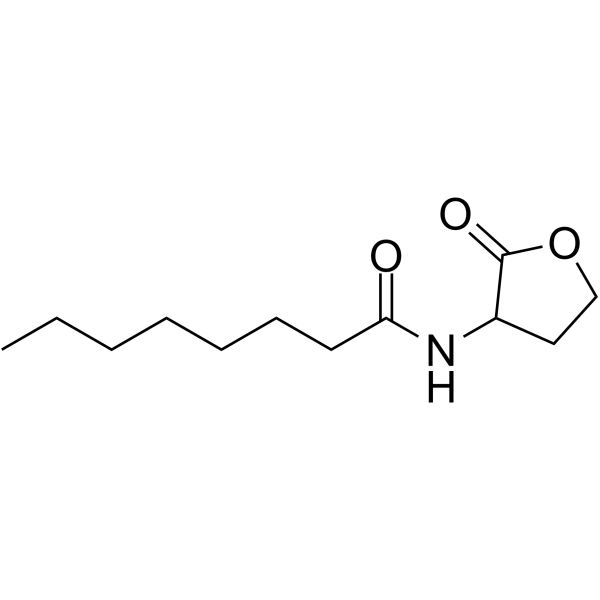
N-Octanoyl-DL-homoserine lactone is a member of N-acyl homoserine lactones (AHLs) family, also one of the signal molecule of quorum-sensing (QS) signals. N-Octanoyl-DL-homoserine lactone can regulate the production of siderophores and present positive correlation in Aeromonas sobria strain AS7. N-Octanoyl-DL-homoserine lactone can also regulate the secretion of proteases and stimulate the production of total volatile basic nitrogen (TVB-N) .
loading...
    loading...
Cat. No.: HY-163838
Target:  

Bacterial

Research Areas:  

Infection

Quorum sensing-IN-6 (compound 27) is a quorum sensing (QS) inhibitor with IC50 values of 8 and 106 nM for E.coli and Pyocyanin, respectively .
loading...
    loading...
Cat. No.: HY-133685R
CAS No.: 147852-83-3
Synonyms: C6-HSL (Standard)
Research Areas:  

Infection Metabolic Disease

N-Hexanoyl-L-homoserine lactone (Standard) is the analytical standard of N-Hexanoyl-L-homoserine lactone (HY-133685). This product is intended for research and analytical applications. N-Hexanoyl-L-homoserine lactone is a short-chained N-acyl homoserine lactone (AHL). N-hexanoyl-L-homoserine lactone is also a mediator of bacterial quorum-sensing regulation. N-hexanoyl-L-homoserine lactone promotes lipid accumulation in algae. AHL is an intercellular communication signal molecule in the quorum sensing system of Gram-negative bacteria and a medium for mediating information exchange between eukaryotic plants and prokaryotic bacteria. AHL can affect bacteria activities, such as biofilm formation, pigment synthesis, and antibiotic synthesis.
loading...
    loading...
Cat. No.: HY-162624
Target:  

Bacterial

Research Areas:  

Infection

Quorum sensing-IN-5 is a RpfF-targeted quorum-sensing inhibitor. Quorum sensing-IN-5 inhibits Xanthomonas oryzae pv oryzae (Xoo) and Xanthomonas axonopodis pv. citri (Xac) with EC50 values of 9.91 μg/mL and 7.04 μg/mL. Quorum sensing-IN-5 has antimicrobial activity .
loading...
    loading...
Cat. No.: HY-W127393
CAS No.: 177158-21-3
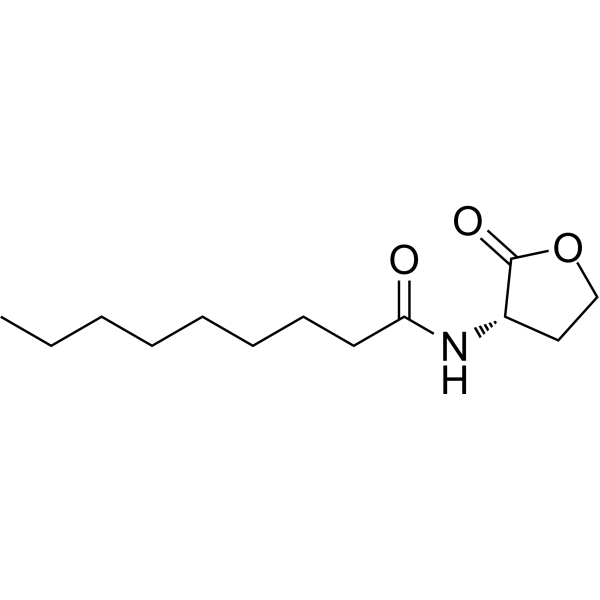
Quorum sensing is a regulatory system used by bacteria to control gene expression in response to increased cell density. This regulatory process manifests itself in a variety of phenotypes, including biofilm formation and virulence factor production. Coordinated gene expression is achieved through the production, release and detection of small diffusible signaling molecules called autoinducers. N-acylated homoserine lactones (AHLs) comprise a class of such autoinducers, each of which generally consists of a fatty acid coupled to a homoserine lactone (HSL). Modulation of bacterial quorum-sensing signaling systems to suppress pathogenesis represents a new approach to antimicrobial research for infectious diseases. AHLs differ in acyl length (C4-C18), C3 substitution (hydrogen, hydroxyl, or oxo group), and the presence or absence of one or more carbon-carbon double bonds in the fatty acid chain. These differences confer signaling specificity through the affinity of the LuxR family of transcriptional regulators. C9-HSL is a rare odd-numbered acyl carbon chain produced by wild-type Erwinia carotovora strain SCC 3193 grown in nutrient-rich Luria-Bertani broth (LB) medium.
loading...
    loading...
Cat. No.: HY-W012572A
CAS No.: 328526-86-9
D-Histidine hydrochloride hydrate is an anti-biofilm agent that targets bacterial quorum sensing systems (such as RhlI/RhlR pathway) and has antibacterial activity. D-Histidine hydrochloride hydrate works by non-covalently binding to bacterial regulatory factors or copper ion complexes, selectively inhibiting bacterial biofilm formation and motility. D-Histidine hydrochloride hydrate downregulates quorum sensing-related gene expression, reduces the synthesis of virulence factors (such as alginate and proteases), and interferes with bacterial membrane stability, inhibiting biofilm formation, promoting the disintegration of mature biofilms, and enhancing antibiotic sensitivity. D-Histidine hydrochloride hydrate is also an efficient catalyst for the salt-induced peptide formation (SIPF) reaction, which promotes the condensation of amino acids to form dipeptides (such as dialanine and dilysine) by forming a complex with copper ions (Cu 2+) .
loading...
    loading...
Cat. No.: HY-141641
CAS No.: 148433-21-0
Synonyms: HSL
Target:  

Bacterial

Research Areas:  

Infection

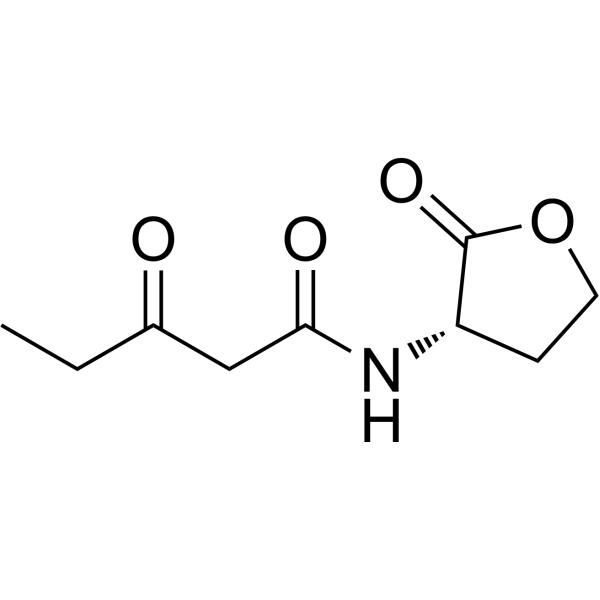
N-(3-Oxopentanoyl)-L-homoserine lactone is an autoinducer, a kind of chemical signal molecule which passively diffuses across the bacterial envelope and accumulates intracellularly at high bacterial densities. It may bind to a protein related to the LuxR protein of V. fischeri and causes cell density-dependent gene expression. N-(3-Oxopentanoyl)-L-homoserine can be used for research of quorum sensing .
loading...
    loading...
Cat. No.: HY-139902
CAS No.: 2762184-06-3
Target:  

Others

Research Areas:  

Others

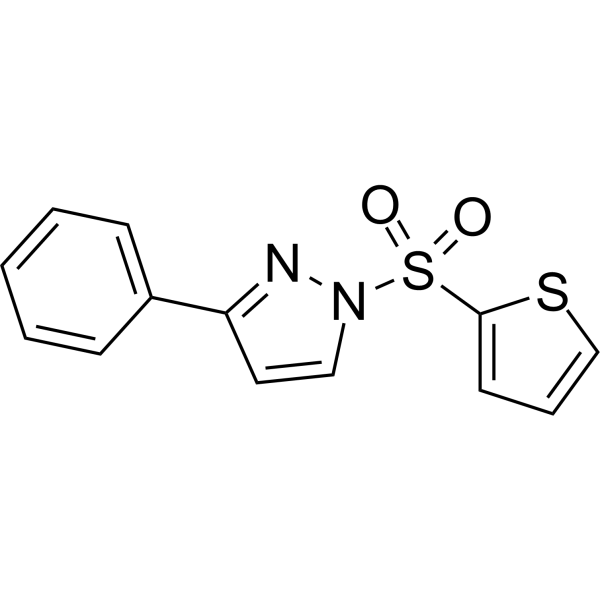
Quorum sensing-IN-1 is a small-molecule quorum sensing inhibitor.
loading...
    loading...
Cat. No.: HY-P1892
CAS No.: 1235882-91-3
Target:  

Inhibitory Antibodies

Research Areas:  

Infection

Competence-Stimulating Peptide-12261, a sixteen peptide, is a fragment of competence-stimulating peptide. Competence-Stimulating Peptide, a quorum-sensing molecule, competence-stimulating peptide (CSP) which inhibits germ tube (GT) formation .
loading...
    loading...
Cat. No.: HY-149479
CAS No.: 5005-14-1
Target:  

Bacterial

Research Areas:  

Infection

Quorum sensing-IN-3 (Compound 3a) is a quorum sensing inhibitor against pseudomonas aeruginosa. Quorum sensing-IN-3 inhibits biofilm formation .
loading...
    loading...
Cat. No.: HY-N12660
Quorum sensing-IN-4 (compound 2) is a quorum sensing inhibitor, and can be isolated from Thailand mangrove-derived Streptomyces strain, OUCMDZ-5511 .
loading...
    loading...
Cat. No.: HY-168948
CAS No.: 3063543-24-5
Target:  

Bacterial

Research Areas:  

Infection

Quorum sensing-IN-9 (Compound 7d) inhibits quorum sensing in Pseudomonas aeruginosa by binding PqsR proteins. Quorum sensing-IN-9 inhibits the expression of quorum sensing systems related genes lasB, rhlA and pqsA, blocks the generation of virulence factors elastase, pyocyanin and rhamnolipid. Quorum sensing-IN-9 destorys the motility of P. aeruginosa, inhibits the biofilm formation, decreasing the virulence and pathogenicity of P. aeruginosa. Quorum sensing-IN-9 exhibits anti-infectious activity in Galleria mellonella larval model .
loading...
    loading...
Cat. No.: HY-W040271
CAS No.: 929222-14-0
Target:  

Bacterial Antibiotic

Research Areas:  

Infection

N-3-Hydroxydecanoyl-DL-Homoserine lactone is a bacterial quorum-sensing molecule. N-3-Hydroxydecanoyl-DL-Homoserine lactone activates the transcription factor SdiA (EC50 = 0.6 µM), which detects N-acyl homoserine lactones (AHLs), and exerts its effect in Salmonella enterica (S. enterica) 1 2.
loading...
    loading...
Cat. No.: HY-159170
Target:  

Bacterial

Research Areas:  

Infection

Quorum sensing-IN-7 (compound HSL 4) is a potent quorum sensing (QS) inhibitor. Quorum sensing-IN-7 interacts with Leu 72 and Gln 95 in the CviR binding pocket. Quorum sensing-IN-7, an antibacterial agent, is highly effective at inhibiting the production of homoserine lactones (HSLs) and biofilm in C. violaceum at 0.25-1 mg/mL .
loading...
    loading...
Cat. No.: HY-149881
CAS No.: 2925926-80-1
Target:  

Bacterial

Research Areas:  

Infection

Quorum sensing-IN-2 (compound 23e) is a quorum sensing inhibitor, which can reduce the pathogenicity of bacteria without affecting bacterial growth. Quorum sensing-IN-2 inhibits bacterial infections with little hemolytic activity. Quorum sensing-IN-2 shows synergistic effect with Ciprofloxacin (HY-B0356) in the bacteremia model infected with P. aeruginosa PAO1 .
loading...
    loading...
Cat. No.: HY-W337680
CAS No.: 192883-12-8
Target:  

Bacterial

Research Areas:  

Infection

N-3-Hydroxydecanoyl-L-homoserine lactone is a type of N-acyl-L-homoserine lactone (AHL), which is a class of signaling molecules in bacterial quorum sensing systems, and it has a weak activating effect on AbaR .
loading...
    loading...
Cat. No.: HY-115393A
CAS No.: 177158-20-2
Target:  

Bacterial

Research Areas:  

Infection

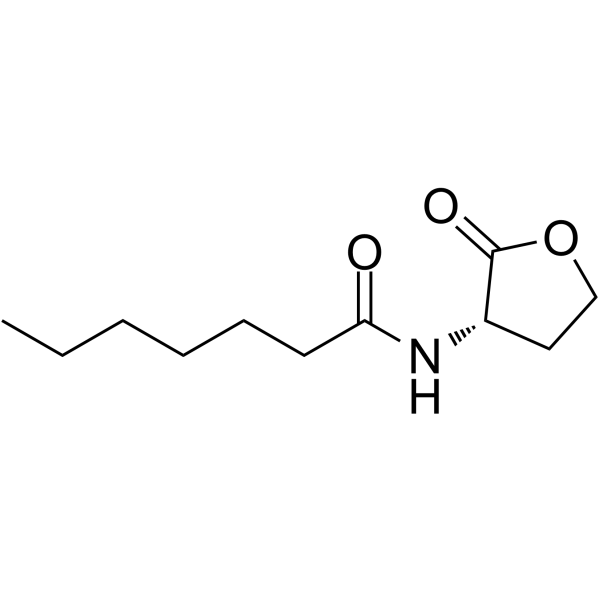
N-Heptanoyl-L-homoserine lactone is a member of N-acyl-homoserine lactone family. N-acyl-homoserine lactones (AHL) can regulate gene expression in gram-negative bacteria, such as Echerichia and Salmonella, and are involved in quorum sensing, cell to cell communication among bacteria.
loading...
    loading...
Cat. No.: HY-111278R
CAS No.: 85-66-5
Synonyms: Pyocyanine (Standard); Sanazin (Standard); Sanasin (Standard)
Pyocyanin (Standard) is the analytical standard of Pyocyanin. This product is intended for research and analytical applications. Pyocyanin (Pyocyanine) is a toxic, quorum sensing (QS) controlled metabolite produced by Pseudomonas aeruginosa. Pyocyanin is a REDOX active compound that promotes the production of reactive oxygen species (ROS). Pyocyanin has antibacterial and anti-inflammatory activity[1][2][3][4].
loading...
    loading...
Cat. No.: HY-169191
Target:  

Bacterial

Research Areas:  

Infection

Quorum sensing-IN-8 (compound 5e) has anti-biofilm activity. Quorum sensing-IN-8 can be used for the study of antimicrobial resistance .
loading...
    loading...
Cat. No.: HY-172895
Target:  

Bacterial

Research Areas:  

Infection Inflammation/Immunology

Quorum sensing-IN-10 (10p), an antibacterial synergist, shows significant inhibition of P. aeruginosa virulence, biofilm, and motility, with low toxicity. Quorum sensing-IN-10 (10p) can be used in the research for drug-resistant Pseudomonas aeruginosa infections .
loading...
    loading...

