592 Results for "

DNA binding

" in MedChemExpress (MCE) Product Catalog:
Products (592)

592 Results for "DNA binding" in MCE Product Catalog:

Cat. No.: HY-183118
CAS No.: 3064485-16-8
Target:  

CDK Apoptosis

Research Areas:  

Neurological Disease Cancer

CID-078 is an orally active macrocyclic cyclin A and cyclin B inhibitor. CID-078 binds cyclin hydrophobic patches, disrupting interactions of cyclin A-Cdk2 with E2F1 and cyclin B-Cdk1 with Myt1, and selectively targets RxL binding motifs to block complex-substrate interactions. CID-078 induces DNA damage, G2/M cell cycle arrest, apoptosis, mitotic catastrophe, spindle assembly checkpoint activation, and neomorphic cyclin B-CDK2 complex formation, driving synthetic lethality in E2F-driven cancer cells. CID-078 can be used for the research of small cell lung cancer, non-small cell lung cancer, triple negative breast cancer, advanced solid tumors, luminal HR +/HER 2- breast cancer, RB1-altered solid tumors, and neuroblastoma .
loading...
    loading...
Cat. No.: HY-L008
738 compounds

The Janus kinase (JAK)/signal transducer and activator of transcription (STAT) pathway is central to signaling by cytokine receptors, a superfamily of more than 30 transmembrane proteins that recognize specific cytokines, and is critical in blood formation and immune response. Canonical JAK/STAT signaling begins with the association of cytokines and their corresponding transmembrane receptors. Activated JAKs then phosphorylate latent STAT monomers, leading to dimerization, nuclear translocation, and DNA binding. In mammals, there are four JAKs (JAK1, JAK2, JAK3, TYK2) and seven STATs (STAT1, STAT2, STAT3, STAT4, STAT5a, STAT5b, STAT6). Since the JAK/STAT pathway plays a major role in many fundamental processes, such as apoptosis and inflammation, dysfunctional proteins in the pathway may lead to a number of diseases. For example, alterations in JAK/STAT signalling can result in cancer and diseases affecting the immune system, such as severe combined immunodeficiency disorder (SCID).

MCE provides 738 compounds that can be used in the study of the JAK/STAT signaling pathway and related diseases.

Cat. No.: HY-P81282
Synonyms: CLL associated antigen KW 6; DNA-binding protein Ikaros; hIk 1; hIk-1; Hs.54452; IK1; Ikaros (zinc finger protein); IKAROS; IKAROS family zinc finger 1 (Ikaros); Ikaros family zinc finger protein 1; Ikzf1; IKZF1_HUMAN; LYF1; Lymphoid transcription factor LyF-1; PRO0758; Zinc finger protein subfamily 1A 1 (Ikaros); zinc finger protein subfamily 1A 1; Zinc finger protein; subfamily 1A; member 1; ZNFN1A1.

Host:  

Mouse

Application:  

WB, IP

Reactivity:  

Human

loading...
    loading...
Cat. No.: HY-P81282A
Synonyms: CLL associated antigen KW 6; DNA-binding protein Ikaros; hIk 1; hIk-1; Hs.54452; IK1; Ikaros (zinc finger protein); IKAROS; IKAROS family zinc finger 1 (Ikaros); Ikaros family zinc finger protein 1; Ikzf1; IKZF1_HUMAN; LYF1; Lymphoid transcription factor LyF-1; PRO0758; Zinc finger protein subfamily 1A 1 (Ikaros); zinc finger protein subfamily 1A 1; Zinc finger protein; subfamily 1A; member 1; ZNFN1A1.

Host:  

Rabbit

Application:  

IHC-P

Reactivity:  

Human

loading...
    loading...
Cat. No.: HY-P85524
Synonyms: CLL associated antigen KW 6; DNA-binding protein Ikaros; hIk 1; hIk-1; Hs.54452; IK1; Ikaros; zinc finger protein; IKAROS; IKAROS family zinc finger 1; Ikaros; Ikaros family zinc finger protein 1; Ikzf1; IKZF1_HUMAN; LYF1; Lymphoid transcription factor LyF-1; PRO0758; Zinc finger protein subfamily 1A 1; Ikaros; zinc finger protein subfamily 1A 1; Zinc finger protein, subfamily 1A, member 1; ZNFN1A1.

Host:  

Rabbit

Application:  

WB, IHC-P, ICC/IF, FC

Reactivity:  

Human, Mouse, Rat

loading...
    loading...
Cat. No.: HY-189126
CAS No.: 1240580-64-6
Research Areas:  

Cancer

YL064 is a multi-target STAT3-c-MYC inhibitor that directly binds to ATXN3 and inhibits its deubiquitinating activity, thereby promoting the ubiquitination and proteasomal degradation of oncogenic substrates of ATXN3. YL064 inhibits the phosphorylation of STAT3-Tyr705 without altering the total protein level of STAT3; meanwhile, it directly binds to the SH2 domain of STAT3 to block the dimerization, nuclear translocation, and DNA-binding activity of STAT3. YL064 directly targets the C-terminal HLH-Zip domain of c-Myc, upregulates the phosphorylation of c-Myc at the Thr58 site, and induces the ubiquitination and proteasome-dependent degradation of c-Myc. YL064 suppresses tumor cell proliferation, induces G2/M cell cycle arrest, reduces cell migration and invasion capacities, and triggers cancer cell apoptosis. YL064 can be used in related research on breast cancer, prostate cancer, diffuse large B-cell lymphoma, and multiple myeloma .
loading...
    loading...
Cat. No.: HY-N20682
CAS No.: 2866266-56-8
1-Hydroxy-4αH-1,10-secoeudesma-5(6),10(14),11(13)-trien-12,8β-olide is a neuroprotective agent. 1-Hydroxy-4αH-1,10-secoeudesma-5(6),10(14),11(13)-trien-12,8β-olide reduces the protein expression levels of iNOS and COX-2, blocks the DNA-binding activity of NF-κB, and inhibits nitric oxide production. 1-Hydroxy-4αH-1,10-secoeudesma-5(6),10(14),11(13)-trien-12,8β-olide promotes the polarization of microglia to the M2 phenotype by inducing the production of Arg-1, and alleviates cell damage induced by H2O2 and 6-Hydroxydopamine (HY-B1081) .
loading...
    loading...
Cat. No.: HY-W008806S
Synonyms: OHHL-d3; N-(3-Oxohexanoyl)homoserine lactone-d3
N-(3-Oxohexanoyl)-L-homoserine lactone-d3 (OHHL-d3) is the deuterated-labeled N-(3-Oxohexanoyl)-L-homoserine lactone (HY-W008806). N-(3-Oxohexanoyl)-L-homoserine lactone (OHHL; N-(3-Oxohexanoyl)homoserine lactone) is a specific agonist of LuxR-type transcription factor CarR with a Kd of 1.8 μM. N-(3-Oxohexanoyl)-L-homoserine lactone activates CarR by inducing protein multimerization, promoting its binding to target DNA sequences in the carR-carA intergenic region, thereby upregulating the transcription of carbapenem biosynthesis genes. N-(3-Oxohexanoyl)-L-homoserine lactone acts as a quorum sensing signal molecule, enabling bacteria to coordinate the production of carbapenem antibiotics in a cell density-dependent manner. N-(3-Oxohexanoyl)-L-homoserine lactone is used to study bacterial quorum sensing mechanisms, especially the secondary metabolism and virulence factor regulatory pathways of Erwinia carotovora and Yersinia enterocolitica .
loading...
    loading...
Cat. No.: HY-W008806S1
Synonyms: OHHL-d2; N-(3-Oxohexanoyl)homoserine lactone-d2
N-(3-Oxohexanoyl)-L-homoserine lactone-d2 (OHHL-d2) is the deuterated-labeled N-(3-Oxohexanoyl)-L-homoserine lactone (HY-W008806). N-(3-Oxohexanoyl)-L-homoserine lactone (OHHL; N-(3-Oxohexanoyl)homoserine lactone) is a specific agonist of LuxR-type transcription factor CarR with a Kd of 1.8 μM. N-(3-Oxohexanoyl)-L-homoserine lactone activates CarR by inducing protein multimerization, promoting its binding to target DNA sequences in the carR-carA intergenic region, thereby upregulating the transcription of carbapenem biosynthesis genes. N-(3-Oxohexanoyl)-L-homoserine lactone acts as a quorum sensing signal molecule, enabling bacteria to coordinate the production of carbapenem antibiotics in a cell density-dependent manner. N-(3-Oxohexanoyl)-L-homoserine lactone is used to study bacterial quorum sensing mechanisms, especially the secondary metabolism and virulence factor regulatory pathways of Erwinia carotovora and Yersinia enterocolitica .
loading...
    loading...
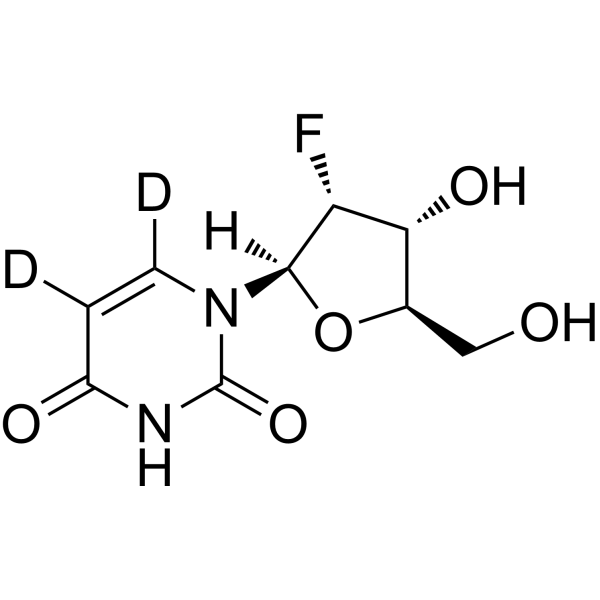
Cat. No.: HY-W013403S
CAS No.: 362049-50-1
2'-Deoxy-2'-fluorouridine-d2 is the deuterium labeled 2'-Deoxy-2'-fluorouridine . 2'-Deoxy-2'-fluorouridine is a derivative of the pyrimidine nucleoside uridine. 2'-Deoxy-2'-fluorouridine is a nucleoside analog that inhibits the replication of wild-type viruses by binding to the viral RNA. Hepatitis C polyU/UC RNA strands containing 2'-Deoxy-2'-fluorouridine, bind to RIG-I but do not activate RIG-I signaling in a reporter assay using Huh7 cells. 2'-Deoxy-2'-fluorouridine also has been used as a starting material in the synthesis of respiratory syncytial virus (RSV) polymerase inhibitors. 2'-Deoxy-2'-fluorouridine can incorporate into DNA and RNA in rat and woodchuck model upon administration. 2'-Deoxy-2'-fluorouridine can be studied in anti-viral research .
loading...
    loading...
Cat. No.: HY-P81282AA
Synonyms: CLL associated antigen KW 6; DNA-binding protein Ikaros; hIk 1; hIk-1; Hs.54452; IK1; Ikaros (zinc finger protein); IKAROS; IKAROS family zinc finger 1 (Ikaros); Ikaros family zinc finger protein 1; Ikzf1; IKZF1_HUMAN; LYF1; Lymphoid transcription factor LyF-1; PRO0758; Zinc finger protein subfamily 1A 1 (Ikaros); zinc finger protein subfamily 1A 1; Zinc finger protein; subfamily 1A; member 1; ZNFN1A1.

Host:  

Rabbit

Application:  

IHC-P

Reactivity:  

Human

loading...
    loading...
Cat. No.: HY-164729
FZ-AD005 is a DLL3-targeting antibody-drug conjugate (ADC) with high selectivity, composed of the anti-DLL3 antibody FZ-A038 (HY-P990896), a dipeptide linker (Val-Ala), and DXd (HY-13631D). The Kd value of FZ-AD005 for human DLL3 ranges from 13.29 to 58.3 pmol/L. After binding to DLL3 on the cell surface, FZ-AD005 mediates endocytosis, and the payload DXd is released via cleavage by lysosomal cathepsins. DXd inhibits topoisomerase TopI to induce double-strand DNA breaks, cell cycle arrest and apoptosis, and FZ-AD005 exhibits bystander killing activity against adjacent DLL3-negative cells. FZ-AD005 shows stable circulation in vivo, has good tolerance and acceptable pharmacokinetic profiles in rats and cynomolgus monkeys, and effectively inhibits the growth of DLL3-expressing tumor cells. FZ-AD005 serves as a promising candidate molecule for research on small cell lung cancer and human neuroendocrine prostate cancer .
loading...
    loading...

