224 Results for "

Docking

" in MedChemExpress (MCE) Product Catalog:
Products (224)

224 Results for "Docking" in MCE Product Catalog:

Cat. No.: HY-163439
Target:  

Amylases Glycosidase

Research Areas:  

Metabolic Disease

α-Amylase/α-Glucosidase-IN-12 (compound 10k) is a dual inhibitor targeting α-glucosidase and α-amylase with IC50 of 34.52 nM and 24.62 nM, respectively. α-Amylase/α-Glucosidase-IN-12 is an inhibitor designed based on triazolo[4,3-b][1,2,4]triazine and has the potential to be used in diabetes research .
loading...
    loading...
Cat. No.: HY-167896
CAS No.: 1096-72-6
Target:  

nAChR

Research Areas:  

Neurological Disease

Hepzidine (compound 40) is a novel nicotinic acetylcholine receptor (nAChR) ligand. Hepzidine can bind to AChBP. Hepzidine can be used in neuro-related research .
loading...
    loading...
Cat. No.: HY-159081
CAS No.: 3052008-10-0
Target:  

Cholinesterase (ChE)

Research Areas:  

Neurological Disease

AChE/BChE-IN-20 (compound 3m) is an acetylcholinesterase (AChE, IC50=34.81 μM) and butylcholinesterase (BChE, IC50=20.66 μM) inhibitor, which has been demonstrated to have affinity for key enzyme pockets and favorable interaction profiles by molecular docking and kinetic simulations, and can be used in the study of Alzheimer's disease .
loading...
    loading...
Cat. No.: HY-163105
CAS No.: 3072778-26-5
Target:  

Microtubule/Tubulin

Research Areas:  

Cancer

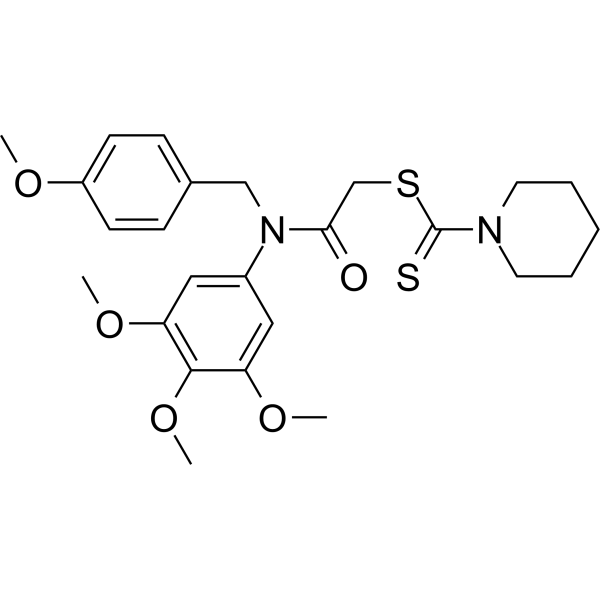
Tubulin/NEDDylation-IN-1 (compound C11) is a dual inhibitor of tubulin (Microtubule/Tubulin)-NEDDylation (IC50 for tubulin=2.40 μM), which has strong anti-proliferative activity. Neddylation is a protein post-translational modification that covalently tags the ubiquitin-like protein NEDD8 to target proteins. Tubulin/NEDDylation-IN-1 forms hydrogen bonds with residues of tubulin and E1 NEDD8 activating enzyme (NAE) through methoxy and dithiocarbamate groups and inhibits NEDDylation and microtubulin in an ATP-dependent manner. tube polymerization .
loading...
    loading...
Cat. No.: HY-159920
PSB-22269 is a GPR17 antagonist with a Ki value of 8.91 nM. PSB-22269 further demonstrated significant inhibitory effects in cAMP and G protein activation assays. Molecular docking studies revealed that the binding site of PSB-22269 contains positively charged arginine residues and a hydrophobic pocket. PSB-22269 provides a strategy to promote remyelination and holds promise for research in the field of multiple sclerosis .
loading...
    loading...
Cat. No.: HY-P1906A
Target:  

CDK

Research Areas:  

Neurological Disease

[pThr3]-CDK5 Substrate TFA is an effective Phospho-Thr3CDK5 Substrate. [pThr3]-CDK5 Substrate is derived from the sequence of the histone H1 peptide that docks in the active site of CDK5. [pThr3]-CDK5 Substrate is phosphorylated by CDK5 with a Km value of 6 µM .
loading...
    loading...
Cat. No.: HY-149523
Research Areas:  

Inflammation/Immunology Cancer

Anticancer agent 157 (compound 15) is a NO inhibitor (IC50=0.62 μg/mL) with anti-inflammatory and anticancer activities. Anticancer agent 157 can bind to iNOS (inducible NO synthase) and caspase 8, causing nuclear fragmentation and chromatin condensation, inducing apoptosis. Anticancer agent 157 inhibits HT29 colon cancer cells (IC50=2.45 μg/mL), Hep-G2 liver cancer cells (IC50=3.25 μg/mL), and B16-F10 murine melanoma cells (IC50=3.84 μg/mL) .
loading...
    loading...
Cat. No.: HY-157168
Target:  

Trk Receptor

Research Areas:  

Neurological Disease

TrkA-IN-6 (compound R48) is a hydrazone-like, selective inhibitor of tropomyosin kinase type A receptor kinase (TrkA). TrkA-IN-6 exhibited a higher cytotoxic effect on U87 GBM cells than Temozolomide (HY-17364), with an IC50 of 68.99 μM .
loading...
    loading...
Cat. No.: HY-Y0775R
CAS No.: 128-08-5
1-Bromo-2,5-pyrrolidinedione (Standard) is the analytical standard of 1-Bromo-2,5-pyrrolidinedione (HY-Y0775). This product is intended for research and analytical applications. 1-Bromo-2,5-pyrrolidinedione is a collagen protein ligand in docking experiments. 1-Bromo-2,5-pyrrolidinedione can be used to study wound healing-related diseases .
loading...
    loading...
Cat. No.: HY-W440835C
Research Areas:  

Inflammation/Immunology

DSPE-PEG1000-DBCO is a phospholipid PEG polymer that combines a hydrophobic phospholipid (DSPE), a hydrophilic polyethylene glycol spacer with a molecular weight of 1000 Da, and a reactive click chemistry terminal group (DBCO). DSPE-PEG-DBCO migrates to lymph nodes via the endogenous albumin transport system, implants bioorthogonal DBCO docking sites, and enables the enrichment of azide-functionalized vesicles in lymph nodes mediated by click chemistry. DSPE-PEG-DBCO can be used in studies related to atherosclerosis .
loading...
    loading...
Cat. No.: HY-W440835A
Research Areas:  

Inflammation/Immunology

DSPE-PEG400-DBCO is a phospholipid PEG polymer that combines a hydrophobic phospholipid (DSPE), a hydrophilic polyethylene glycol spacer with a molecular weight of 400 Da, and a reactive click chemistry terminal group (DBCO). DSPE-PEG-DBCO migrates to lymph nodes via the endogenous albumin transport system, implants bioorthogonal DBCO docking sites, and enables the enrichment of azide-functionalized vesicles in lymph nodes mediated by click chemistry. DSPE-PEG-DBCO can be used in studies related to atherosclerosis .
loading...
    loading...
Cat. No.: HY-W440835B
Research Areas:  

Inflammation/Immunology

DSPE-PEG600-DBCO is a phospholipid PEG polymer that combines a hydrophobic phospholipid (DSPE), a hydrophilic polyethylene glycol spacer with a molecular weight of 600 Da, and a reactive click chemistry terminal group (DBCO). DSPE-PEG-DBCO migrates to lymph nodes via the endogenous albumin transport system, implants bioorthogonal DBCO docking sites, and enables the enrichment of azide-functionalized vesicles in lymph nodes mediated by click chemistry. DSPE-PEG-DBCO can be used in studies related to atherosclerosis .
loading...
    loading...
Cat. No.: HY-W440835H
Research Areas:  

Inflammation/Immunology

DSPE-PEG10000-DBCO is a phospholipid PEG polymer that combines a hydrophobic phospholipid (DSPE), a hydrophilic polyethylene glycol spacer with a molecular weight of 10000 Da, and a reactive click chemistry terminal group (DBCO). DSPE-PEG-DBCO migrates to lymph nodes via the endogenous albumin transport system, implants bioorthogonal DBCO docking sites, and enables the enrichment of azide-functionalized vesicles in lymph nodes mediated by click chemistry. DSPE-PEG-DBCO can be used in studies related to atherosclerosis .
loading...
    loading...
Cat. No.: HY-144701
CAS No.: 690681-65-3
Purity:  99.15%
Target:  

Antibiotic Bacterial

Research Areas:  

Infection Inflammation/Immunology

SABA1 possesses antibacterial properties against Pseudomonas aeruginosa and Escherichia coli, with an IC50 of 4.0 µM against E. coli ACC .
loading...
    loading...
Cat. No.: HY-144701R
CAS No.: 690681-65-3
Fluopicolide (Standard) is the analytical standard of Fluopicolide. This product is intended for research and analytical applications. Fluopicolide is the active compound.
loading...
    loading...
Cat. No.: HY-161067
Target:  

EGFR Apoptosis

Research Areas:  

Cancer

EGFR-IN-96 (compound 7a) is a thieno[2,3-d]pyrimidine EGFR inhibitor that can induce apoptosis. EGFR-IN-96 arrests the growth of HepG2 cells in the S phase and G2/M phase, and inhibits the growth of cancer cells bearing EGFR wild-type and EGFR T790M .
loading...
    loading...
Cat. No.: HY-168001
CAS No.: 1332833-27-8
Target:  

NTPDase

Research Areas:  

Infection Cancer

TcNTPDase1-IN-1 (compound 16) is an inhibitor of nucleoside triphosphate diphosphohydrolase 1 (TcNTPDase1) from Trypanosoma cruzi in vitro. TcNTPDase1-IN-1 can be used in antibacterial, antitoxic and antitumor related research .
loading...
    loading...
Cat. No.: HY-179493
CAS No.: 3002069-20-4
Research Areas:  

Infection

DHFR-IN-25 (Compound N2) is a type of inhibitor of dihydrofolate reductase (DHFR). DHFR-IN-25 is a broad-spectrum and highly effective antibacterial agent, particularly showing significant effects on Candida albicans and Staphylococcus aureus. DHFR-IN-25 can be used for the study of local anti-infection .
loading...
    loading...
Cat. No.: HY-N2025R
CAS No.: 57396-78-8
Oroxin A (Standard) is the analytical standard of Oroxin A. This product is intended for research and analytical applications. Oroxin A is the major component of an ethanol-water Oroxylum indicum (L.) Kurz (Bignoniaceae) seed extract (OISE). Oroxin A acts as a partial PPARγ agonist that can activate PPARγ transcriptional activation. Oroxin A activates PPARγ by docking into the PPARγ protein ligand-binding domain. Oroxin A also exhibits an inhibitory activity against α-glucosidase and an antioxidant capacity . Oroxin A exerts anti-breast cancer effects by inducing ER stress-mediated senescence .
loading...
    loading...
Cat. No.: HY-110100R
CAS No.: 310460-39-0
Research Areas:  

Inflammation/Immunology

CPYPP (Standard) is the analytical standard of CPYPP (HY-110100). This product is intended for research and analytical applications. CPYPP is a DOCK2-Rac1 interaction inhibitor. CPYPP binds to DOCK2 DHR-2 domain and inhibits the guanine nucleotide exchange factor (GEF) activity of DOCK2DHR-2 for Rac1 in a dose-dependent manner with an IC50 of 22.8 μM. CPYPP also inhibits DOCK180 and DOCK5 and less inhibits DOCK9 .
loading...
    loading...