106 Results for "

muscle function

" in MedChemExpress (MCE) Product Catalog:
Products (106)

106 Results for "muscle function" in MCE Product Catalog:

Cat. No.: HY-B2202R
CAS No.: 77-91-8
Research Areas:  

Others

Choline dihydrogen citrate (Standard) is the analytical standard of Choline dihydrogen citrate. This product is intended for research and analytical applications. Choline dihydrogen citrate is a choline-rich hydrochloride that can be absorbed by the body and converted into acetylcholine, which enhances the function of the nervous system and muscles and promotes good health. In addition, this compound is widely used in supplements such as certain energy drinks and protein powders to help improve the body's metabolism and exercise capacity.
loading...
    loading...
Cat. No.: HY-W783254
CAS No.: 799279-67-7
Synonyms: PA(18:0e/0:0)
C18 LPA (PA(18:0e/0:0)) is a water-soluble phospholipid that functions as a signaling molecule, influencing various cellular responses through G protein-coupled receptors (GPCRs). It is known to promote smooth muscle contraction, cytoskeletal rearrangement, and chemotaxis, while also playing a role in neurotransmitter release, cell proliferation, platelet aggregation, and Ca2+ mobilization. Elevated levels of C18 LPA in human plasma are associated with ovarian cancer and atherosclerosis, suggesting its potential as a biomarker for ovarian cancer.
loading...
    loading...
Cat. No.: HY-113443
CAS No.: 71774-10-2
Target:  

AP-1

Research Areas:  

Metabolic Disease

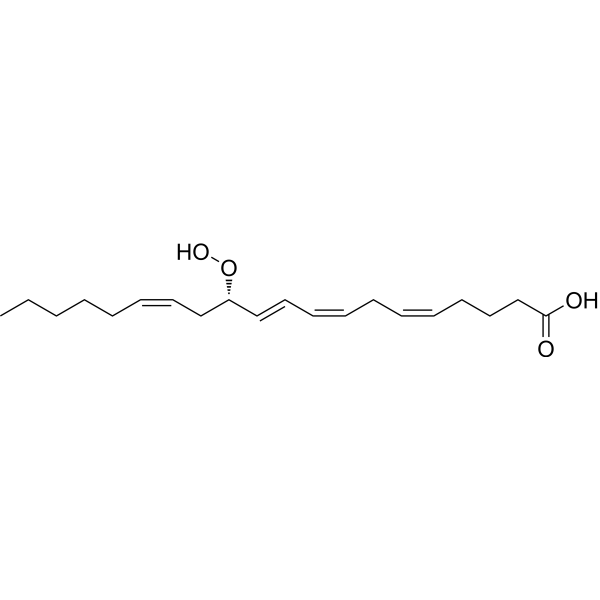
12(S)-HPETE is a 12-hydroxyeicosatetraenoic acid. 12(S)-HPETE has the function of regulating vascular tone. 12(S)-HPETE induces the expression of c-Fos and c-Jun protein and increases activating protein 1 (AP-1) activity in vascular smooth muscle cells.12(S)-HPETE may play a physiological role in vasomotor regulation through endothelium itself and crosstalk between blood cells and endothelium. 12(S)-HPETE can be used in the study of cerebrovascular tension .
loading...
    loading...
Cat. No.: HY-B1173R
CAS No.: 464-49-3
Synonyms: D-(+)-Camphor (Standard); (1R)-(+)-Camphor (Standard)
(+)-Camphor (Standard) is the analytical standard of (+)-Camphor. This product is intended for research and analytical applications. (+)-Camphor (D-(+)-Camphor; (1R)-(+)-Camphor) is an isomer of Camphor. Camphor is an agonist of monoterpenoid transient receptor potential (TRP) channels (such as TRPV1, TRPV3, TRPM8) and an inhibitor of TRPA1 channels. Camphor's derivatives have multiple biological activities, including antibacterial, antiviral, antioxidant, analgesic and anticancer. Camphor can selectively activate cold-sensitive TRP channels and inhibit TRPA1-mediated nociceptive signals. Camphor stimulates the cold-sensing nerve endings in the skin and regulates the activity of ion channels to exert analgesic, anti-inflammatory and anti-itching effects. It also has anti-proliferative and anti-mutagenic activities on tumor cells, which may be related to inhibiting ribosome function or inducing cell apoptosis. Camphor can be absorbed through the skin and (+)-Camphor can be used in the study of muscle and joint pain and inflammation .
loading...
    loading...
Cat. No.: HY-117255
CAS No.: 161229-62-5
Target:  

Potassium Channel

Research Areas:  

Others

ZM260384 is a KATP channel opener that accelerates metabolism and inhibits the decline of guinea pig isolated diaphragm function, thereby affecting muscle contraction. ZM260384 can be used to study muscle function under hypoxic conditions .
loading...
    loading...
Cat. No.: HY-D0885BR
CAS No.: 922-32-7
Synonyms: Disodium creatine phosphate (Standard)
Phosphocreatine (disodium) (Standard) is the analytical standard of Phosphocreatine (disodium). This product is intended for research and analytical applications. Phosphocreatine (disodium) is an organic compound found in vertebrate skeletal muscles. Phosphocreatine (disodium) enhances antioxidant activity, and activates the TAK1 pathway to protect the heart. Phosphocreatine (disodium) normalizing mitochondrial function and reducing oxidative stress via Akt mediated Nrf2/HO-1 pathway. Phosphocreatine (disodium) provides renal protection by suppressing Apoptosis and ROS (Reactive Oxygen Species) generation through ERK mediated mediated Nrf-2/HO-1 pathway. .
loading...
    loading...
Cat. No.: HY-126175
CAS No.: 1212-37-9
Target:  

Endogenous Metabolite

Research Areas:  

Neurological Disease

Neostigmine iodide is a reversible acetylcholinesterase inhibitor with muscle tone-enhancing activity. Neostigmine iodide is primarily used to improve muscle function in patients with myasthenia gravis. Neostigmine iodide is also used in routine anesthesia to reverse the effects of nondepolarizing muscle relaxants such as rocuronium .
loading...
    loading...
Cat. No.: HY-176041
CAS No.: 1448792-38-8
Target:  

Calcium Channel

Research Areas:  

Cardiovascular Disease

Troponin modulator 1 (compound 7) modulates the mutant cardiac muscle thin filament function. Troponin modulator 1 enhances Ca 2+ sensitivity by phosphorylation with an EC50 of 67 μM .
loading...
    loading...
Cat. No.: HY-12980A
CAS No.: 945905-37-3
Synonyms: GSK961081 Succinate; TD-5959 Succinate
Research Areas:  

Neurological Disease

Batefenterol Succinate (GSK961081 Succinate) is a first-of-its-kind inhaled bifunctional bronchodilator with smooth muscle relaxant properties. The activities of Batefenterol Succinate include acting as a smooth muscle parasympathetic antagonist and a beta2-adrenoceptor agonist. Batefenterol Succinate is used to improve respiratory function, especially in patients with chronic obstructive pulmonary disease (COPD) .
loading...
    loading...
Cat. No.: HY-P10267
CAS No.: 98537-35-0
Neuromedin B-30 is the neuropeptide, which is orignally isolated from porcine brain and spinal cord. , and may exhibit activity in stimulating smooth-muscle. Neuromedin B causes local vasodilation, increases vascular permeability and local hyperalgesia, thereby participating in neurogenic inflammation. Neuromedin B regulates appetite, body temperature, and behavioral responses to stress. Neuromedin B is also involved in regulating smooth muscle contraction and secretory function in the gastrointestinal tract .
loading...
    loading...
Cat. No.: HY-P10595
CAS No.: 118904-15-7
Target:  

Sodium Channel

Research Areas:  

Neurological Disease

Antho-Rwamide II is a neuropeptide that can be isolated from the sea anemone Anthopleura elegantissima. Antho-Rwamide II can induce contraction of the endothelial muscles of the sea anemone and participate in neurotransmission. Antho-Rwamide II can be used to explore the function of the nervous system in invertebrates .
loading...
    loading...
Cat. No.: HY-101586A
CAS No.: 219581-36-9
Synonyms: Lu 25-109 maleate
Target:  

mAChR

Research Areas:  

Neurological Disease

Alvameline (Lu 25-109) maleate is a partial agonist of M1 and an antagonist of M2/M3. Alvameline maleate competitively antagonizes contractions induced by ammonium chloride (HY-Y1269) and electrical field stimulation in human detrusor muscle, indicating its potential application in regulating bladder function. Additionally, alvameline maleate can improve cognitive function following traumatic brain injury in rats .
loading...
    loading...
Cat. No.: HY-B1435A
CAS No.: 54-32-0
Synonyms: Thymoxamine
Moxisylyte (Thymoxamine) is a selective α1A-adrenergic receptor antagonist. Moxisylyte competitively antagonizes the activation mediated by norepinephrine. Moxisylyte relaxes penile cavernous smooth muscle and aids erectile function. Moxisylyte is applicable to research related to erectile dysfunction and multiple system atrophy .
loading...
    loading...
Cat. No.: HY-14915A
CAS No.: 194785-31-4
Synonyms: MN-221; KUR-1246
Target:  

Adrenergic Receptor

Research Areas:  

Inflammation/Immunology

Bedoradrine (MN-221) sulfate is a highly selective β2-adrenergic receptor agonist. Bedoradrine sulfate can effectively relieve airway spasm, dilate airway smooth muscle cells, reduce airway inflammation, and thus improve respiratory function. Bedoradrine sulfate can be used in research on asthma .
loading...
    loading...
Cat. No.: HY-113354R
CAS No.: 584-85-0
Anserine (Standard) is the analytical standard of Anserine. This product is intended for research and analytical applications. Anserine, a methylated form of Carnosine, is an orally active, natural Histidine-containing dipeptide found in skeletal muscle of vertebrates. Anserine is not cleaved by serum carnosinase and act as biochemical buffers, chelators, antioxidants, and anti-glycation agents. Anserine improves memory functions in Alzheimer's disease (AD)-model mice[1][2].
loading...
    loading...
Cat. No.: HY-113354S1
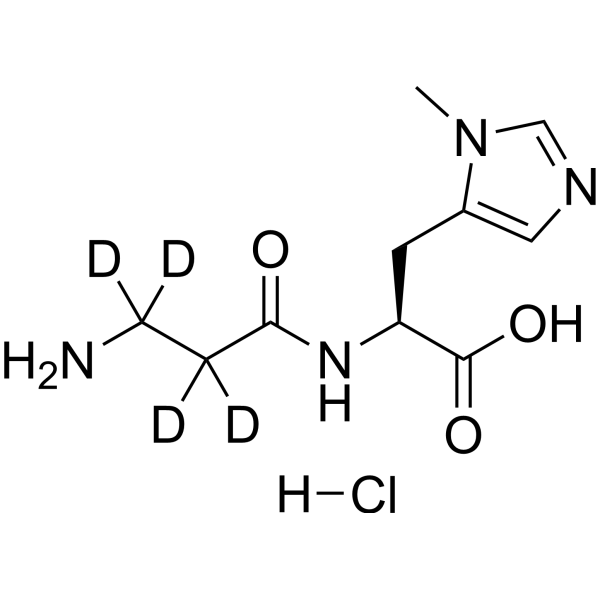
Anserine-d4 hydrochloride is the deuterium labeled Anserine (HY-113354). Anserine, a methylated form of Carnosine, is an orally active, natural Histidine-containing dipeptide found in skeletal muscle of vertebrates. Anserine is not cleaved by serum carnosinase and act as biochemical buffers, chelators, antioxidants, and anti-glycation agents. Anserine improves memory functions in Alzheimer's disease (AD)-model mice .
loading...
    loading...
Cat. No.: HY-137378A
CAS No.: 144510-04-3
Target:  

PKG

8-Br-PET-cGMP is an agonist of cGMP-dependent protein kinase type I (cGKI). 8-Br-PET-cGMP promotes the dimerization of cGKI and activates its catalytic activity by binding to the regulatory domain of cGKI. 8-Br-PET-cGMP can be used to study the role of cGMP signaling pathways in cell growth, vasodilation, and smooth muscle cell function .
loading...
    loading...
Cat. No.: HY-77813R
CAS No.: 622-78-6
Benzyl isothiocyanate (Standard) is the analytical standard of Benzyl isothiocyanate. This product is intended for research and analytical applications. Benzyl isothiocyanate is an orally available isothiocyanate with bactericidal, anticancer, antiangiogenic and anthelmintic activities. Benzyl isothiocyanate exerts anticancer functions by regulating multiple signaling pathways, including apoptosis, cell proliferation, cell cycle arrest, metastasis, angiogenesis, and autophagy. In addition, Benzyl isothiocyanate can enhance muscle insulin sensitivity to improve obesity-induced hyperglycemia[1][2][3][4][5][6][7][8][9].
loading...
    loading...
Cat. No.: HY-W709349
CAS No.: 33400-45-2
Synonyms: D 9998 hydrochloride
Flupirtine (D 9998) hydrochloride is an orally active, blood-brain barrier-crossing non-opioid analgesic and neuroprotective agent. Flupirtine hydrochloride is a neuronal potassium channel opener (Kv7 activator), a NMDA receptor antagonist and a GABA receptor activator. Flupirtine hydrochloride stabilizes blood-brain-barrier integrity, reduces oxidative stress and brain leukocyte infiltration, enhances angioneurogenesis, suppresses calcium influx, stabilizes neuronal resting membrane potential, and counteracts focal cerebral ischemia. Flupirtine hydrochloride exhibits analgesic, muscle relaxant properties, protects neurons from excitotoxic, ischemic, or cytokine-mediated death. Flupirtine hydrochloride functions as a non-opioid analgesic without antipyretic or antiphlogistic properties, shows no relevant affinity to opiate receptor. Flupirtine hydrochloride can be used for the research of focal cerebral ischemia, pain, Alzheimer’s disease, or multiple sclerosis .
loading...
    loading...
Cat. No.: HY-17001R
CAS No.: 75507-68-5
Synonyms: D 9998 Maleate (Standard)
Flupirtine Maleate (Standard) is the analytical standard of Flupirtine Maleate (HY-17001). This product is intended for research and analytical applications. Flupirtine Maleate is an orally active, blood-brain barrier-crossing non-opioid analgesic and neuroprotective agent. Flupirtine Maleate is a neuronal potassium channel opener (Kv7 activator), a NMDA receptor antagonist and a GABA receptor activator. Flupirtine Maleate stabilizes blood-brain-barrier integrity, reduces oxidative stress and brain leukocyte infiltration, enhances angioneurogenesis, suppresses calcium influx, stabilizes neuronal resting membrane potential, and counteracts focal cerebral ischemia. Flupirtine Maleate exhibits analgesic, muscle relaxant properties, protects neurons from excitotoxic, ischemic, or cytokine-mediated death. Flupirtine Maleate functions as a non-opioid analgesic without antipyretic or antiphlogistic properties, shows no relevant affinity to opiate receptor. Flupirtine Maleate can be used for the research of focal cerebral ischemia, pain, Alzheimer’s disease, or multiple sclerosis .
loading...
    loading...

