205 Results for "

OPTimization

" in MedChemExpress (MCE) Product Catalog:
Products (205)

205 Results for "OPTimization" in MCE Product Catalog:

Cat. No.: HY-179626
CAS No.: 2138299-66-6
Target:  

STING ADC Payloads

Research Areas:  

Cancer

STING agonist-49 (Compound 1) is a STING agonist and can be used as a payload for ADCs. STING agonist-49 can be applied in lung cancer research .
loading...
    loading...
Cat. No.: HY-180452
CAS No.: 2998560-77-1
Target:  

Paraptosis

Research Areas:  

Infection

HAT-IN-10 (Compound 12a) is an anti-human African trypanosomiasis (HAT) agent, with an EC50 value of 0.23 μM for T. brucei. HAT-IN-10 can be used for research on HAT .
loading...
    loading...
Cat. No.: HY-129836R
CAS No.: 26889-93-0
Research Areas:  

Infection

L-Amoxicillin (Standard) is the analytical standard of L-Amoxicillin. This product is intended for research and analytical applications. L-Amoxicillin is an antibiotic with activity against a wide range of bacterial infections. L-Amoxicillin is commonly used in antibacterial combinations when used in combination with the β-lactamase inhibitor potassium clavulanic acid. The related substances analysis method for L-Amoxicillin has been developed and validated according to the International Conference on Harmonization (ICH) guidelines, ensuring its effectiveness and accuracy in mixtures. L-Amoxicillin and some of its impurities have been further analyzed in stress testing and stability studies, providing support for optimizing its application .
loading...
    loading...
Cat. No.: HY-P3187
CAS No.: 9025-53-0
Target:  

DNA/RNA Synthesis

Research Areas:  

Others

Exo-1,4-β-xylosidase is an exonuclease that specifically acts on the β-1,4 glycosidic bonds at the non-reducing ends of xylan and xylooligosaccharides. Exo-1,4-β-xylosidase is Ca 2+-dependent and reversibly binds to metal ions to catalyze the hydrolysis of β-1,4 glycosidic bonds, thereby degrading xylan to produce xylose. Exo-1,4-β-xylosidase can be used in research fields such as lignocellulose bioconversion, bioethanol production, and optimization of xylan saccharification processes .
loading...
    loading...
Cat. No.: HY-W743258
L-Amoxicillin-d4 sodium is the deuterium labeled L-Amoxicillin (HY-129836). L-Amoxicillin is an antibiotic with activity against a wide range of bacterial infections. L-Amoxicillin is commonly used in antibacterial combinations when used in combination with the β-lactamase inhibitor potassium clavulanic acid. The related substances analysis method for L-Amoxicillin has been developed and validated according to the International Conference on Harmonization (ICH) guidelines, ensuring its effectiveness and accuracy in mixtures. L-Amoxicillin and some of its impurities have been further analyzed in stress testing and stability studies, providing support for optimizing its application .
loading...
    loading...
Cat. No.: HY-159771
CAS No.: 3095069-75-0
Target:  

FAP

Research Areas:  

Cancer

FAP6-19 is a fibroblast activation protein (FAP) targeting radioligand with a Kd of 18.2 nM. FAP6-19 selectively delivers therapeutic radioactive nuclides (such as 177Lu) to the tumor site by targeting the overexpressed FAP protein in the tumor microenvironment, achieving precise killing of cancer cells while minimizing radiation damage to healthy tissues. FAP6-19 exhibits extremely high total cellular uptake and good intracellular retention ability in HT1080 cells. After being labeled with 111In, FAP6-19 produced extremely high tumor/kidney and tumor/liver dose ratios in the mouse model with 4T1 tumors. FAP6-19 can be used in the research of solid tumors expressing FAP.
loading...
    loading...
Cat. No.: HY-P11398
Research Areas:  

Infection Cancer

Tachyplesin II is a broad-spectrum cationic antimicrobial peptide. Tachyplesin II has significant inhibitory effects on Gram-positive bacteria, Gram-negative bacteria, and some fungi. Tachyplesin II binds to bacterial membrane lipopolysaccharides through its positive charge, disrupting membrane integrity and causing leakage of cellular contents. Tachyplesin II can bind to DNA grooves, inhibiting microbial replication, and also suppressing HIV-1 replication and the proliferation of liver cancer cells .
loading...
    loading...
Cat. No.: HY-117380
CAS No.: 224961-34-6
Target:  

Neurokinin Receptor

Research Areas:  

Neurological Disease

SB 235375 is a potent and selective antagonist of the human neurokinin-3 (hNK-3) receptor designed by optimizing the structure of 2-phenyl-4-quinolinecarboxylic acid amide. SB 235375 displays high affinity for the hNK-3 receptor, with significantly higher binding affinities than hNK-2 and hNK-1 receptors. In vitro studies demonstrated its ability to block NK-3 receptor-mediated contraction and calcium mobilization, while in vivo, SB 223412 demonstrated oral and intravenous activity against NK-3 receptor-driven responses in animal models .
loading...
    loading...
Cat. No.: HY-177554
CAS No.: 2724919-69-9
Research Areas:  

Cancer

KB05yne is a site-selective, alkyne-functionalized electrophilic "probe" fragment probe designed for covalent ligand discovery, with preferential reactivity toward specific cysteine residues in proteins. KB05yne strongly labels wild-type target proteins (e.g., CDKN2AIP, HPCAL1) but does not label their cysteine-to-alanine mutants, confirming site-specific cysteine reactivity. KB05yne can be used for the discovery and optimization of site-specific covalent ligands, and is applicable to proteins with diverse structures and functions, especially in studies targeting cysteine residues in cancer-related or difficult-to-purify proteins .
loading...
    loading...
Cat. No.: HY-184849
CAS No.: 7219-59-2
Research Areas:  

Others

Glu-Arg is a dipeptide linked by L-glutamic acid and L-arginine. Glu-Arg contributes to the construction of the hydrophobic network and maintenance of stability of mouse cAMP-dependent protein kinase; it acts as a core hub connecting the activation segment and the GHI subdomain in eukaryotic protein kinases, and promotes signal transmission between elements and within enzymes. As a salt bridge, Glu-Arg regulates the formation and unfolding rates of α-helices, and its optimized spatial conformation is conducive to the stability and folding rate of α-helices. Glu-Arg induces concentration-dependent intracellular calcium changes in cultured human fungiform taste bud cells .
loading...
    loading...
Cat. No.: HY-K0606

MCE Methenamine Silver Stain Kit For Basement Membrane (PASM) is developed based on the classical staining principle. Through an optimized staining system and standardized reagent combination, it enables clear visualization of basement membranes and related reticular structures in tissue sections. This method is particularly widely used in renal pathology research, where it is commonly applied to examine morphological alterations of the glomerular capillary basement membrane, such as thickening, rupture, folding, double-contour (tram-track) appearance, or abnormal proliferation caused by inflammatory injury. In addition, this method can also be applied to the histological investigation and morphological observation of glomerular diseases, diabetic nephropathy, and other basement membrane–associated pathological changes.

loading...
    loading...
Cat. No.: HY-L935
1039 compounds

POI (Protein of Interest) refers to the target protein, namely the disease-causing protein or key functional protein that undergoes degradation or functional modulation in molecular glue-mediated processes. The Molecular Glue POI Library consists of a series of fragments that can specifically bind to different types of POIs. As key components of molecular glues, these ligands form stable interactions with target proteins, laying the foundation for molecular glues to induce the interaction between POIs and E3 ubiquitin ligases. The covered POIs include various types such as cancer-associated GSPT1, androgen receptors, and abnormally aggregated proteins linked to neurodegenerative diseases.

This fragment library can be applied to the screening and optimization of targeted protein degraders. By screening ligands with high affinity and strong selectivity for specific POIs from the library, core structures can be identified to develop novel molecular glues. For instance, optimization of ligands targeting GSPT1 has yielded molecular glue degraders with enhanced degradation activity. Since many POIs are difficult to drug due to the lack of traditional small-molecule binding pockets, some ligands in the POI Ligand Library can modulate such POIs by inducing protein-protein interactions, thereby further expanding the scope of drug discovery for undruggable targets.

MCE has compiled a POI Fragment Library comprising thousands of POI fragments with molecular weights ranging from 150 to 400. This compound library can be widely applied in Molecular Glue research and development.

Cat. No.: HY-179221
Target:  

HIV

Research Areas:  

Infection

HIV-1-IN-89 (Compound 20a-D) is a prodrug of 20a (an HIV-1 protease inhibitor). HIV-1-IN-89 has better pharmacokinetic properties. HIV-1-IN-89 can be used for studying the resistance to HIV-1 .
loading...
    loading...
Cat. No.: HY-P3187A
CAS No.: 9025-53-0
Target:  

DNA/RNA Synthesis

Research Areas:  

Others

exo-β-1,4-xylosidase,Clostridium stercorarium (EC.3.2.1.37) is an exonuclease that specifically acts on the β-1,4 glycosidic bonds at the non-reducing ends of xylan and xylooligosaccharides. exo-β-1,4-xylosidase is Ca 2+-dependent and reversibly binds to metal ions to catalyze the hydrolysis of β-1,4 glycosidic bonds, thereby degrading xylan to produce xylose. exo-β-1,4-xylosidase can be used in research fields such as lignocellulose bioconversion, bioethanol production, and optimization of xylan saccharification processes .
loading...
    loading...
Cat. No.: HY-P3187B
CAS No.: 9025-53-0
Target:  

DNA/RNA Synthesis

Research Areas:  

Others

exo-β-1,4-xylosidase, Bacteroides ovatus (EC.3.2.1.37) is an exonuclease that specifically acts on the β-1,4 glycosidic bonds at the non-reducing ends of xylan and xylooligosaccharides. exo-β-1,4-xylosidase is Ca 2+-dependent and reversibly binds to metal ions to catalyze the hydrolysis of β-1,4 glycosidic bonds, thereby degrading xylan to produce xylose. exo-β-1,4-xylosidase can be used in research fields such as lignocellulose bioconversion, bioethanol production, and optimization of xylan saccharification processes .
loading...
    loading...
Cat. No.: HY-133031A
CAS No.: 474084-56-5
Research Areas:  

Others

CSV0C018875 hydrochloride is a G9a (EHMT2) inhibitor that inhibits G9a activity. CSV0C018875 can effectively inhibit G9a activity in both enzyme and cell-based assays, and its toxicity is much lower than that of the known G9a inhibitor BIX-01294. CSV0C018875 binds tightly to the active site cavity of G9a, thereby improving the binding firmness and prolonging the residence time of the compound, further enhancing the inhibitory effect of G9a. CSV0C018875 has the potential to improve its ADME (absorption, distribution, metabolism and excretion) and pharmacodynamic properties through further optimization .
loading...
    loading...
Cat. No.: HY-145432
CAS No.: 2747100-02-1
Target:  

PI3K

Research Areas:  

Cancer

PI3K-IN-28 (Compound 6c) is a potent inhibitor of PI3K. PI3K-IN-28 displays the most potent activity with lower toxic effects on MCF-10a. PI3K-IN-28 displays half-maximal inhibitory concentration (IC50, μM) values of 5.8, 2.3, and 7.9. PI3K-IN-28 is the most potent one with a selectivity index (SI) of 39 and is considered as a latent lead for further optimization of anticancer agents .
loading...
    loading...
Cat. No.: HY-153021
CAS No.: 326879-46-3
Purity:  ≥98.0%
Target:  

Parasite

Research Areas:  

Infection

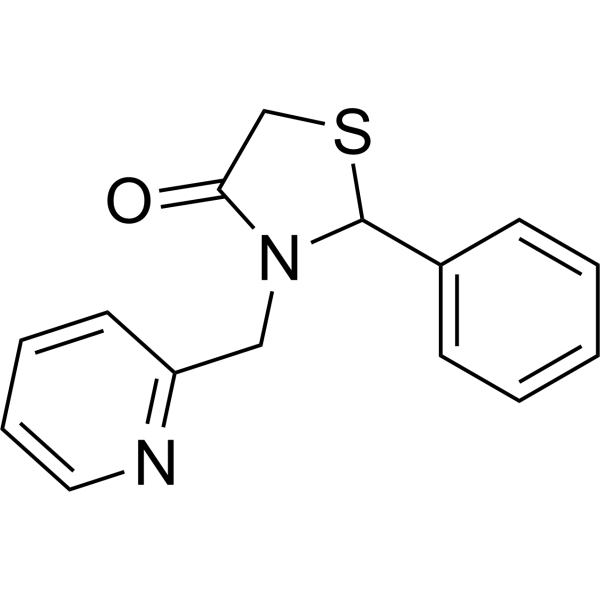
NMT-IN-1 is a Trypanosoma brucei N-myristoyltransferase (TbNMT) inhibitor, with an IC50 of 31 μM against TbNMT and an IC50 of 66 μM against hNMT. As a thiazolidinone hit compound identified via virtual screening, NMT-IN-1 exerts enzymatic inhibitory effects by binding to the active site of TbNMT. NMT-IN-1 adopts a binding mode distinct from that of pyrazole sulfonamide inhibitors and can inhibit the myristoyl transfer reaction catalyzed by TbNMT. NMT-IN-1 is mainly used in the research of anti-parasitic lead compounds for human African trypanosomiasis (African sleeping sickness). It provides a structural basis for the subsequent optimization of TbNMT inhibitors with high activity, high selectivity and blood-brain barrier permeability .
loading...
    loading...
Cat. No.: HY-W237439
CAS No.: 958712-85-1
Target:  

MDM-2/p53

Research Areas:  

Cancer

SEN205A is a fragment compound that binds to the hydrophobic pocket of human S100B (Kd=0.5-1.0 mM), which is the key region for the interaction of S100B with TRTK-12 and p53, and SEN205A can be displaced from this site by TRTK-12. SEN205A exhibits excellent in vitro ADME properties, including high metabolic stability, chemical stability, and good solubility under physiological pH conditions. SEN205A can serve as a starting fragment for structure-based optimization to develop inhibitors targeting the S100B-p53 protein-protein interaction and investigate the pathogenesis of malignant melanoma .
loading...
    loading...
Cat. No.: HY-L0115V
10,091 compounds

ASINEX has elaborated a library of diverse macrocycles using an effective tool box of synthetic methods. The resulting scaffolds are novel, tremendously diverse, medchem-relevant, macrocyclic frameworks.

Macrocyles tend to be larger than traditional screening molecules which make them perfect discovery tools for targets with shallow or extended binding sites. At the same time, their unique character based on restricted flexibility and ability to form intra-molecular hydrogen bonds allows for design approaches effectively optimizing properties such asaqueous solubility and membrane permeability. Many of these macrocycles have been tested for aqueous and DMSO solubility with cut-offs applied at 10 mM in DMSO and 50 µM in PBS (pH 7.4) followed by PAMPA permeability assay.

