1. Search Result
Search Result
Results for "

5-HT4 Receptors Inhibitors

" in MedChemExpress (MCE) Product Catalog:

13

Inhibitors & Agonists

1

Natural
Products

Targets Recommended:
Cat. No. Product Name Target Research Areas Chemical Structure
  • HY-B2132
    Tryptamine
    1 Publications Verification

    3-(2-Aminoethyl)indole~2-(3-Indolyl)ethylamine

    Endogenous Metabolite 5-HT Receptor Aryl Hydrocarbon Receptor Neurological Disease Metabolic Disease
    Tryptamine is a selective, blood-brain-penetrating 5-HT4 receptor agonist (EC50=1-3 mM) and an endogenous ligand of the aryl hydrocarbon receptor (AHR) (Kd=10-50 nM). Tryptamine promotes intestinal anion secretion and fluid transport by activating G protein-coupled receptors (GPCRs) and accelerates gastrointestinal motility. Tryptamine regulates Th17/Treg balance to inhibit neuroinflammation, competitively binds to 5-HT receptors to regulate central nervous system activity, and participates in temperature regulation and spinal reflex regulation as a neuromodulator. Tryptamine can be used to study intestinal motility disorders such as functional constipation, and has shown significant efficacy in multiple sclerosis models .
    Tryptamine
  • HY-15574
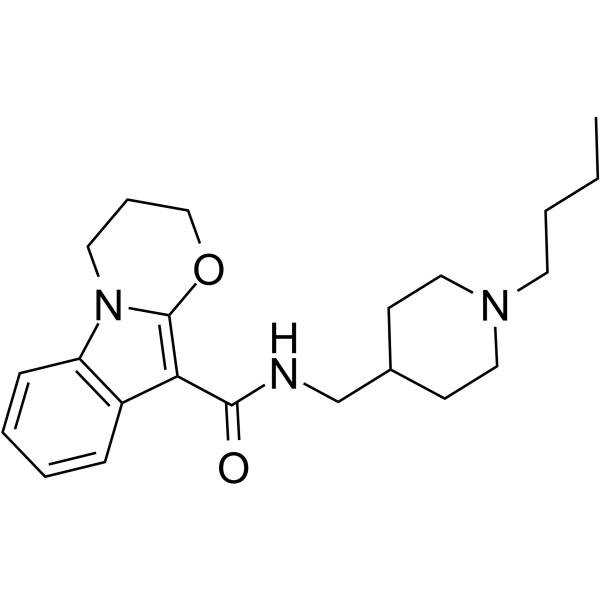
    Piboserod
    4 Publications Verification

    SB-207266

    5-HT Receptor Cardiovascular Disease
    Piboserod is an orally available selective antagonist of the 5-HT4 receptor, with a Ki value of approximately 0.1 nM for human 5-HT4 receptors. Piboserod can competitively bind to the 5-HT4 receptor and block the activation of the 5-HT4 receptor. Piboserod can inhibit the enhancing effect of 5-HT on the nerve-mediated contraction response of the human bladder detrusor muscle. Piboserod is mainly used in the research of urinary system diseases (such as overactive bladder) and cardiovascular diseases (such as chronic heart failure) .
    Piboserod
  • HY-101172

    EP-A-501322

    5-HT Receptor Cardiovascular Disease
    RS 23597-190 (EP-A-501322) is a high affinity and selective 5-HT4 receptor antagonist. RS 23597-190 inhibits Serotonin (HY-B1473A)-induced tachycardia. RS 23597-190 significantly inhibits superoxide production in high glucose .
    RS 23597-190
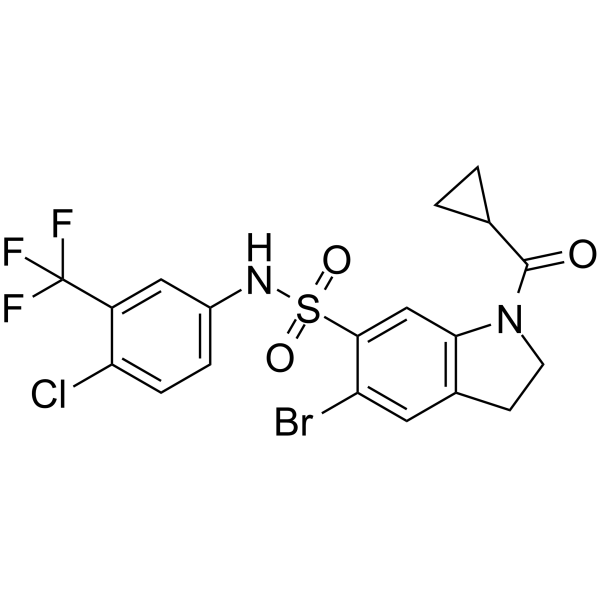
  • HY-134807

    P2X Receptor 5-HT Receptor Autophagy Cancer
    Indophagolin is a potent, indoline-containing autophagy inhibitor (IC50=140 nM). Indophagolin antagonizes the purinergic receptor P2X4 as well as P2X1 and P2X3 with IC50s of 2.71, 2.40 and 3.49 μM, respectively. Indophagolin also antagonizes the Gq-protein-coupled P2Y4, P2Y6, and P2Y11 receptors (IC50s =3.4~15.4 μM). Indophagolin has a strong antagonistic effect on serotonin receptor 5-HT6 (IC50=1.0 μM) and a moderate effect on receptors 5-HT1B, 5-HT2B, 5-HT4e, and 5-HT7 .
    Indophagolin
  • HY-135439

    5-HT Receptor Neurological Disease
    SB-203186 is a highly selective 5-HT4 receptor antagonist. SB-203186 exhibits a potent competitive antagonistic effect, with its pKB value being 8.3 in the isolated right atrium model of piglets. SB-203186 can dose-dependently shift the 5-HT-induced tachycardia curve to the right, and does not inhibit the maximum response. SB-203186 is an efficient 5-HT₄ antagonist in pig and human atria, but has no significant inhibitory effect in rat atria. SB-203186 can be used for the study of diseases such as arrhythmias and abnormal myocardial contraction .
    SB-203186
  • HY-14149A
    Cisapride monohydrate
    2 Publications Verification

    R 51619 monohydrate; (±)-Cisaprid monohydrate

    5-HT Receptor Neurological Disease Metabolic Disease
    Cisapride monohydrate is an orally and potent 5-HT4 receptor agonist and hERG inhibitor. Cisapride monohydrate is an prokinetic agent which facilitates or restores motility throughout the length of the gastrointestinal tract. Cisapride monohydrate stimulates gastrointestinal motor activity through an indirect mechanism involving the release of acetylcholine mediated by postganglionic nerve endings in the myenteric plexus of the gut .
    Cisapride monohydrate
  • HY-15574R

    SB-207266 (Standard)

    5-HT Receptor Reference Standards Cardiovascular Disease
    Piboserod (Standard) is the analytical standard of Piboserod. This product is intended for research and analytical applications. Piboserod is an orally available selective antagonist of the 5-HT4 receptor, with a Ki value of approximately 0.1 nM for human 5-HT4 receptors. Piboserod can competitively bind to the 5-HT4 receptor and block the activation of the 5-HT4 receptor. Piboserod can inhibit the enhancing effect of 5-HT on the nerve-mediated contraction response of the human bladder detrusor muscle. Piboserod is mainly used in the research of urinary system diseases (such as overactive bladder) and cardiovascular diseases (such as chronic heart failure) .
    Piboserod (Standard)
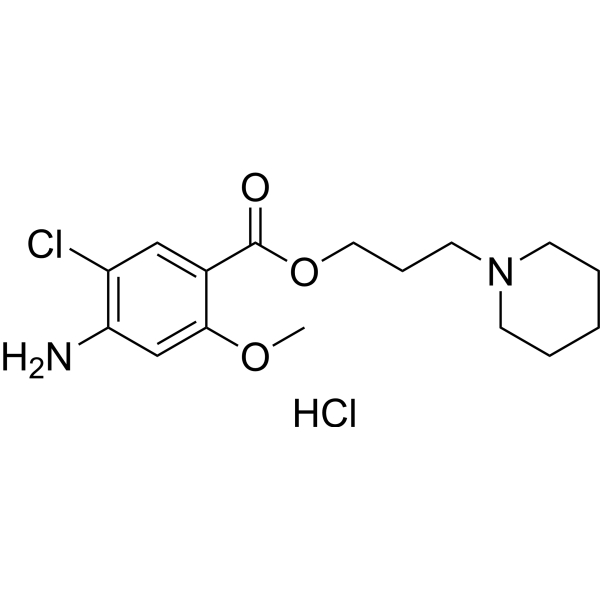
  • HY-19927A

    5-HT Receptor Neurological Disease Endocrinology
    DA-6886 is a 5-Hydroxytryptamine receptor 4 (5-HT4) agonist. DA-6886 induces relaxation of the rat oesophagus preparation in a 5-HT4 receptor antagonist-sensitive manner. The evaluation of DA-6886 in CHO cells expressing hERG channels reveals that it inhibits hERG channel current with an pIC50 value of 4.3, indicating that the compound is 1000-fold more selective for the 5-HT4 receptor over hERG channels. DA-6886 can be used in the study of constipated irritable bowel syndrome .
    DA-6886 monohydrochloride
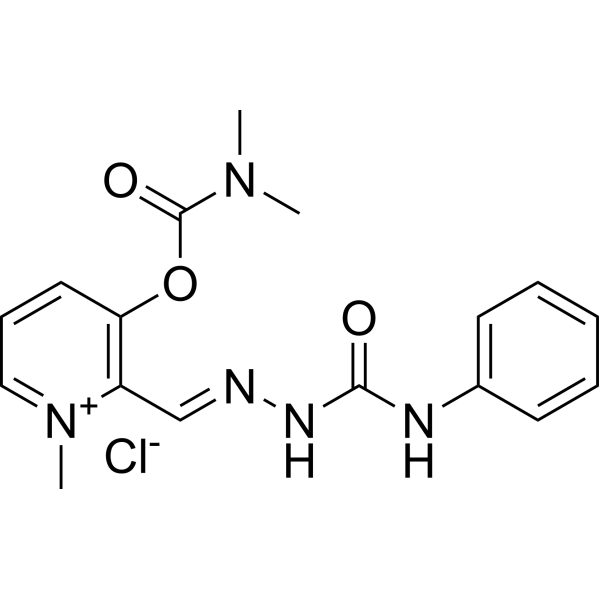
  • HY-162591

    Cholinesterase (ChE) 5-HT Receptor Neurological Disease
    MR33317 is an inhibitor of acetylcholinesterase with an IC50 value of 41nM. MR33317 is also an agonist at brain 5-HT4 receptors .
    MR33317
  • HY-101653

    Cholinesterase (ChE) mAChR 5-HT Receptor Neurological Disease
    MHP 133 is a agent with multiple CNS targets, and inhibits acetylcholinesterase (AChE) with Ki of 69 μM; also active against muscarinic M1 and M2 receptors, serotonin 5HT4 receptors, and imidazole I2 receptors.
    MHP 133
  • HY-14148

    5-HT Receptor Neurological Disease
    Renzapride hydrochloride is a benzamide that inhibits irritable bowel syndrome and has antagonistic activity at 5-HT(3) receptors and agonistic activity at 5-HT(4) receptors. Renzapride hydrochloride also exhibits antagonistic activity at 5-HT(2B) receptors and has a certain affinity for 5-HT(2A) and 5-HT(2C) receptors .
    Renzapride hydrochloride
  • HY-180372

    5-HT Receptor Adrenergic Receptor GABA Receptor Serotonin Transporter Dopamine Receptor Neurological Disease
    CSP-2503 is a potent and selective 5-HT1A receptor agonist , with an EC50 of 0.15 μM and a Ki of 4.1 nM. CSP-2503 exhibits excellent selectivity over α1-adrenoceptors (Ki > 1000 nM), 5-HT4 receptors, and benzodiazepine receptors. CSP-2503 inhibits cAMP increase in vitro and exhibits anxiolytic activity in vivo. CSP-2503 can be used for the research of anxiety-related disorders .
    CSP-2503
  • HY-101172R

    EP-A-501322 (Standard)

    5-HT Receptor Reference Standards Cardiovascular Disease
    RS 23597-190 (Standard) is the analytical standard of RS 23597-190 (HY-101172). This product is intended for research and analytical applications. RS 23597-190 (EP-A-501322) is a high affinity and selective 5-HT4 receptor antagonist. RS 23597-190 inhibits Serotonin (HY-B1473A)-induced tachycardia. RS 23597-190 significantly inhibits superoxide production in high glucose .
    RS 23597-190 (Standard)

Inquiry Online

Your information is safe with us. * Required Fields.

Salutation


Country or Region *

Applicant Name *


Organization Name *

Department *


Email Address *


Product Name *

Cat. No.


Requested quantity *

Phone Number *


Remarks

Inquiry Online

Inquiry Information

Product Name:
Cat. No.:
Quantity:
MCE Japan Authorized Agent:

