8 Results for "

Carboxypeptidase D

" in MedChemExpress (MCE) Product Catalog:
Products (8)

8 Results for "Carboxypeptidase D" in MCE Product Catalog:

Cat. No.: HY-W096171
CAS No.: 5796-17-8
Synonyms: 3-Hydroxy-D-tyrosine
Target:  

Carboxypeptidase

Research Areas:  

Infection Neurological Disease

D-Dopa (3-Hydroxy-D-tyrosine) is a potent, orally active, non-competitive and allosteric inhibitor of glutamate carboxypeptidase II (GCPII) with an IC50 of 200 nM. D-Dopa elevates brain dopamine and produce turning behavior in rats. D-Dopa inhibit severe fever with thrombocytopenia syndrome (SFTS) virus infection. D-Dopa can be used for neurological disease and virus infection research .
loading...
    loading...
Cat. No.: HY-114118S
Semaglutide-d8 is the deuterium labeled Semaglutide (HY-114118). Semaglutide is a long-acting, selective, competitive GLP-1R agonist that can penetrate the blood-brain barrier. After activating GLP-1R, Semaglutide promotes insulin secretion, inhibits gastric emptying and appetite, and at the same time enhances autophagy, inhibits oxidative stress and apoptosis. Semaglutide also regulates mitochondrial function and lipid metabolism (such as reducing de novo lipogenesis in the liver). Semaglutide has activities such as lowering blood sugar, reducing weight, neuroprotection (such as improving motor function in Parkinson's disease models, reducing α-synuclein aggregation) and improving hepatic steatosis. Semaglutide can be used for the study of neurodegenerative diseases and liver diseases such as type 2 diabetes, obesity, Parkinson's disease, metabolic associated fatty liver disease (MASLD), and cancer .
loading...
    loading...
Cat. No.: HY-114118S1
Semaglutide-d8 tetraTFA is the deuterium labeled Semaglutide (HY-114118). Semaglutide is a long-acting, selective, competitive GLP-1R agonist that can penetrate the blood-brain barrier. After activating GLP-1R, Semaglutide promotes insulin secretion, inhibits gastric emptying and appetite, and at the same time enhances autophagy, inhibits oxidative stress and apoptosis. Semaglutide also regulates mitochondrial function and lipid metabolism (such as reducing de novo lipogenesis in the liver). Semaglutide has activities such as lowering blood sugar, reducing weight, neuroprotection (such as improving motor function in Parkinson's disease models, reducing α-synuclein aggregation) and improving hepatic steatosis. Semaglutide can be used for the study of neurodegenerative diseases and liver diseases such as type 2 diabetes, obesity, Parkinson's disease, metabolic associated fatty liver disease (MASLD), and cancer .
loading...
    loading...
Cat. No.: HY-P4519
CAS No.: 65882-12-4
Target:  

Carboxypeptidase

Research Areas:  

Others

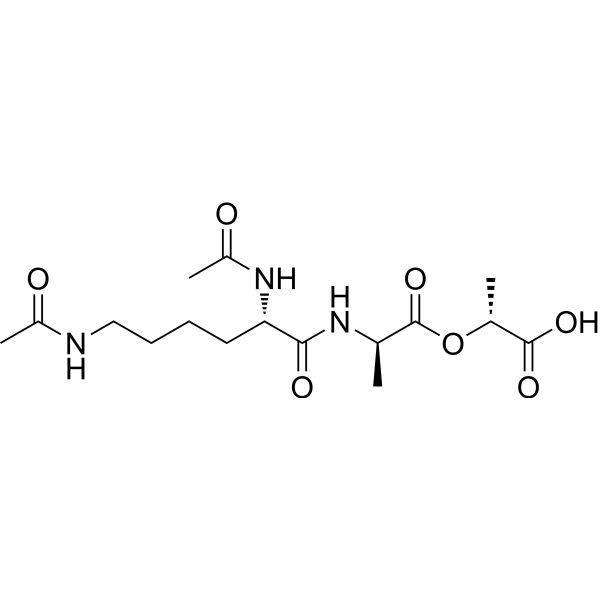
Ac-Lys(Ac)-D-Ala-D-Lactic acid is a depsipeptide substrate for penicillin-sensitive D-alanine carboxypeptidases (DD-carboxypeptidases) .
loading...
    loading...
Cat. No.: HY-P4523
CAS No.: 76079-06-6
Target:  

Endogenous Metabolite

Research Areas:  

Endocrinology

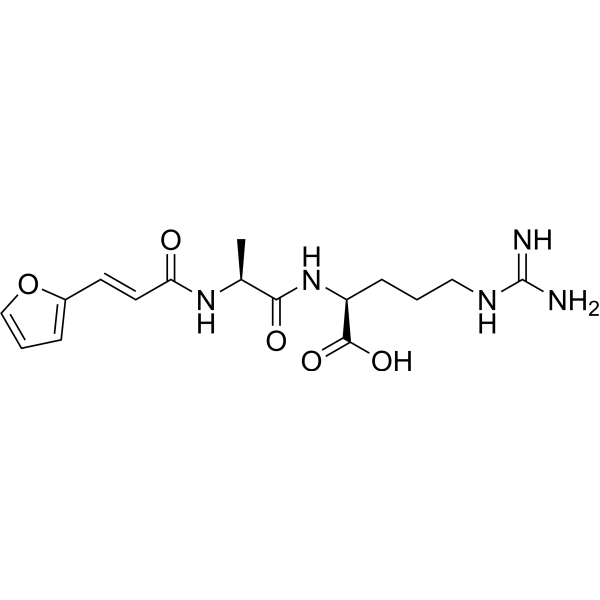
FA-Ala-Arg is a dipeptide with furylacryloyl group. FA-Ala-Arg breaks down to produce arginine. While cell-surface Carboxypeptidase-D (CPD) also increases intracellular Arg, which is converted to nitric oxide (NO). FA-Ala-Arg enhances NO production in MCF-7 cells. FA-Ala-Arg also increases the cell survival of prolactin (PRL)-treated cells, PRL regulates CPD mRNA levels in cells .
loading...
    loading...
Cat. No.: HY-P1982
CAS No.: 157381-55-0
Rpi-856 C is an Aspartic protease inhibitor, with an IC50 of 5.5 nM against HIV-1 protease, 9.2 nM against HTLV-I protease, 2.0 μM against Cathepsin D, and 4.8 μM against Pepsin. Rpi-856 C is produced by the Streptomyces strain AL-322. Rpi-856 C does not inhibit chymosin, trypsin, chymotrypsin, papain, bromelain, thermolysin, prolyl endopeptidase, carboxypeptidase A or carboxypeptidase B. Rpi-856 C can be used in the research of acquired immunodeficiency syndrome (AIDS) and related diseases, as well as HIV infection .
loading...
    loading...
Cat. No.: HY-E71335
Research Areas:  

Others

γ-D-Glutamyl-meso-diaminopimelate peptidase (EC 3.4.19.11) is a 45-kDa metallopeptidase from Bacillus sphaericus, the substrates being components of the bacterial spore wall. A member of peptidase family M14 (carboxypeptidase A family) . Endopeptidase II has similar activity, but differs in cellular location, molecular mass and catalytic mechanism.
loading...
    loading...
Cat. No.: HY-D3189
CAS No.: 2370825-44-6
5GluAF-2MeTG is an activatable fluorescent probe targeting the glutamate carboxypeptidase (CP) activity of PSMA (Ex/Em=490/500-600 nm). After being hydrolyzed by PSMA, 5GluAF-2MeTG releases a cell membrane-permeable fluorescent product, and achieves fluorescence activation by disrupting donor-excited photoinduced electron transfer (d-PeT). 5GluAF-2MeTG enables fluorescence imaging of live PSMA-expressing prostate cancer cells in vitro and visualizes the carboxypeptidase activity of PSMA. 5GluAF-2MeTG can be used to detect prostate cancer regions in preclinical excised tissue specimens .
loading...
    loading...

