1. Search Result
Search Result
Isoforms Recommended: D4 Receptor
Results for "

D4-receptor

" in MedChemExpress (MCE) Product Catalog:

95

Inhibitors & Agonists

1

Screening Libraries

1

Natural
Products

13

Isotope-Labeled Compounds

Cat. No. Product Name Target Research Areas Chemical Structure
  • HY-14546
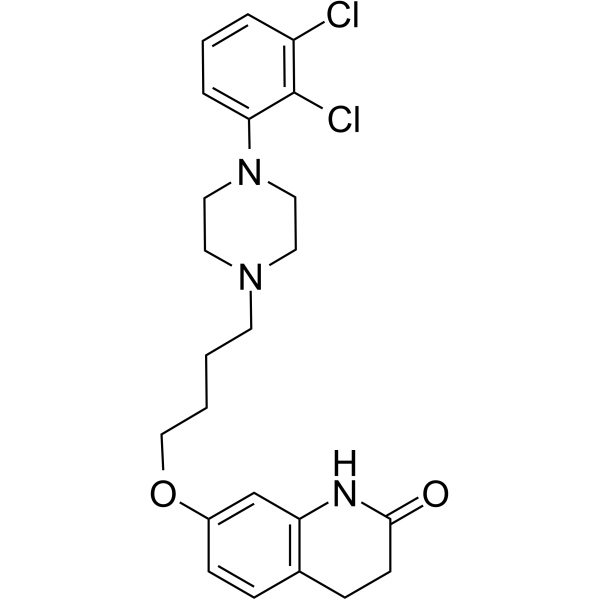
    Aripiprazole
    10+ Cited Publications

    OPC-14597

    5-HT Receptor Dopamine Receptor Infection Neurological Disease Inflammation/Immunology
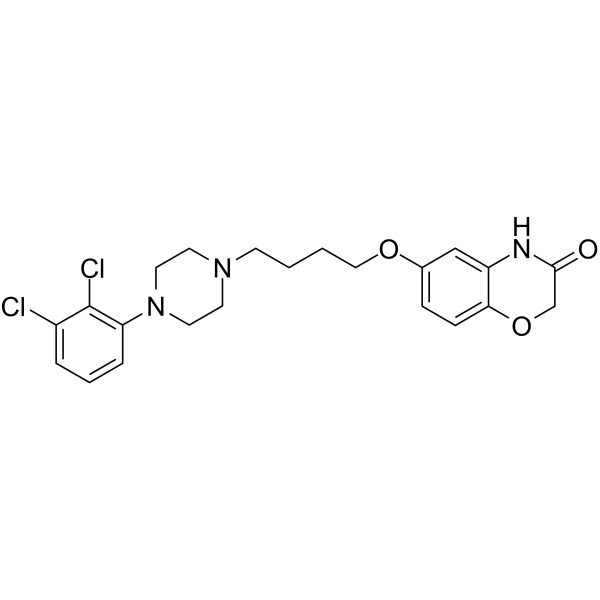
    Aripiprazole (OPC-14597), an atypical antipsychotic, is a potent and high-affinity dopamine D2 receptor partial agonist. Aripiprazole is an inverse agonist at 5-HT2B and 5-HT2A receptors and displays partial agonist actions at 5-HT1A, 5-HT2C, D3, and D4 receptors. Aripiprazole can be used for the research of schizophrenia and COVID19 [4].
    Aripiprazole
  • HY-17355
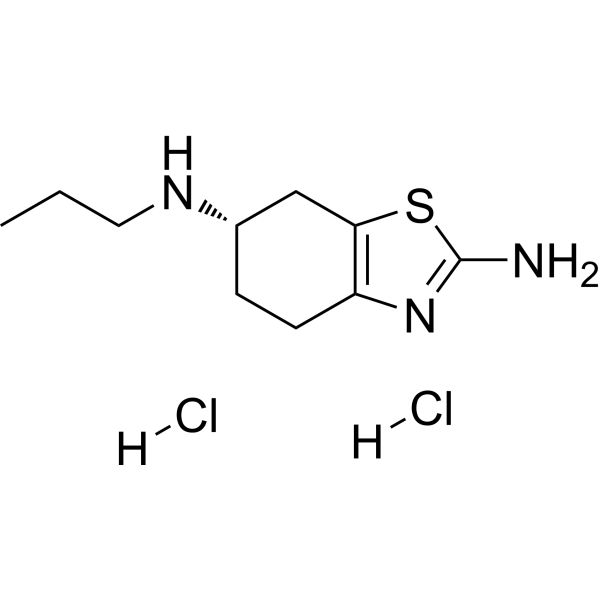
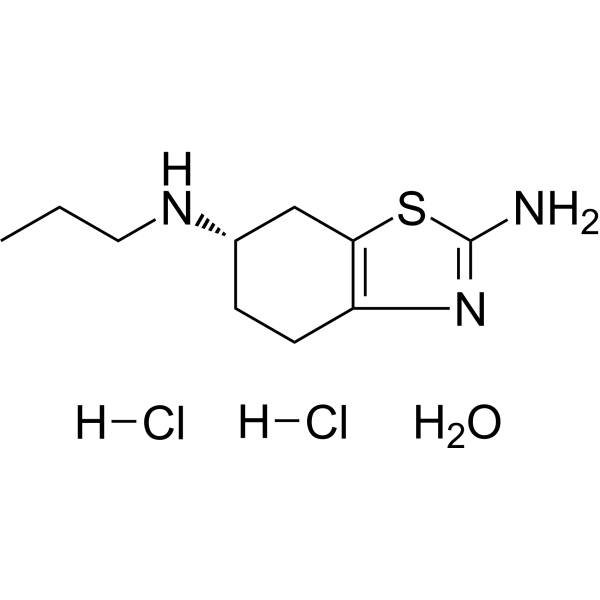
    Pramipexole dihydrochloride
    Maximum Cited Publications
    13 Publications Verification

    Dopamine Receptor Neurological Disease
    Pramipexole dihydrochloride is a selective and blood-brain barrier (BBB) penetrant dopamine D2-type receptor agonist, with Kis of 2.2 nM, 3.9 nM, 0.5 nM and 1.3 nM for D2-type receptor, D2, D3 and D4 receptors, respectively. Pramipexole dihydrochloride can be used for the research of Parkinson's disease (PD) and restless legs syndrome (RLS) .
    Pramipexole dihydrochloride
  • HY-10349
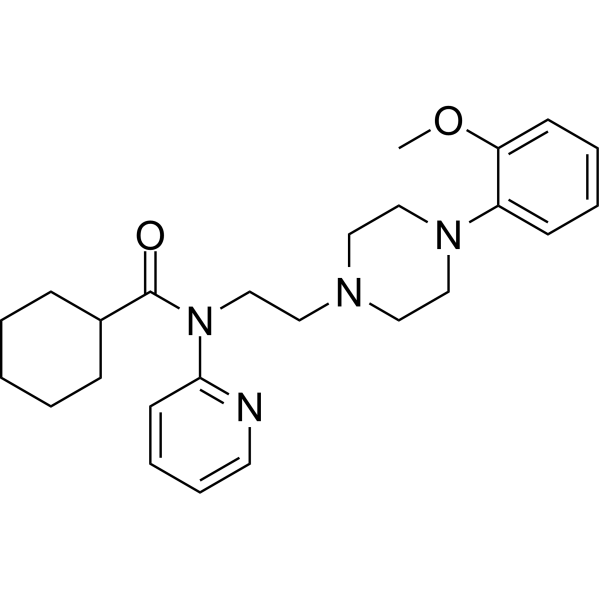
    WAY-100635
    10+ Cited Publications

    5-HT Receptor Dopamine Receptor Neurological Disease
    WAY-100635 is a potent and selective 5-HT1A Receptor antagonist with a pIC50 of 8.87, an apparent pA2 of 9.71. WAY-100635 is a potent and selective 5-hydroxytryptamine 1A (5-HT1A) receptor antagonist with an IC50 value of 0.91 nM and Ki value of 0.39 nM. WAY-100635 has pIC50 values for 5-HT1A and α1-adrenergic receptors of 8.9 and 6.6, respectively. WAY-100635 is also a potent dopamine D4 receptor agonist .
    WAY-100635
  • HY-B0410
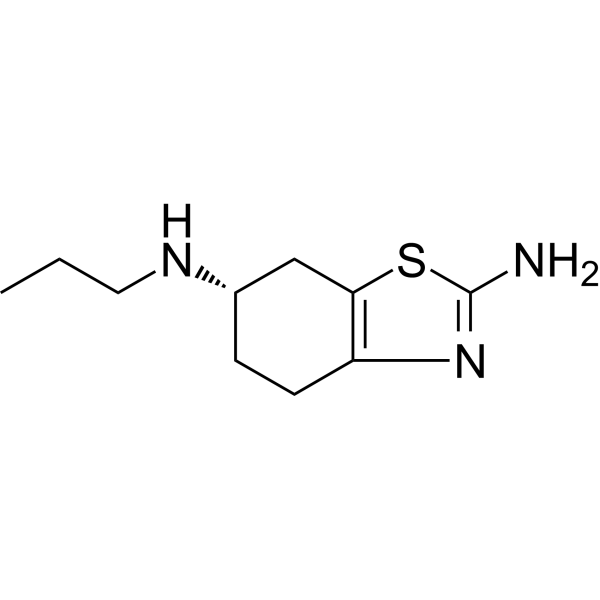
    Pramipexole
    Maximum Cited Publications
    13 Publications Verification

    Dopamine Receptor Neurological Disease
    Pramipexole is a selective and blood-brain barrier (BBB) penetrant dopamine D2-type receptor agonist, with Kis of 2.2 nM, 3.9 nM, 0.5 nM and 1.3 nM for D2-type receptor, D2, D3 and D4 receptors, respectively. Pramipexole can be used for the research of Parkinson's disease (PD) and restless legs syndrome (RLS) .
    Pramipexole
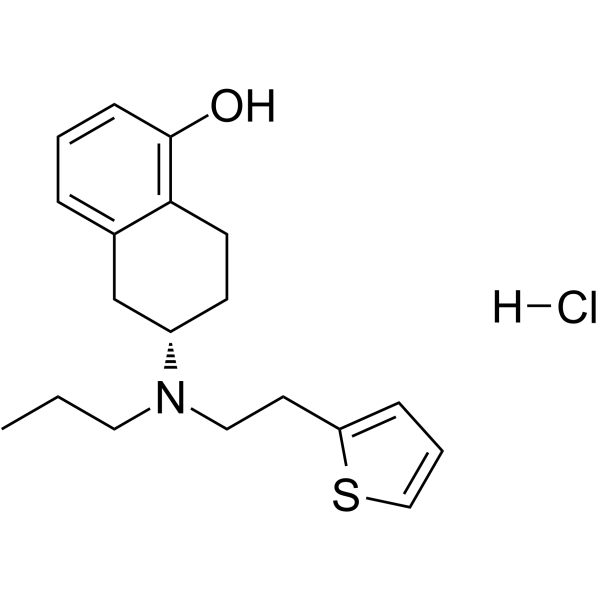
  • HY-75502
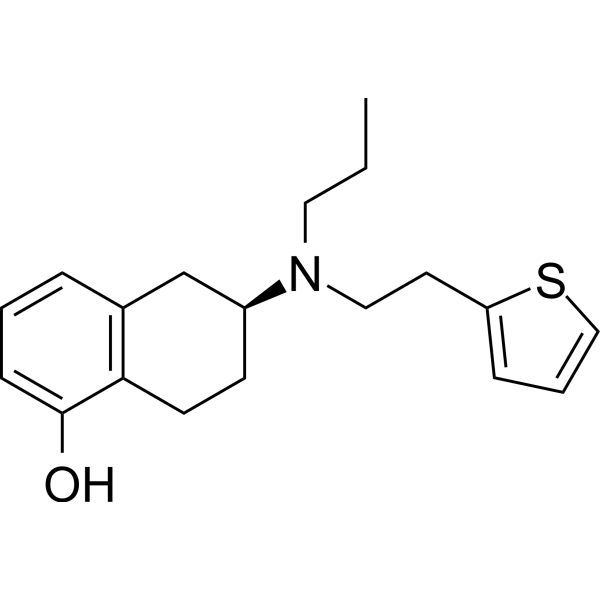
    Rotigotine
    3 Publications Verification

    N-0923; (-)-N 0437

    Dopamine Receptor Adrenergic Receptor 5-HT Receptor Neurological Disease Endocrinology
    Rotigotine is a potent dopamine receptor agonist with Ki values of 0.71 nM, 4-15 nM, and 83 nM for the dopamine D3 receptor and D2, D5, D4 receptors and dopamine D1 receptor. Rotigotine a partial agonist of the 5-HT1A receptor, and an antagonist of the α2B-adrenergic receptor. Rotigotine can be used for parkinson's disease (PD) research [4].
    Rotigotine
  • HY-A0095
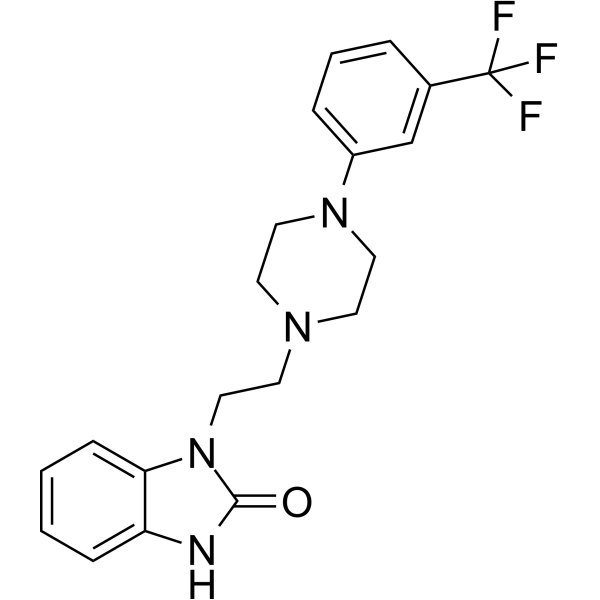
    Flibanserin
    2 Publications Verification

    BIMT-17; BIMT-17BS

    5-HT Receptor Neurological Disease Cancer
    Flibanserin (BIMT-17; BIMT-17BS) is an orally active serotonin 5-HT1A receptor agonist and 5-HT2A receptor antagonist with Ki values of 1 nM and 49 nM, respectively. Flibanserin binds to dopamine D4 receptors with an Ki value of 4-24 nM. Flibanserin shows anti-depression and anti-anxiety effect, can be used to hypoactive sexual desire disorder (HSDD) research - .
    Flibanserin
  • HY-10349A
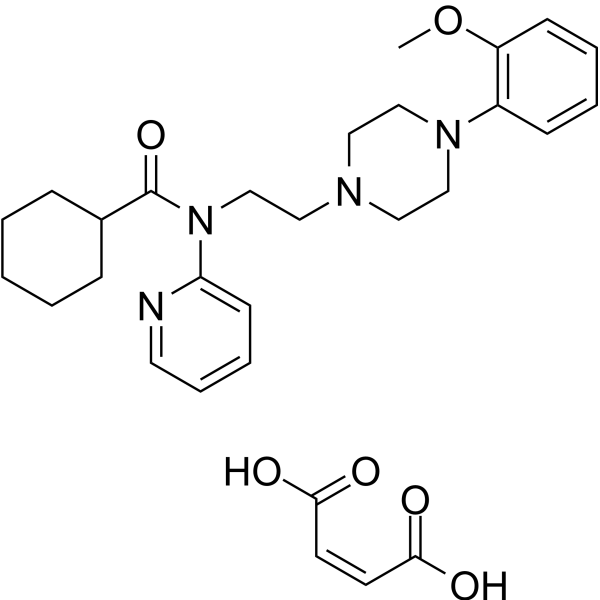
    WAY-100635 maleate
    10+ Cited Publications

    5-HT Receptor Dopamine Receptor Neurological Disease
    WAY-100635 maleate is a potent and selective 5-hydroxytryptamine 1A (5-HT1A) receptor antagonist with an IC50 value of 0.91 nM and Ki value of 0.39 nM. WAY-100635 maleate has pIC50 values for 5-HT1A and α1-adrenergic receptors of 8.9 and 6.6, respectively. WAY-100635 maleate is also a potent dopamine D4 receptor agonist .
    WAY-100635 maleate
  • HY-A0007
    Rotigotine Hydrochloride
    3 Publications Verification

    N-0923 Hydrochloride

    Dopamine Receptor Adrenergic Receptor 5-HT Receptor Neurological Disease
    Rotigotine Hydrochloride (N-0923 Hydrochloride) is a full agonist of dopamine receptor, a partial agonist of the 5-HT1A receptor, and an antagonist of the α2B-adrenergic receptor, with Ki of 0.71 nM, 4-15 nM, and 83 nM for the dopamine D3 receptor and D2, D5, D4 receptors, and dopamine D1 receptor.
    Rotigotine Hydrochloride
  • HY-101348
    L-741626
    2 Publications Verification

    Dopamine Receptor Neurological Disease
    L-741626 is a selective D2 dopamine receptor antagonist, with the Ki values of 2.4, 100 and 220 nM for human D2, D3 and D4 receptors respectively .
    L-741626
  • HY-14546A
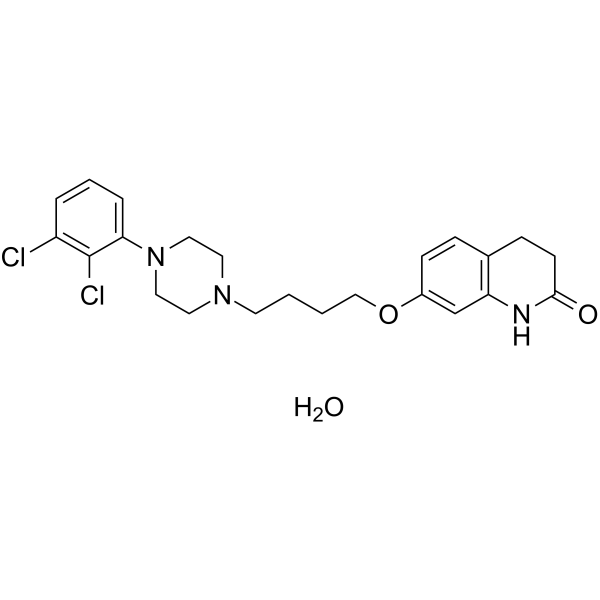
    Aripiprazole monohydrate
    10+ Cited Publications

    OPC-14597 monohydrate

    5-HT Receptor Dopamine Receptor Infection Neurological Disease Inflammation/Immunology
    Aripiprazole (OPC-14597) monohydrate, an atypical antipsychotic, is a potent and high-affinity dopamine D2 receptor partial agonist. Aripiprazole monohydrate is an inverse agonist at 5-HT2B and 5-HT2A receptors and displays partial agonist actions at 5-HT1A, 5-HT2C, D3, and D4 receptors. Aripiprazole monohydrate can be used for the research of schizophrenia and COVID19 [4].
    Aripiprazole monohydrate
  • HY-109112

    RP5063

    Dopamine Receptor 5-HT Receptor Neurological Disease Inflammation/Immunology
    Brilaroxazine (RP5603) is a potent and orally active multimodal dopamine (DA)/serotonin (5-HT) modulator. Brilaroxazine is a partial agonist of dopamine (DA) D2, D3, and D4 receptors, 5-HT1A (Ki=1.5 nM) and 5-HT2A (Ki=2.5 nM), and has antagonist activity at 5-HT2B (Ki=0.19 nM), and 5-HT7 (Ki=2.7 nM) receptors . Brilaroxazine is an atypical antipsychotic agent, and has the potential to improve cognitive impairments in neuropsychiatric and neurological diseases in vivo .
    Brilaroxazine
  • HY-21098A
    PD-168077 maleate
    1 Publications Verification

    Dopamine Receptor Neurological Disease
    PD-168077 maleate is a selective dopamine D4 receptor agonist, with a Ki of 9 nM.
    PD-168077 maleate
  • HY-B0410A
    Pramipexole dihydrochloride hydrate
    Maximum Cited Publications
    13 Publications Verification

    Dopamine Receptor Neurological Disease
    Pramipexole dihydrochloride hydrate is a selective and blood-brain barrier (BBB) penetrant dopamine D2-type receptor agonist, with Kis of 2.2 nM, 3.9 nM, 0.5 nM and 1.3 nM for D2-type receptor, D2, D3 and D4 receptors, respectively. Pramipexole dihydrochloride hydrate can be used for the research of Parkinson's disease (PD) and restless legs syndrome (RLS) .
    Pramipexole dihydrochloride hydrate
  • HY-100703

    Floropipamide; McN-JR 3345; R 3345

    5-HT Receptor Dopamine Receptor Neurological Disease
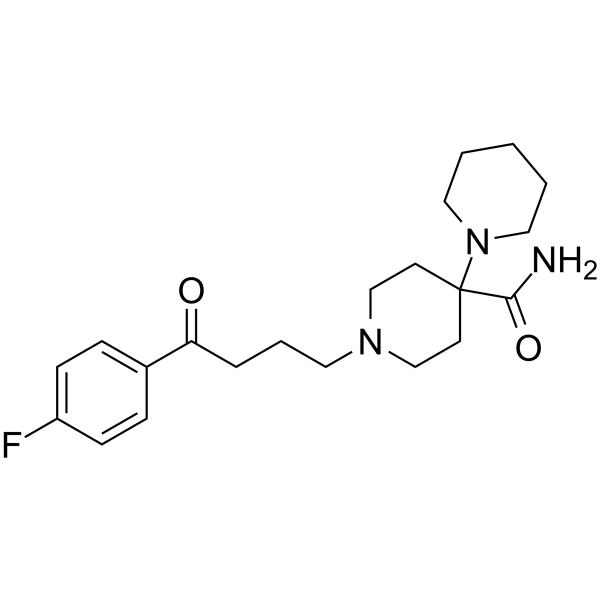
    Pipamperone (Floropipamide) is a butyrophenone derivative and high-affinity antagonist of 5-HT2A receptor (pKi=8.2) and D4 receptor (pKi=8.0). Pipamperone is also a low-affinity antagonist of D2 receptor (pKi=6.7). Pipamperone affects neurotransmitter functions and exerts antipsychotic activity. Pipamperone is used in the research of mental disorders such as autism-related behavioral disorders and Alzheimer's disease [4].
    Pipamperone
  • HY-147398

    Dopamine Receptor Neurological Disease
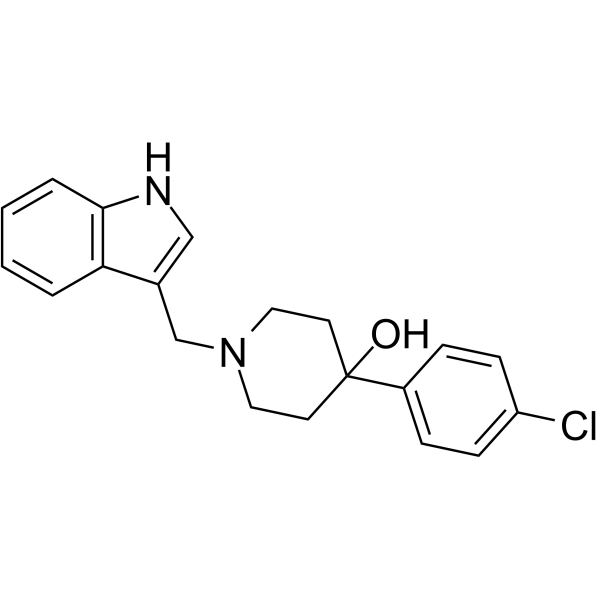
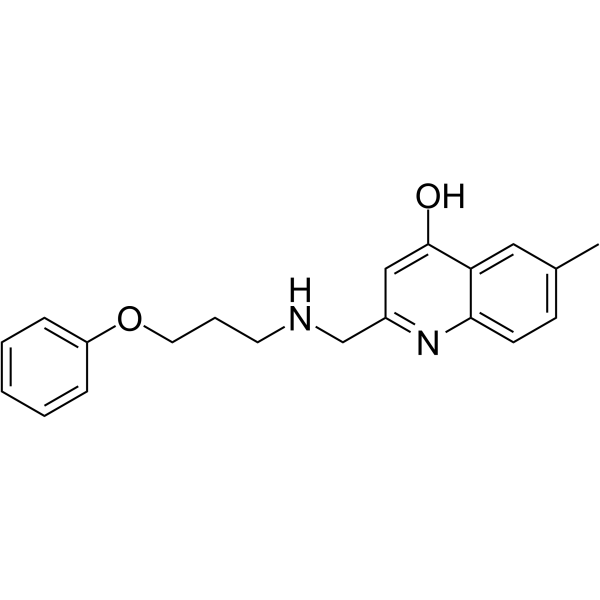
    Dopamine D4 receptor antagonist-1 is a selective DRD4 antagonists, with a Ki of 9.0 nM for Hd4.2. Dopamine D4 receptor antagonist-1 can be used in study of schizophrenia .
    Dopamine D4 receptor antagonist-1
  • HY-125751
    UCSF924
    1 Publications Verification

    Dopamine Receptor Neurological Disease
    UCSF924, a chemical probe, is a potent and specific dopamine D4 receptor (DRD4) partial agonist with a EC50 of 4.2 nM. UCSF924 has no off-target effects on more than 320 non-olfactory GPCRs. UCSF924 can be used for research in the field of neuropsychiatric diseases .
    UCSF924
  • HY-14325
    L-745870
    3 Publications Verification

    Dopamine Receptor Neurological Disease
    L-745870 is a potent, selective, brain-penetrant and orally active dopamine D4 receptor antagonist with a Ki of 0.43 nM. L-745870 shows weaker affinity for D2 (Ki of 960 nM) and D3 (Ki of 2300 nM) receptors, and exhibits moderate affinity for 5-HT2 receptors, sigma sites and α-adrenoceptors .
    L-745870
  • HY-14325B
    L-745870 hydrochloride
    3 Publications Verification

    Dopamine Receptor Neurological Disease
    L-745870 hydrochloride is a potent, selective, brain-penetrant and orally active dopamine D4 receptor antagonist with a Ki of 0.43 nM. L-745870 hydrochloride shows weaker affinity for D2 (Ki of 960 nM) and D3 (Ki of 2300 nM) receptors, and exhibits moderate affinity for 5-HT2 receptors, sigma sites and α-adrenoceptors .
    L-745870 hydrochloride
  • HY-116941

    Dopamine Receptor Neurological Disease
    A-381393 is a potent, selective, brain penetrate dopamine D4 receptor antagonist, with Kis of 1.5, 1.9 and 1.6 nM for human dopamine D4.4, D4.2, and D4.7 receptor, respectively, >2700-fold selectivity over D1, D2, D3 and D5 dopamine receptors. A-381393 shows moderate affinity for 5-HT2A (Ki, 370 nM) .
    A-381393
  • HY-103409

    Dopamine Receptor Neurological Disease
    ABT-724 trihydrochloride is a potent and highly selective dopamine D4 receptor agonist with an EC50 of 12.4 nM for human dopamine D4 receptor. ABT-724 trihydrochloride is a potent partial agonist at the rat D4 (EC50 of 14.3 nM) and the ferret D4 receptor (EC50 of 23.2 nM), and has no effect on dopamine D1, D2, D3, or D5 receptors. ABT-724 trihydrochloride could be useful for the treatment of erectile dysfunction and has favorable side-effect profile .
    ABT-724 trihydrochloride
  • HY-116082

    Dopamine Receptor Neurological Disease
    CP 226269 is a potent dopamine D4 receptor agonist that induces calcium flux with EC50 of 32 nM. CP 226269 stimulates phospholipid methylation (PLM) in SK-N-MC neuroblastoma cells with an EC50 of 2.9 nM. CP 226269 can be used in the research of schizophrenia and other related diseases .
    CP 226269
  • HY-15394

    N-0437 hydrochloride

    Dopamine Receptor Adrenergic Receptor 5-HT Receptor Neurological Disease Endocrinology
    (Rac)-Rotigotine hydrochloride is a racemate of Rotigotine. Rotigotine is a full agonist of dopamine receptor, a partial agonist of the 5-HT1A receptor, and an antagonist of the α2B-adrenergic receptor, with Kis of 0.71 nM, 4-15 nM, and 83 nM for the dopamine D3 receptor and D2, D5, D4 receptors, and dopamine D1 receptor.
    (Rac)-Rotigotine hydrochloride
  • HY-N0927

    Tetrahydrocolumbamine; (S)-Tetrahydrocolumbamine

    Dopamine Receptor Others Neurological Disease
    (-)-Isocorypalmine (Tetrahydrocolumbamine; (S)-Tetrahydrocolumbamine) is a dopamine receptor ligand and modulator capable of crossing the blood-brain barrier. (-)-Isocorypalmine exhibits receptor selectivity, acting as a partial agonist of dopamine D1 and D5 receptors (coupled via Gs proteins), as well as an antagonist of D2, D3 and D4 receptors (by blocking Gi protein-mediated signaling). (-)-Isocorypalmine shows no significant binding to various non-dopamine receptors, ion channels and transporters. (-)-Isocorypalmine is metabolically stable in vivo, effectively inhibits spontaneous and cocaine-induced hyperlocomotion, sensitization and conditioned place preference in mice, and does not induce addictive place preference when administered alone. (-)-Isocorypalmine can be used in addiction research .
    (-)-Isocorypalmine
  • HY-103407A

    Dopamine Receptor Neurological Disease Cancer
    PD 168568 dihydrochloride is a orally active and potent dopamine receptor D4 (DRD4) antagonist. PD 168568 dihydrochloride contains an isoindolinone and is selective for the D4 receptor versus D2 and D3, with Ki values of 8.8, 1842, and 2682 nM, respectively. PD 168568 dihydrochloride can be used for glioblastoma (GBM) research .
    PD 168568 dihydrochloride
  • HY-17355S1

    Isotope-Labeled Compounds Dopamine Receptor Neurological Disease
    Pramipexole-d5 dihydrochloride is deuterium labeled Pramipexole dihydrochloride. Pramipexole dihydrochloride is a selective and blood-brain barrier (BBB) penetrant dopamine D2-type receptor agonist, with Kis of 2.2 nM, 3.9 nM, 0.5 nM and 1.3 nM for D2-type receptor, D2, D3 and D4 receptors, respectively. Pramipexole dihydrochloride can be used for the research of Parkinson's disease (PD) and restless legs syndrome (RLS) .
    Pramipexole-d5 dihydrochloride
  • HY-A0095A

    BIMT-17 hydrochloride (propan-2-ol) hydrate; BIMT-17BS hydrochloride (propan-2-ol) hydrate

    5-HT Receptor Neurological Disease Cancer
    Flibanserin (BIMT-17) hydrochloride (propan-2-ol) hydrate is an orally active serotonin 5-HT1A receptor agonist and 5-HT2A receptor antagonist with Ki values of 1 nM and 49 nM, respectively. Flibanserin hydrochloride (propan-2-ol) hydrate binds to dopamine D4 receptors with an Ki value of 4-24 nM. Flibanserin hydrochloride (propan-2-ol) hydrate shows anti-depression and anti-anxiety effect, can be used to hypoactive sexual desire disorder (HSDD) research - .
    Flibanserin hydrochloride (propan-2-ol) hydrate
  • HY-14330

    Dopamine Receptor Neurological Disease
    ABT-724, a chemical probe, is a potent and highly selective dopamine D4 receptor agonist with an EC50 of 12.4 nM for human dopamine D4 receptor. ABT-724 is a potent partial agonist at the rat D4 (EC50 of 14.3 nM) and the ferret D4 receptor (EC50 of 23.2 nM). ABT-724 has no effect on dopamine D1, D2, D3, or D5 receptors. ABT-724 could be useful for the treatment of erectile dysfunction and has favorable side-effect profile .
    ABT-724
  • HY-111155

    Dopamine Receptor Neurological Disease
    RBI-257 maleate is a potent dopamine D4 receptor antagonist with a Ki value of 0.3 nM .
    RBI-257 maleate
  • HY-U00185

    Lu201640; A37203

    Dopamine Receptor Neurological Disease
    A-437203 is a selective D3 receptor antagonist with Ki of 71, 1.6, and 6220 nM for D2, D3, and D4 receptors, respectively.
    A-437203
  • HY-103424

    Dopamine Receptor Neurological Disease
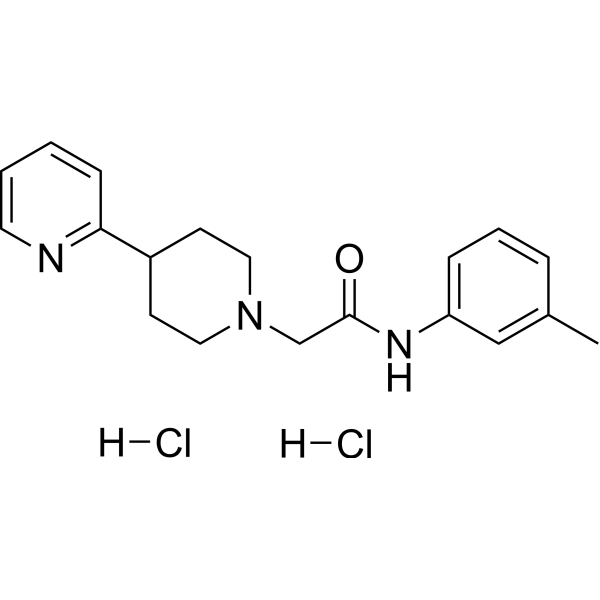
    A-412997 dihydrochloride is a selective dopamine D4 receptor agonist. A-412997 dihydrochloride improves cognitive performance in rats and can be used in the research of psychiatric diseases .
    A-412997 dihydrochloride
  • HY-14546R

    OPC-14597 (Standard)

    Reference Standards 5-HT Receptor Dopamine Receptor Infection Neurological Disease Inflammation/Immunology
    Aripiprazole (Standard) is the analytical standard of Aripiprazole. This product is intended for research and analytical applications. Aripiprazole (OPC-14597), an atypical antipsychotic, is a potent and high-affinity dopamine D2 receptor partial agonist. Aripiprazole is an inverse agonist at 5-HT2B and 5-HT2A receptors and displays partial agonist actions at 5-HT1A, 5-HT2C, D3, and D4 receptors. Aripiprazole can be used for the research of schizophrenia and COVID19 [4].
    Aripiprazole (Standard)
  • HY-14546S

    OPC-14597-d8

    5-HT Receptor Neurological Disease
    Aripiprazole-d8 (OPC-14597-d8) is the deuterium labeled Aripiprazole (HY-14546). Aripiprazole (OPC-14597), an atypical antipsychotic, is a potent and high-affinity dopamine D2 receptor partial agonist. Aripiprazole is an inverse agonist at 5-HT2B and 5-HT2A receptors and displays partial agonist actions at 5-HT1A, 5-HT2C, D3, and D4 receptors. Aripiprazole can be used for the research of schizophrenia and COVID19.
    Aripiprazole-d8
  • HY-101384A
    Ro 10-5824 dihydrochloride
    1 Publications Verification

    Dopamine Receptor Others
    Ro 10-5824 dihydrochloride is a selective dopamine D4 receptor partial agonist, with Ki of 5.2 nM.
    Ro 10-5824 dihydrochloride
  • HY-14326

    Dopamine Receptor Neurological Disease
    L-750667 is a selective dopamine D4 receptor antagonist ligand. 125I-labeled L-750667 can specifically bind to dopamine D4 receptors in the rat retina, with a Kd value of 0.06 nM. L-750667 is involved in the regulation of the light-sensitive cAMP pool .
    L-750667
  • HY-U00253

    Leukotriene Receptor Prostaglandin Receptor Inflammation/Immunology Endocrinology
    KP496 is a selective, dual antagonist for Leukotriene D4 receptor and Thromboxane A2 receptor.
    KP496
  • HY-103104

    RP 62203

    5-HT Receptor Dopamine Receptor Neurological Disease
    Fananserin (RP 62203) is an orally bioavailable, potent and selective 5-hydroxytryptamine2 (5-HT2) receptor antagonist, with a Ki of 0.37 nM for the rat 5-HT2A receptor. Fananserin also is a selective dopamine D4 receptor antagonist, with a Ki of 2.93 nM for the human dopamine D4 receptor .
    Fananserin
  • HY-122149

    Leukotriene Receptor Cardiovascular Disease
    L-648051 is a leukotriene D4 receptor (LTD4) antagonist. L-648051 plays an important role in arrhythmias .
    L-648051
  • HY-106995

    CI 1030

    Dopamine Receptor Neurological Disease
    PD 172760 (CI 1030) is a selective D4 receptor antagonist. PD 172760 along with the action of other neurotransmitter receptors may be important in study psychosis .
    PD 172760
  • HY-14331

    Dopamine Receptor Neurological Disease
    YM-50001 is a potent and selective dopamine D4 receptor antagonist with a Ki 5.62 nM. YM-50001 can be used for the research of neurological disease .
    YM-50001
  • HY-19483

    Dopamine Receptor Neurological Disease
    ABT-670 is a selective, oral bioavailable agonist of dopamine D4 receptor, with EC50 of 89 nM, 160 nM, and 93 nM for human D4, ferret D4, and rat D4, respectively.
    ABT-670
  • HY-103407

    Dopamine Receptor Neurological Disease Cancer
    PD 168568 is a orally active and potent dopamine receptor D4 (DRD4) antagonist. PD 168568 contains an isoindolinone and is selective for the D4 receptor versus D2 and D3, with Ki values of 8.8, 1842, and 2682 nM, respectively. PD 168568 can be used for glioblastoma (GBM) research .
    PD 168568
  • HY-123663

    PNU-101958 maleate

    Dopamine Receptor Neurological Disease
    U-101958 (PNU-101958) maleate is a highly selective ligand and antagonist for dopamine D4 receptor, with an IC50 of 2.7 nM. U-101958 maleate behaves as an agonist in HEK-293 cells expressing the human recombinant D4.4 receptor. U-101958 maleate is an antipsychotic .
    U-101958 maleate
  • HY-A0095B

    BIMT-17 hydrochloride; BIMT-17BS hydrochloride

    5-HT Receptor Dopamine Receptor Neurological Disease
    Flibanserin hydrochloride (BIMT-17 hydrochloride) is an orally active 5-HT1A receptor agonist and 5-HT2A receptor antagonist with binding affinities Ki of 1 nM and 49 nM, respectively. Flibanserin hydrochloride also binds to dopamine D4 receptors with a Ki of 4-24 nM. Flibanserin hydrochloride has antidepressant and anxiolytic effects and can be used in the study of hypoactive sexual desire disorder (HSDD) .
    Flibanserin hydrochloride
  • HY-103405A

    Dopamine Receptor Neurological Disease
    NGD 94-1 (dimaleate) is a potent and selective dopamine D4 receptor antagonist. NGD 94-1 (dimaleate) shows high affinity for the cloned human D4.2 receptor (Ki = 3.6 nM). NGD 94-1 (dimaleate) modulates the cognitive functions of the frontostriatal system and regulates dopaminergic transmission in Phencyclidine (PCP)-induced monkeys. NGD 94-1 (dimaleate) can be used for neurological disease research [1][2].
    NGD 94-1 dimaleate
  • HY-17355S

    Isotope-Labeled Compounds Dopamine Receptor Neurological Disease
    Pramipexole-d7 dihydrochloride is the deuterium labeled Pramipexole dihydrochloride. Pramipexole dihydrochloride is a selective and blood-brain barrier (BBB) penetrant dopamine D2-type receptor agonist, with Kis of 2.2 nM, 3.9 nM, 0.5 nM and 1.3 nM for D2-type receptor, D2, D3 and D4 receptors, respectively. Pramipexole dihydrochloride can be used for the research of Parkinson's disease (PD) and restless legs syndrome (RLS) .
    Pramipexole-d7 dihydrochloride
  • HY-100703A

    Floropipamide dihydrochloride; McN-JR 3345 dihydrochloride; R 3345 dihydrochloride

    Dopamine Receptor 5-HT Receptor Neurological Disease
    Pipamperone dihydrochloride (Floropipamide dihydrochloride) is a butyrophenone derivative and high-affinity antagonist of 5-HT2A receptor (pKi=8.2) and D4 receptor (pKi=8.0). Pipamperone dihydrochloride is also a low-affinity antagonist of D2 receptor (pKi=6.7). Pipamperone dihydrochloride affects neurotransmitter functions and exerts antipsychotic activity. Pipamperone dihydrochloride is used in the research of mental disorders such as autism-related behavioral disorders and Alzheimer's disease [4].
    Pipamperone dihydrochloride
  • HY-B0410S1

    Dopamine Receptor Neurological Disease
    Pramipexole-d5 is the deuterium labeled Pramipexole . Pramipexole is a selective and blood-brain barrier (BBB) penetrant dopamine D2-type receptor agonist, with Kis of 2.2 nM, 3.9 nM, 0.5 nM and 1.3 nM for D2-type receptor, D2, D3 and D4 receptors, respectively. Pramipexole can be used for the research of Parkinson's disease (PD) and restless legs syndrome (RLS) [4].
    Pramipexole-d5
  • HY-14325R

    Dopamine Receptor Neurological Disease
    L-745870 (Standard) is the analytical standard of L-745870. This product is intended for research and analytical applications. L-745870 is a potent, selective, brain-penetrant and orally active dopamine D4 receptor antagonist with a Ki of 0.43 nM. L-745870 shows weaker affinity for D2 (Ki of 960 nM) and D3 (Ki of 2300 nM) receptors, and exhibits moderate affinity for 5-HT2 receptors, sigma sites and α-adrenoceptors .
    L-745870 (Standard)
  • HY-15394S

    N-0437-d7 (hydrochloride)

    Isotope-Labeled Compounds Dopamine Receptor Adrenergic Receptor 5-HT Receptor Neurological Disease Endocrinology
    (Rac)-Rotigotine-d7 (hydrochloride) is deuterium labeled (Rac)-Rotigotine (hydrochloride). (Rac)-Rotigotine hydrochloride is a racemate of Rotigotine. Rotigotine is a full agonist of dopamine receptor, a partial agonist of the 5-HT1A receptor, and an antagonist of the α2B-adrenergic receptor, with Kis of 0.71 nM, 4-15 nM, and 83 nM for the dopamine D3 receptor and D2, D5, D4 receptors, and dopamine D1 receptor.
    (Rac)-Rotigotine-d7 (hydrochloride)
  • HY-A0007S

    N-0923 D7 Hydrochloride

    Isotope-Labeled Compounds Dopamine Receptor Neurological Disease
    Rotigotine-d7 (N-0923-d7) hydrochloride is the deuterium labeled Rotigotine(HY-75502). Rotigotine is a potent dopamine receptor agonist with Ki values of 0.71 nM, 4-15 nM, and 83 nM for the dopamine D3 receptor and D2, D5, D4 receptors and dopamine D1 receptor. Rotigotine a partial agonist of the 5-HT1A receptor, and an antagonist of the α2B-adrenergic receptor. Rotigotine can be used for parkinson's disease (PD) research.
    Rotigotine-d7 hydrochloride

Inquiry Online

Your information is safe with us. * Required Fields.

Salutation


Country or Region *

Applicant Name *


Organization Name *

Department *


Email Address *


Product Name *

Cat. No.


Requested quantity *

Phone Number *


Remarks

Inquiry Online

Inquiry Information

Product Name:
Cat. No.:
Quantity:
MCE Japan Authorized Agent:

