1. Search Result
Search Result
Results for "

Daphnia

" in MedChemExpress (MCE) Product Catalog:

12

Inhibitors & Agonists

1

Biochemical Assay Reagents

5

Natural
Products

2

Isotope-Labeled Compounds

Cat. No. Product Name Target Research Areas Chemical Structure
  • HY-B2011

    Environmental Pollutants Succinate Dehydrogenase Fungal Mitochondrial Metabolism Infection
    Flutolanil is a succinate dehydrogenase complex inhibitor and fungicide. Flutolanil blocks electron transfer between the redox center of succinate dehydrogenase and coenzyme Q, inhibits mycelial oxygen consumption, and suppresses mycelial growth. Flutolanil induces acute and sublethal toxicity in zebrafish at different life stages. Flutolanil can be used in studies on plant disease control .
    Flutolanil
  • HY-Y1667
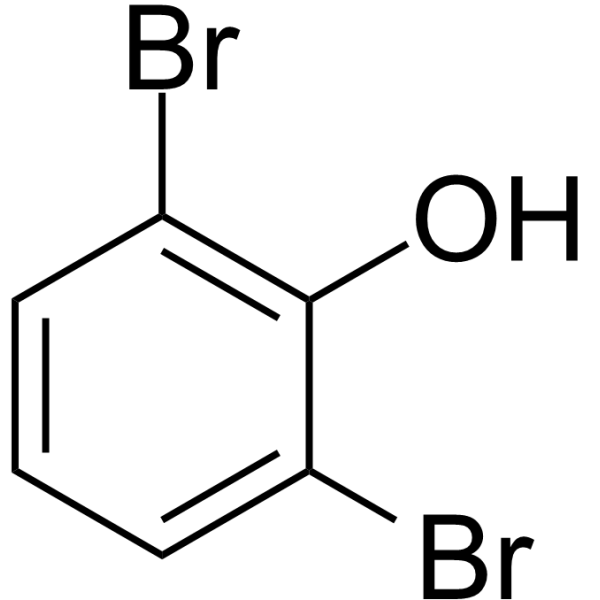
    2,6-Dibromophenol
    1 Publications Verification

    Calcium Channel Fungal Parasite Metabolic Disease
    2,6-Dibromophenol (2,6-DBP) is a weak inhibitor targeting voltage-gated Ca 2+ channels. 2,6-Dibromophenol has no significant effect on potassium-induced calcium elevation in PC12 cells. 2,6-Dibromophenol shows a 48 h EC50 of 2.78 mg/L for Daphnia magna and a 96 h EC50 of 9.90 mg/L for algae (Scenedesmus quadricauda) .
    2,6-Dibromophenol
  • HY-W679754

    PFTrDA

    Biochemical Assay Reagents Cytochrome P450 Metabolic Disease
    Pentacosafluorotridecanoic Acid (PFTrDA) is a long-chain perfluoroalkyl carboxylic acid with strong endocrine-disrupting activity. Pentacosafluorotridecanoic Acid exhibits estrogenic effects and disrupts vtg1 transcription as well as sex hormone homeostasis in male Danio rerio. Pentacosafluorotridecanoic Acid disturbs steroidogenesis and HPG axis function in a sex-dependent pattern. Pentacosafluorotridecanoic Acid inhibits CYP17A and CYP11A1 to reduce testosterone and increase E2/T ratio in H295R cells. Pentacosafluorotridecanoic Acid triggers gender-specific immunomodulation after prenatal exposure. Pentacosafluorotridecanoic Acid correlates with lower eczema risk in female infants. Pentacosafluorotridecanoic Acid can be used for the research of endocrine disruption and eczema .
    Pentacosafluorotridecanoic Acid
  • HY-W012815

    Biochemical Assay Reagents Drug Intermediate Others
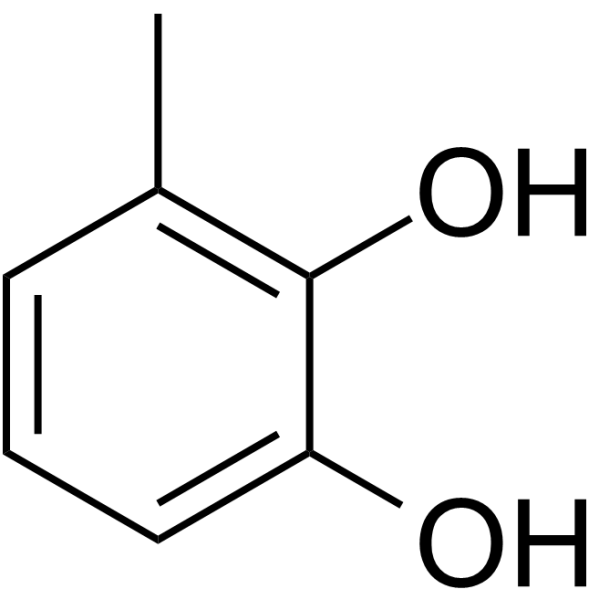
    3-Methylcatechol is a phenolic derivative that can be produced by Pseudomonas putida MC2. 3-Methylcatechol can serve as a molecular building block in chemical synthesis to produce other active compounds .
    3-Methylcatechol
  • HY-W014226

    Drug Intermediate Ser/Thr Protease Others
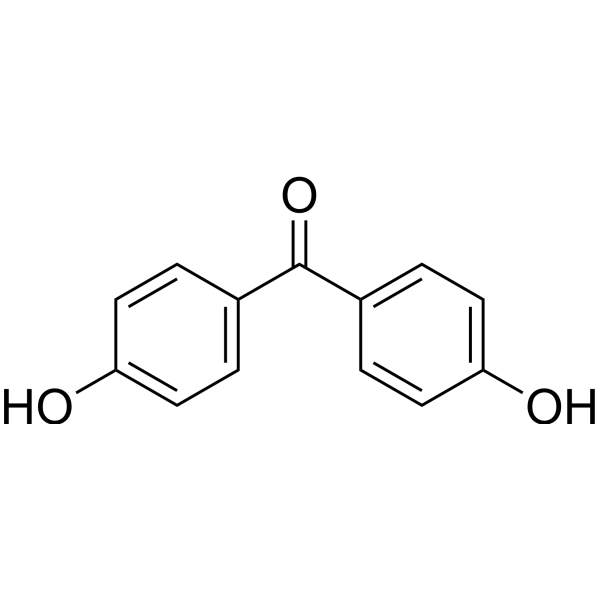
    4,4'-Dihydroxybenzophenone is a type of phenolic ultraviolet absorber and a drug intermediate for synthesis of various anticancer active compounds (such as Sivifene (HY-14801)). 4,4'-Dihydroxybenzophenone binds to the active site of trypsin with binding constants (KA = 7.59 x 10 5 L/moL) and leads to abnormal structure of trypsin, suggesting that long-term intake may affect the digestive function of the human body. 4,4’-dihydroxybenzophenone has a relatively low toxicity to Chlorella vulgaris and a moderate toxicity to Daphnia magna .
    4,4'-Dihydroxybenzophenone
  • HY-123230S

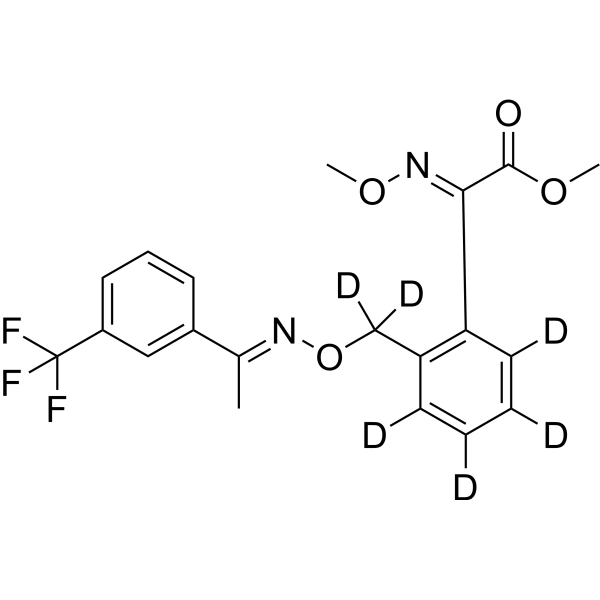
    CGA 279202-d6

    Isotope-Labeled Compounds Fungal Infection
    Trifloxystrobin-d6 is the deuterium labeled Trifloxystrobin. Trifloxystrobin (CGA 279202) is a fungicide, with EC50s of 23.0 μg/L and 1.7 μg/L for Daphnia magna neonate and embryos, respectively, after treatment for 48 h .
    Trifloxystrobin-d6
  • HY-Y1667R

    Calcium Channel Fungal Parasite Reference Standards Metabolic Disease
    2,6-Dibromophenol (2,6-DBP) is a weak inhibitor targeting voltage-gated Ca2+ channels. 2,6-Dibromophenol has no significant effect on potassium-induced calcium elevation in PC12 cells. 2,6-Dibromophenol shows a 48 h EC50 of 2.78 mg/L for Daphnia magna and a 96 h EC50 of 9.90 mg/L for algae (Scenedesmus quadricauda) .
    2,6-Dibromophenol (Standard)
  • HY-178064

    Parasite Mitochondrial Metabolism Infection
    Antiparasitic agent-29 (Compound 5) is a Trypanosome alternative oxidase (TAO) inhibitor with an IC50 of 1.3 nM in Trypanosoma brucei. Antiparasitic agent-29 has a broad-spectrum antiparasitic activity against Trypanosoma and Leishmania spp. Antiparasitic agent-29 accumulates in parasite mitochondria, selectively disrupting its energy metabolism and has potent membrane-perturbing activity with no cross-resistance. Antiparasitic agent-29 shows low ecotoxicity in zebrafish and Daphnia magna models. Antiparasitic agent-29 can be used for parasitic diseases like surra and dourine research .
    Antiparasitic agent-29
  • HY-W096997S

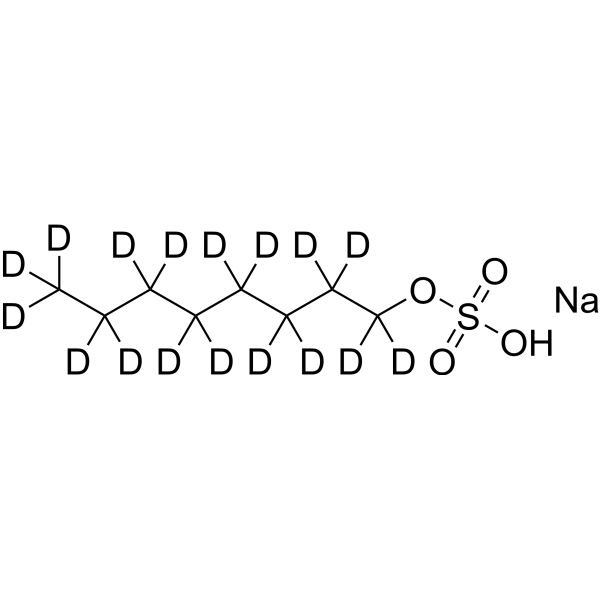
    Sodium capryl sulfate-d17

    Isotope-Labeled Compounds Others
    Sodium octyl sulfate (SOS)-d17 (Sodium capryl sulfate-d17) is the deuterated analogue of Sodium octyl sulfate (SOS). Sodium octyl sulfate (Sodium capryl sulfate; SOS) is a medium‑chain anionic surfactant. Sodium octyl sulfate (SOS) can undergo strong hydrophobic interactions with serum albumins (such as human serum albumin (HSA) and bovine serum albumin (BSA)), while exhibiting weak interactions with other proteins including myoglobin and hemoglobin. As an environmental pollutant in freshwater ecosystems, Sodium octyl sulfate (SOS) can mimic interspecific pheromones released by Daphnia magna and induce the formation of multicellular colonies in green algae.
    Sodium octyl sulfate (SOS)-d17
  • HY-N10625A

    5α-Cyprinol

    Phosphatase Metabolic Disease
    Cyprinol (5α-Cyprinol) is an orally active bile salt and xenochemical pheromone . Cyprinol impairs renal function and increases plasma ALP activity in rats, induces diel vertical migration in Daphnia spp., enhances the permeability of the rectal mucosa to water-soluble compounds, and aids lipid digestion in fish. Cyprinol can be used in studies of fish toxicity and acute renal failure .
    Cyprinol
  • HY-122480

    SYP-1620

    Fungal ATP Synthase Cytochrome P450 Infection
    Fenaminstrobin (SYP-1620) is a strobilurin Fungicide. Fenaminstrobin binds to cytochrome bc1 in the mitochondrial respiratory chain, thereby inhibiting ATP production. Fenaminstrobin exhibits acute toxicity to Daphnia magna. Fenaminstrobin effectively controls diseases such as Fusarium ear rot, downy mildew, rice blast and pear scab .
    Fenaminstrobin
  • HY-N18490

    Drug Derivative Metabolic Disease
    5α-Cyprinol sulfate is an orally active bile salt and heterospecific pheromone. 5α-Cyprinol sulfate promotes lipid digestion in fish. 5α-Cyprinol sulfate inhibits taurocholic acid uptake mediated by apical bile salt transporters in rat ileum. 5α-Cyprinol sulfate can be used in studies of fish toxic acute renal failure .
    5α-Cyprinol sulfate

Inquiry Online

Your information is safe with us. * Required Fields.

Salutation


Country or Region *

Applicant Name *


Organization Name *

Department *


Email Address *


Product Name *

Cat. No.


Requested quantity *

Phone Number *


Remarks

Inquiry Online

Inquiry Information

Product Name:
Cat. No.:
Quantity:
MCE Japan Authorized Agent:

