






1. Search Result
Search Result
Results for "

F(ab')2

" in MedChemExpress (MCE) Product Catalog:

18

Inhibitors & Agonists

1

Biochemical Assay Reagents

1

Peptides

14

Inhibitory Antibodies

4

Antibodies

Targets Recommended:
Cat. No. Product Name Target Research Areas Chemical Structure
  • HY-P99507

    MCLA-128; PB4188; R040517

    EGFR Cancer
    Zenocutuzumab (MCLA-128) is a bispecific humanized IgG1 antibody containing two different Fab arms, targeting extracellular domains of HER2 and HER3 .
    Zenocutuzumab
  • HY-P990688

    AMG-509

    CD3 Cancer
    Xaluritamig (AMG-509) is a bispecific T cell engager and cytolytic agent with a Kd of 27.6 nM for human CD3ε. Xaluritamig binds to CD3ε via an anti-CD3 single-chain variable fragment (scFv) domain, and to STEAP1 via a bispecific anti-STEAP1 antigen-binding fragment (Fab) domain, thereby recruiting and activating T cells and forming a bridge between T cells and STEAP1-expressing cancer cells. Xaluritamig induces T cell-mediated redirected cytotoxicity, tumor cell lysis, cytokine release, CD8 + T cell activation and expansion, as well as tumor stasis or regression. Xaluritamig contains an Fc domain with no effector function, which prolongs serum half-life, exhibits only minimal activity against cells with low STEAP1 expression and normal cells, and shows extremely low target-related off-tumor toxicity in cynomolgus monkeys. Xaluritamig is used in STEAP1×CD3 XmAb 2+1 immunotherapy and in research on metastatic castration-resistant prostate cancer and Ewing sarcoma [2] .
    Xaluritamig
  • HY-NP006
    Protein A
    1 Publications Verification

    SPA

    Endogenous Metabolite Apoptosis Inflammation/Immunology
    Protein A (SPA) is an immunoglobulin (Ig)-binding protein that exists on the bacterial surface and can be freely secreted into the extracellular environment. Protein A blocks opsonophagocytosis and induces B cell apoptosis in vitro by binding to the Fc region of antibodies and the Fab region of B cell receptors. Protein A can form toxic immune complexes with IgG, thereby inducing leukocyte necrosis. Protein A contributes to the virulence expression of Staphylococcus aureus. Protein A triggers allergic reactions in IgG-pretreated mouse models. Protein A can be used in studies related to immune system diseases [2] .
    Protein A
  • HY-P99644
    ACT017
    1 Publications Verification

    Glycoprotein VI Cardiovascular Disease
    ACT017 is a Fab fragment of humanized anti-GPVI monoclonal antibody. ACT017 inhibits collagen-induced platelet aggregation. ACT017 has the potential for the research of acute ischemic stroke [2].
    ACT017
  • HY-P990735

    Interleukin Related Inflammation/Immunology
    Donzakimig is a trispecific anti-IL-13/IL-22/HSA antibody. Donzakimig adopts a Fab-scFv-scFv structural format (without an Fc region), in which the Fab domain is linked to the scFv domains via a S (G4S)2 linker. Donzakimig binds to and inhibits the activities of IL-13 and IL-22, thereby blocking the signal transduction of these two cytokines. Donzakimig can extend its serum half-life by binding to human serum albumin, enhancing its in vivo stability and achieving long-acting efficacy. Donzakimig can be used in research on moderate-to-severe atopic dermatitis, moderate-to-severe asthma (especially eosinophilic type), psoriasis, inflammatory bowel disease, and other conditions .
    Donzakimig
  • HY-P99629

    FHTR 2163; RG 6147; RO 7171009

    Ser/Thr Protease Neurological Disease
    Galegenimab (FHTR 2163) is a humanized monoclonal antibody Fab fragment targeting the HtrA1 trimer. Galegenimab is used in research on age-related macular degeneration (AMD) [2].
    Galegenimab
  • HY-P990981

    ALPS-12; RG-6524; RO 7616789

    CD3 Inflammation/Immunology Cancer
    Clesitamig (ALPS-12) is a trispecific T cell engager with two CD3/CD137 dual-specific Fabs and one DLL3 Fab. Clesitamig engages CD3 and CD137 on T cells to activate and co-stimulate T cells, promoting their proliferation, survival, and antitumor activity. Clesitamig binds to DLL3 on tumor cells for tumor-specific recognition. Clesitamig can be used for the research of small cell lung cancer (SCLC) [2].
    Clesitamig
  • HY-P99155

    2F8; HUMAX-EGFR

    EGFR Cancer
    Zalutumumab is a high affinity, completely human IgG1 monoclonal antibody targeting EGFR. Zalutumumab binds to domain III of the EGF receptor and acts by blocking the binding of EGF and by sterically interfering with the active conformation of the receptor. Zalutumumab binds with IgG and its Fab fragment with EC50s of 7 and 19 nM, respectively. Zalutumumab can be used for the research of cancer [2] .
    Zalutumumab
  • HY-P99872

    CSJ-117; NVP-CSJ117

    Interleukin Related Inflammation/Immunology
    Ecleralimab (CSJ-117; NVP-CSJ117) is a Fab-IgG1-λ2 antibody targeting the thymic stromal lymphopoietin (TSLP). Ecleralimab significantly attenuates allergen-induced airway responses and inflammation. Ecleralimab can be used for the study of inhaled asthma .
    Ecleralimab
  • HY-D0054

    Fluorescent Dye Inflammation/Immunology
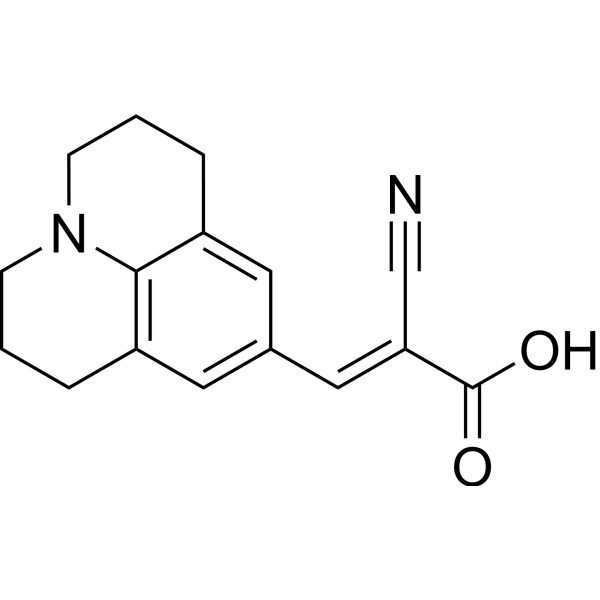
    9-(2-Carboxy-2-cyanovinyl)julolidine is a fluorescent molecular rotor. 9-(2-Carboxy-2-cyanovinyl)julolidine can be used to bind to IgG and Fab, and preparing antibodies .
    9-(2-Carboxy-2-cyanovinyl)julolidine
  • HY-E70364

    Biochemical Assay Reagents Inflammation/Immunology
    IgdE protease is a cysteine protease, which is initially isolated from Streptococcus agalactiae. IgdE protease digests monoclonal antibodies (mAbs) of the IgG1 type specifically at their upper hinge region, produces Fc/2, hinge peptide dimers, and Fab fragment. IgdE protease can be used in disulfide bonds and free thiol analysis, as it requires no reducing agents for cleavage .
    IgdE protease
  • HY-P99155A

    EGFR Cancer
    Zalutumumab (powder) is a high affinity, completely human IgG1 monoclonal antibody targeting EGFR. Zalutumumab (powder) binds to domain III of the EGF receptor and acts by blocking the binding of EGF and by sterically interfering with the active conformation of the receptor. Zalutumumab (powder) binds with IgG and its Fab fragment with EC50s of 7 and 19 nM, respectively. Zalutumumab (powder) can be used for the research of cancer [2] .
    Zalutumumab (powder)
  • HY-E70365A

    Biochemical Assay Reagents Inflammation/Immunology
    IdeS (Immobilized, Microspin) is a resin that covalently couples IdeS protease to agarose beads and cleaves IgG at specific sites to generate F(ab')2 and Fc fragments. After IdeS (Immobilized, Microspin) digestion, F(ab')2 and Fc fragments are obtained in the solution without IdeS enzyme.
    IdeS (Immobilized, Microspin)
  • HY-165604

    Liposome Others
    C14-490, an ionizable cationic lipid (pKa = 5.94), is used for the synthesis of lipid nanoparticles (LNPs). C14-490 LNPs is used as the basis for subsequent study of in utero gene editing in HSCs. C14-490 LNPs are used to encapsulate SpCas9 mRNA and TTR sgRNA using optimized B5 formulation parameters and surface conjugation to CD45 antibody F(ab’)2 fragments-Systematically optimized Targeted Editing Machinery LNPs (STEM LNPs) .
    C14-490
  • HY-P991594

    Interleukin Related Inflammation/Immunology
    Anti-IL-13 Antibody (C836) is a neutralizing monoclonal antibody targeting human IL-13. The Fab fragment of Anti-IL-13 Antibody (C836) is a heterodimer composed of heavy chains and light chains, each folded into variable and constant domains. Anti-IL-13 Antibody (C836) can be used for chronic inflammatory diseases, such as asthma [2] .
    Anti-IL-13 Antibody (C836)
  • HY-P99803

    VAL-1221

    Glycosidase Others
    Clervonafusp alfa (VAL-1221) is a fusion protein targeting both cytosolic and lysosomal glycogen. Clervonafusp alfa is comprised of the Fab portion of a cell-penetrating antibody and recombinant human acid alpha glucosidase (rhGAA), the former utilizing the nucleoside transporter ENT-2 to gain access to the cytosol, and the latter enters lysosomes via mannose-6-phosphate receptors (M6PRs). Clervonafusp alfa can be used for late-onset Pompe disease research .
    Clervonafusp alfa
  • HY-P9S0124

    ORM-6151 Antibody; BMS-986497 Antibody

    Cancer
    Anti-CD33 Antibody (OR000283) (ORM-6151 Antibody; BMS-986497 Antibody) is an antibody targeting CD33. It is generated by grafting the FAb (H&L) sequence of Gemtuzumab (HY-P99971) onto an IgG1 Fc carrying the N297A mutation, which inhibits Fc-γR binding. Anti-CD33 Antibody (OR000283) can be used to construct degrader-antibody conjugates (DACs), such as ORM-6151 (HY-171792) [2].
    Anti-CD33 Antibody (OR000283)
  • HY-P991921

    TNF Receptor Fc Receptor (FcR) Cardiovascular Disease Endocrinology
    TNX-1500 is a crystallizable fragment-modified anti-CD154 antibody. TNX-1500 contains the hu5c8 fragment antigen-binding (Fab) domain from Ruplizumab (HY-P99315) and an IgG4 Fc region engineered to reduce FcγRIIa binding. TNX-1500 has significantly weaker binding affinity to FcγRI, FcγRIIaH, FcγRIIbF, FcγRIIIaF, and FcγRIIIaV compared to hu5c8 (Kd values: 8.7 nM, 7100 nM, 4900 nM, 8000 nM, 6000 nM respectively). TNX-1500 prolongs nonhuman primate renal allograft survival, prolongs nonhuman primate cardiac allograft survival. TNX-1500 can be used for the research of allograft rejection [1] [2].
    TNX-1500

Inquiry Online

Your information is safe with us. * Required Fields.

Salutation


Country or Region *

Applicant Name *


Organization Name *

Department *


Email Address *


Product Name *

Cat. No.


Requested quantity *

Phone Number *


Remarks

Inquiry Online

Inquiry Information

Product Name:
Cat. No.:
Quantity:
MCE Japan Authorized Agent:

