1. Search Result
Search Result
Results for "

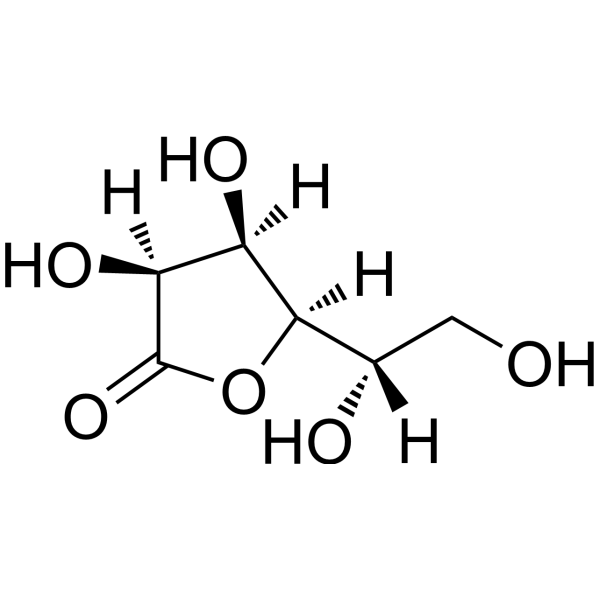
L-Gulono-1,4-lactone

" in MedChemExpress (MCE) Product Catalog:

9

Inhibitors & Agonists

2

Biochemical Assay Reagents

4

Peptides

3

Natural
Products

1

Isotope-Labeled Compounds

1

Click Chemistry

Cat. No. 상품명 Target 연구분야 Chemical Structure
  • HY-W016628

    L-Gulonolactone

    Endogenous Metabolite Metabolic Disease
    L-Gulono-1,4-lactone is a substrate of L-gulono-1,4-lactone oxidoreductase, which catalyzes the last step of the biosynthesis of L-ascorbic (Vatamin) C. In other words, L-Gulono-1,4-lactone is a direct precursor of vitamin C in animals, in plants and in some protists.
    L-Gulono-1,4-lactone
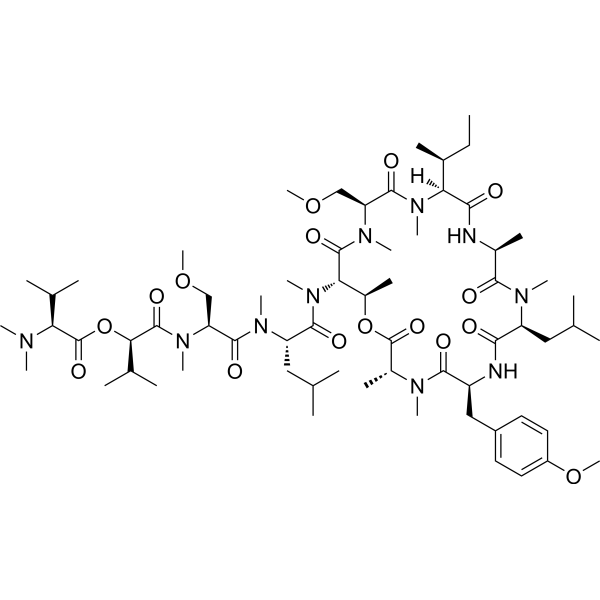
  • HY-P3990

    VEGFR Autophagy Apoptosis Cancer
    Coibamide A, an N-methyl-stabilized cytotoxic depsipeptide, shows potent antiproliferative activity. Coibamide A induces autophagosome accumulation via an mTOR-independent mechanism. Coibamide A induces apoptosis. Coibamide A inhibits VEGFA/VEGFR2 expression and suppresses tumor growth in glioblastoma xenografts .
    Coibamide A
  • HY-W016628R

    L-Gulonolactone (Standard)

    Reference Standards Endogenous Metabolite Metabolic Disease
    L-Gulono-1,4-lactone (L-Gulonolactone) (Standard) is the analytical standard of L-Gulono-1,4-lactone. This product is intended for research and analytical applications. L-Gulono-1,4-lactone is a biosynthetic precursor of L-Ascorbic acid (Vitamin C) (HY-B0166). L-Gulono-1,4-lactone can be enzymatically converted to L-Ascorbic acid via the animal uronic acid pathway, while species such as humans lack the key oxidase that catalyzes this step, resulting in the disruption of this pathway and the necessity to obtain Vitamin C from diet. L-Gulono-1,4-lactone is a putative intermediate in an alternative biosynthetic pathway of L-Ascorbic acid in Arabidopsis thaliana.
    L-Gulono-1,4-lactone (Standard)
  • HY-W701862

    Biochemical Assay Reagents Others
    5-Azido-6-(tert-butyldimethylsilyl)-2,3-O-isopropylidene L-gulono-1,4-lactone is a class of biochemical reagents used in glycobiology research. Glycobiology studies the structure, synthesis, biology, and evolution of sugars. It involves carbohydrate chemistry, enzymology of glycan formation and degradation, protein-glycan recognition, and the role of glycans in biological systems. This field is closely related to basic research, biomedicine, and biotechnology .
    5-Azido-6-(tert-butyldimethylsilyl)-2,3-O-isopropylidene L-gulono-1,4-lactone
  • HY-W768934

    L-Gulonolactone-13C6

    Isotope-Labeled Compounds Endogenous Metabolite Metabolic Disease
    L-Gulono-1,4-lactone- 13C6 (L-Gulonolactone- 13C6) is the 13C-labeled L-Gulono-1,4-lactone (HY-W016628). L-Gulono-1,4-lactone is a substrate of L-gulono-1,4-lactone oxidoreductase, which catalyzes the last step of the biosynthesis of L-ascorbic (Vatamin) C. In other words, L-Gulono-1,4-lactone is a direct precursor of vitamin C in animals, in plants and in some protists.
    L-Gulono-1,4-lactone-13C6
  • HY-116283

    Biochemical Assay Reagents Others
    2,3:5,6-Di-O-isopropylidene-L-gulono-1,4-lactone is a class of biochemical reagents used in glycobiology research. Glycobiology studies the structure, synthesis, biology, and evolution of sugars. It involves carbohydrate chemistry, enzymology of glycan formation and degradation, protein-glycan recognition, and the role of glycans in biological systems. This field is closely related to basic research, biomedicine, and biotechnology .
    2,3:5,6-Di-O-isopropylidene-L-gulono-1,4-lactone
  • HY-P1720

    Antibiotic Bacterial Infection
    Telomycin is a calcium-dependent antibiotic, which can be produced by Streptomyces. Telomycin inhibits gram-positive bacteria, including multidrug-resistant (MDR) pathogens .
    Telomycin
  • HY-P1709

    Bacterial Infection
    Protactin is a pentapeptide lactone produced by Streptomyces cucumeris strain L703-4 (ATCC 53784) with significant antioxidant properties. Protactin can be converted to actinomycin Zp by ferrocyanide oxidation. Actinomycin Zp exhibits potent antibacterial activity in vitro and has significant antitumor effects against P-388 leukemia in a mouse model .
    Protactin
  • HY-P11022

    A-3302-B

    Endogenous Metabolite HSV TRP Channel Infection Cancer
    TL-119 (A-3302-B) is a polypeptide. TL-119 can be isolated from the bacteria Micromonospora sp. MAG 9-7 and Saccharomonospora sp. CNQ-490. TL-119 inhibits TRPV-1. TL-119 exhibits antiviral activity against HSV-2. TL-119 possesses anticancer activity against gastric cancer and colorectal cancer .
    TL-119

온라인 문의

Your information is safe with us. * Required Fields.

호칭


Country or Region *

고객명 *


회사명 *

Department *


메일주소 *


상품명 *

Cat. No.


Requested quantity *

전화번호 *


비고

온라인 문의

Inquiry Information

상품명:
Cat. No.:
수량:
MCE Japan Authorized Agent:

