11 Results for "

SK-MEL-5 melanoma

" in MedChemExpress (MCE) Product Catalog:
Products (11)

11 Results for "SK-MEL-5 melanoma" in MCE Product Catalog:

3
3 Cited Publications
Cat. No.: HY-B1180
CAS No.: 4880-88-0
Synonyms: (-)-Eburnamonine; (-)-Vincamone
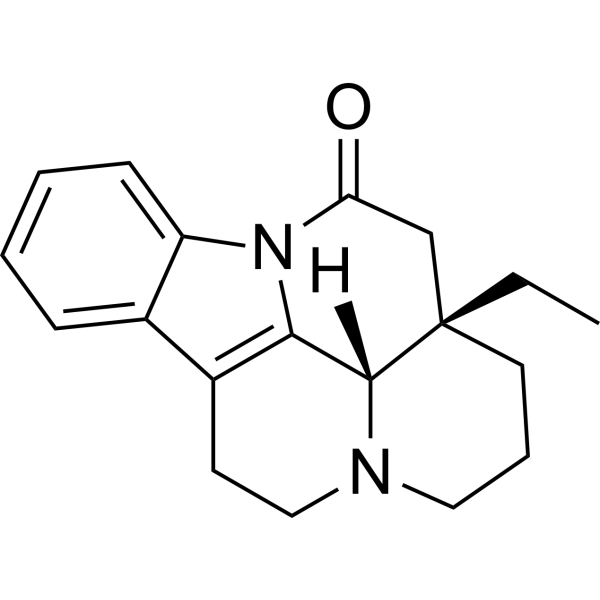
Vinburnine ((-)-Eburnamonine; (-)-Vincamone) is an orally active, blood-brain barrier permeable immunomodulator and apoptosis inducer. Vinburnine drives the secretion of IL-24 by activating the P38/MAPK/ATF3 signaling axis. Vinburnine induces reactive oxygen species production and DNA damage in cancer cells, thereby inhibiting cancer cell proliferation, activating the apoptotic cascade, and enhancing CD8+ T cell function to remodel the tumor immune microenvironment. Vinburnine can be used in the research of diseases such as melanoma .
loading...
    loading...
Cat. No.: HY-170824
CAS No.: 3033586-31-8
Target:  

PROTACs SWI/SNF Complex

Research Areas:  

Cancer

SMD-3236 is a SMARCA2 PROTAC degrader with a DC50 of 0.5 nM, a Dmax of 98%, and an IC50 of 42.2 nM against human SMARCA2. SMD-3236 induces proteasome- and ubiquitin-like modification-dependent degradation of SMARCA2 protein by binding to SMARCA2 and VHL-1. SMD-3236 inhibits the growth of SMARCA4-deficient cancer cells. SMD-3236 induces significant and persistent depletion of SMARCA2 in tumor tissues. SMD-3236 suppresses tumor growth in SMARCA4-deficient human cancer xenograft models. SMD-3236 can be used in research related to SMARCA4-deficient cancers such as melanoma, non-small cell lung cancer, and acute myeloid leukemia .
loading...
    loading...
Cat. No.: HY-161767
CAS No.: 3069975-17-0
Research Areas:  

Cancer

JWJ-01-306 is a CRBN-recruiting ZBTB11 Molecular Glues degrader. JWJ-01-306 degrades ZBTB11 and reprograms cellular metabolism, thereby reducing the level of Oxidative Phosphorylation and the activity of the tricarboxylic acid cycle. JWJ-01-306 enhances the response of organoids to K-Ras inhibition. JWJ-01-306 inhibits the proliferation of pancreatic ductal adenocarcinoma cells and melanoma cells. JWJ-01-306 can be used in studies related to pancreatic ductal adenocarcinoma and melanoma .
loading...
    loading...
Cat. No.: HY-169021
CAS No.: 3056388-71-4
Target:  

JNK

Research Areas:  

Cancer

JNK-1-IN-3 (Compound 9e) is an inhibitor of JNK1 that downregulates JNK1 gene expression and inhibits the protein levels of its phosphorylated form, concurrently reducing the expression of its downstream targets, c-Jun and c-Fos, in tumors while restoring p53 activity. JNK-1-IN-3 exhibits broad-spectrum antiproliferative activity, particularly with high inhibitory activity against renal and breast cancer cell lines, demonstrating both in vivo and in vitro anticancer activity .
loading...
    loading...
Cat. No.: HY-151587
CAS No.: 2977251-05-9
Target:  

Others

Research Areas:  

Cancer

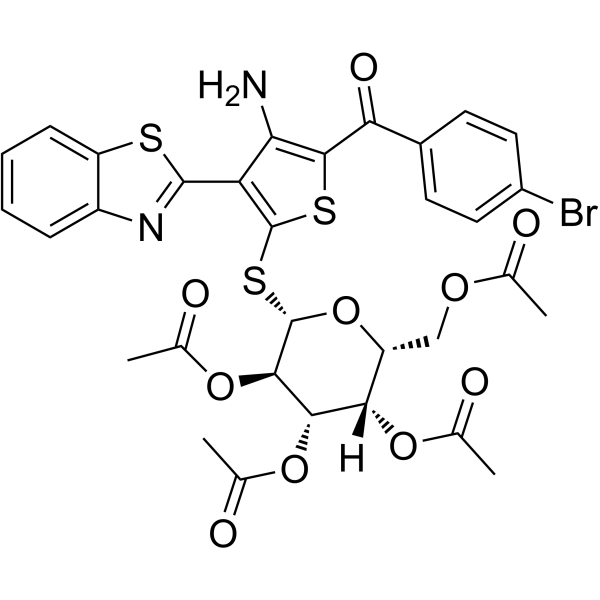
Anticancer agent 89 is a benzothiazole-2-thiophene S-glycoside derivative with antitumor activity, has high inhibition against the three cell line from ovarian cancer (OVCAR-4), renal cancer (A498), and melanoma (SK-MEL-5) .
loading...
    loading...
Cat. No.: HY-B1180R
CAS No.: 4880-88-0
Synonyms: (-)-Eburnamonine (Standard); (-)-Vincamone (Standard)
Vinburnine ((-)-Eburnamonine; (-)-Vincamone) (Standard) is the analytical standard of Vinburnine (HY-B1180). This product is intended for research and analytical applications. Vinburnine ((-)-Eburnamonine; (-)-Vincamone) phosphate is an orally active, blood-brain barrier permeable immunomodulator and apoptosis inducer. Vinburnine drives the secretion of IL-24 by activating the P38/MAPK/ATF3 signaling axis. Vinburnine induces reactive oxygen species production and DNA damage in cancer cells, thereby inhibiting cancer cell proliferation, activating the apoptotic cascade, and enhancing CD8+ T cell function to remodel the tumor immune microenvironment. Vinburnine can be used in the research of diseases such as melanoma .
loading...
    loading...
Cat. No.: HY-158061
Purity:  98.44%
Target:  

Topoisomerase Apoptosis

Research Areas:  

Cancer

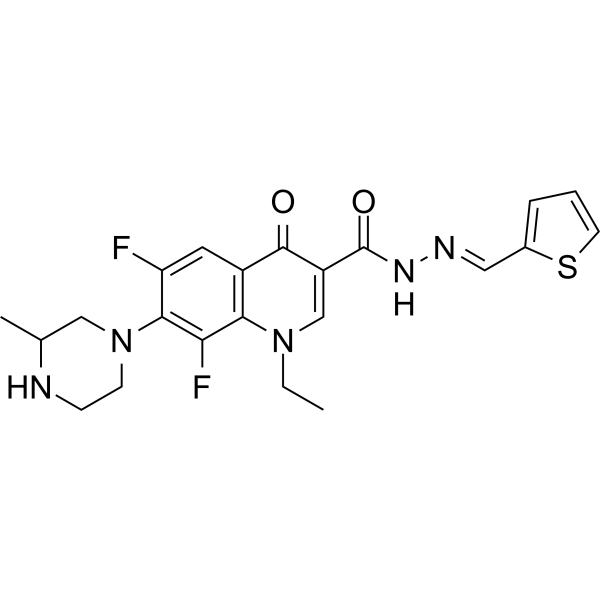
Topoisomerase II inhibitor 20 (Compound 3e) is a potent topoisomerase II (Topoisomerase II) inhibitor with an IC50 of 0.98 µM. Topoisomerase II inhibitor 20 induces apoptosis and has broad-spectrum anticancer activity .
loading...
    loading...
Cat. No.: HY-158061A
Target:  

Topoisomerase Apoptosis

Research Areas:  

Cancer

Topoisomerase II inhibitor 20 TFA is a potent topoisomerase II inhibitor with IC50 of 0.98 µM. Topoisomerase II inhibitor 20 TFA can induce apoptosis and has broad-spectrum anticancer activity .
loading...
    loading...
Cat. No.: HY-B1180A
CAS No.: 94134-60-8
Synonyms: (-)-Eburnamonine phosphate; (-)-Vincamone phosphate
Target:  

Apoptosis p38 MAPK

Research Areas:  

Cancer

Vinburnine ((-)-Eburnamonine; (-)-Vincamone) phosphate is an orally active, blood-brain barrier permeable immunomodulator and apoptosis inducer. Vinburnine phosphate drives the secretion of IL-24 by activating the P38/MAPK/ATF3 signaling axis. Vinburnine phosphate induces reactive oxygen species production and DNA damage in cancer cells, thereby inhibiting cancer cell proliferation, activating the apoptotic cascade, and enhancing CD8+ T cell function to remodel the tumor immune microenvironment. Vinburnine phosphate can be used in the research of diseases such as melanoma .
loading...
    loading...
Cat. No.: HY-181726
Research Areas:  

Cancer

BRAFV600E/ABL2-IN-2 is a dual BRAFV 600E and ABL2 kinase inhibitor, with an IC50 of 0.088 μM against human BRAFV 600E and an IC50 of 0.3 μM against human ABL2. BRAFV600E/ABL2-IN-2 reduces the phosphorylation levels of downstream ERK1/2 and CrkL in melanoma cells. BRAFV600E/ABL2-IN-2 decreases the expression of P-glycoprotein (P-glycoprotein) in melanoma cells. BRAFV600E/ABL2-IN-2 induces G1 cell cycle arrest and apoptosis (Apoptosis) in melanoma cells. BRAFV600E/ABL2-IN-2 is applicable to relevant research on melanoma .
loading...
    loading...
Cat. No.: HY-P992433
Target:  

LILRB

Research Areas:  

Cancer

OR502 is a humanized IgG1 monoclonal antibody targeting LILRB2 (ILT4/CD85d), with a Kd value of 1.18 nM. OR502 binds to LILRB2 with high affinity and blocks its interaction with HLA class I ligands, relieving myeloid cell-mediated immunosuppression, restoring CD8 + T cell function, and reprogramming the immunosuppressive macrophage phenotype, thereby simultaneously enhancing both innate and adaptive antitumor immune responses. OR502 can be used in the research of cancers and advanced cancers (including melanoma, non-small cell lung cancer, sarcoma/soft tissue cancer, and urothelial carcinoma) .
loading...
    loading...
  • 1

