7 Results for "

Syncytium formation

" in MedChemExpress (MCE) Product Catalog:
Products (7)

7 Results for "Syncytium formation" in MCE Product Catalog:

Cat. No.: HY-P2988B
CAS No.: 9001-67-6
Target:  

Bacterial HIV

Research Areas:  

Infection

Neuraminidase, arthrobacter ureafaciens is a neuraminidase derived from Arthrobacter ureafaciens. Neuraminidase, arthrobacter ureafaciens catalyzes the removal of sialic acid residues from cell surfaces and viral glycoconjugates. Neuraminidase, arthrobacter ureafaciens enhances HIV-1-mediated syncytium formation and promotes the viral binding and entry steps in the HIV-1 replication cycle .
loading...
    loading...
Cat. No.: HY-161844
CAS No.: 1794091-10-3
Target:  

SARS-CoV Dengue Virus

Research Areas:  

Infection

Virapinib is a macropinocytosis inhibitor with antiviral activity. Virapinib exhibits broad-spectrum antiviral activity against SARS-CoV-2, monkeypox virus, tick-borne encephalitis virus, and Ebola pseudotyped vesicular stomatitis virus, and it enhances Dengue Virus infection. Virapinib blocks viral entry by inhibiting macropinocytosis, reduces syncytium formation in SARS-CoV-2-infected cells, and impairs cellular entry of SARS-CoV-2 variants. Virapinib upregulates the expression of genes related to sterol biosynthesis. Virapinib can be used in studies related to COVID-19, monkeypox, tick-borne encephalitis, and Ebola virus infection .
loading...
    loading...
Cat. No.: HY-P3795
CAS No.: 361443-81-4
Target:  

HSV

Research Areas:  

Infection Neurological Disease

G2-Peptide is a 3-O-sulfated heparan sulfate (3-OS HS) binder and antiviral agent. G2-Peptide blocks herpesvirus attachment, entry, cell-to-cell spread and syncytium formation, and reduces viral protein translocation. G2-Peptide exhibits antiviral activity against both HSV-1 and HSV-2. G2-Peptide inhibits neural activity and impairs synapse assembly. G2-Peptide can be used in the research of genital herpes, ocular herpes infection and keratitis .
loading...
    loading...
Cat. No.: HY-163362
Research Areas:  

Infection

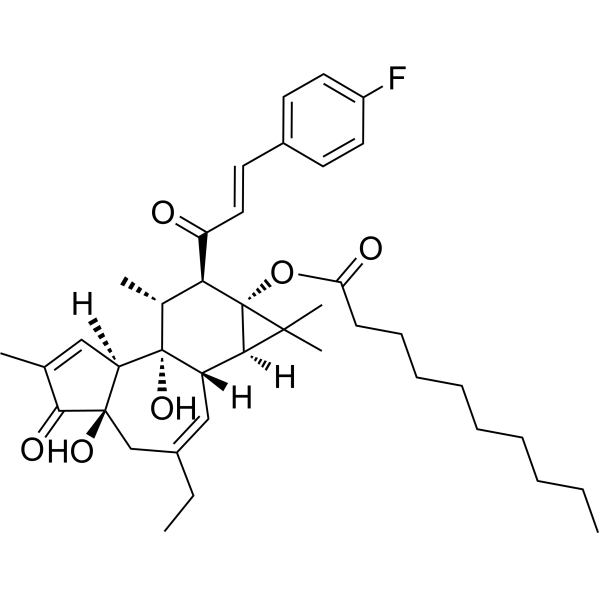
HIV-1 inhibitor-65 (compound 3c) is an inhibitor of HIV-1 (EC50: 2.9 nM) and an activator of protein kinase C (PKC). HIV-1 inhibitor-65 inhibits syncytium formation (EC50: 7.0 nM) and inhibits HIV-1 entry and HIV-1 reverse transcriptase .
loading...
    loading...
Cat. No.: HY-164682
CAS No.: 170861-77-5
Target:  

HIV CXCR

Research Areas:  

Infection

AMD 3329 octahydrobromide is a potent and selective anti-HIV-1 and HIV-2 compound with activity to inhibit viral replication. AMD 3329 blocks viral invasion by binding to the chemokine receptor CXCR4. AMD 3329 exhibits EC50 values as low as 0.8 and 1.6 nM when inhibiting HIV-1 and HIV-2 replication, showing better antiviral efficacy than AMD3100. AMD 3329 significantly inhibits the binding of specific CXCR4 monoclonal antibodies and the Ca(2+) flux induced by SDF-1alpha. AMD 3329 is also able to effectively interfere with virus-induced syncytium formation, with an EC50 value of 12 nM .
loading...
    loading...
Cat. No.: HY-189244
CAS No.: 3103996-88-6
Target:  

RSV

Research Areas:  

Infection

RSV-IN-14 is an orally active pre-fusion F protein inhibitor of respiratory syncytial virus (RSV), with a Kd of 5.0 μM, and exhibits lung-targeted distribution properties. RSV-IN-14 binds to the central cavity of the trimeric pre-fusion F protein, locks it in the pre-fusion state, and inhibits the conformational changes required for membrane fusion to block viral entry. RSV-IN-14 suppresses respiratory syncytial virus-induced syncytium formation. RSV-IN-14 can be used in studies on respiratory syncytial virus infection .
loading...
    loading...
Cat. No.: HY-184852
CAS No.: 151-41-7
Synonyms: Dodecyl hydrogen sulphate; Dodecyl sulfate
Lauryl sulfate (Dodecyl hydrogen sulphate) is an anionic chaotropic surfactant. Lauryl sulfate dissolves viral envelopes, denatures viral proteins, inhibits viral infectivity and HIV-1 syncytium formation. Lauryl sulfate potently inhibits the infectivity of HSV-1 strain F (ED50 = 17.9 μM) and HSV-2 strain 333 (ED50 = 32.7 μM). Lauryl sulfate induces environmental toxicity, disrupting environmental balance and physiological processes of organisms. As a contaminant, Lauryl sulfate is toxic to aquatic and terrestrial organisms. Lauryl sulfate can be used in studies related to sexually transmitted infections .
loading...
    loading...

