4 Results for "

Type II GSK-3

" in MedChemExpress (MCE) Product Catalog:
Products (4)

4 Results for "Type II GSK-3" in MCE Product Catalog:

Cat. No.: HY-P4685
CAS No.: 185461-45-4
Target:  

Angiotensin Receptor

Research Areas:  

Metabolic Disease

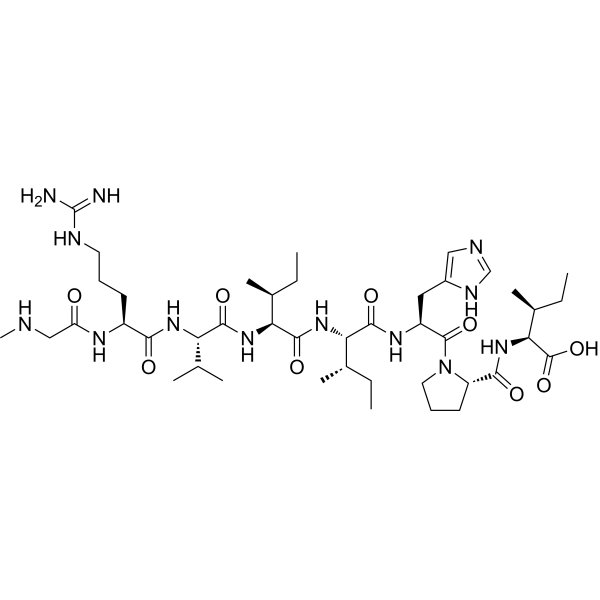
(Sar1,Ile4,8)-Angiotensin II is a functionally selective angiotensin II type 1 receptor (AT1R) agonist. (Sar1,Ile4,8)-Angiotensin II potentiates insulin-stimulated insulin receptor (IR) signaling and glycogen synthesis. (Sar1,Ile4,8)-Angiotensin II potentiates insulin-stimulated phosphorylation of Akt and GSK3α/β .
loading...
    loading...
Cat. No.: HY-161595
CAS No.: 1212711-91-5
Target:  

CDK GSK-3

Research Areas:  

Cancer

CDK5-IN-4 (compound 4) is a potent multikinase type-II inhibitor targeting CDK5, with an IC50 of 9.8 μM. CDK5-IN-4 also inhibits GSK-3α, GSK-3β, CDK9, and CDK2, with IC50 values of 0.98, 4.00, 1.76, and 6.24 μM, respectively. CDK5-IN-4 can be used for glioblastoma research .
loading...
    loading...
Cat. No.: HY-184447
CAS No.: 3091508-49-2
Target:  

PAK

Research Areas:  

Others

RN193 is a type II kinase inhibitor with a human PAK1 IC50 of 4.28 μM. RN193 functionally inhibits kinase activity of PAK1, PAK2, and PAK3, and engages with their kinase domains in live cells. RN193 induces thermal shifts in CLK1, GSK3B, ULK1, MELK, MAPK13, BRAF, and STK10, indicating binding and stabilization of these proteins. RN193 induces formation of PAK3:PAK2 heterodimers and displaces PAK2 homodimers in live cells. RN193 acts as a tool compound for studying group I PAK conformational states .
loading...
    loading...
Cat. No.: HY-N11231
CAS No.: 7176-02-5
Fucoxanthinol, a carotenoid, is a deacetylated Fucoxanthin (HY-N2302) metabolite with oral activity, and inhibits rat pancreatic lipase with an IC50 of 764 nM. Fucoxanthinol reduces expression of Bcl-2, Bcl-xL, survivin, XIAP, cIAP2, cyclin D1, cyclin D2, cyclin E, CDK4, CDK6, β-catenin, JunD, PPARγ, and induces GADD45α expression. Fucoxanthinol activates caspase-3, caspase-8, caspase-9, Nrf2/Keap1/ARE pathway, and inhibits activation of Akt, NF-κB, AP-1, PDPK1, GSK3β phosphorylation. Fucoxanthinol induces apoptosis, G0/G1 cell cycle arrest, inhibits cancer cell viability, proliferation, migration, invasiveness, tumour growth, adipocyte differentiation, oxidative stress, neurotoxicity, triglyceride absorption, angiogenesis, and obesity-induced inflammation. Fucoxanthinol can be used for the research of osteosarcoma, leukemia, lymphoma, adult T-cell leukemia, prostate cancer, colon cancer, breast cancer, hypertriglyceridaemia, Alzheimer’s disease, Parkinson’s disease, obesity, insulin resistance, malignant melanoma, and type II diabetes .
loading...
    loading...

