14 Results for "

USP7 degraders

" in MedChemExpress (MCE) Product Catalog:
Products (14)

14 Results for "USP7 degraders" in MCE Product Catalog:

Cat. No.: HY-175360
CAS No.: 3098774-65-0
USP7 Ligand-Linker Conjugates 1 is an Target Protein Ligand-Linker Conjugate that incorporates a ligand for USP7 (HY-175359) and a PROTAC linker, which recruits E3 ligases. USP7 Ligand-Linker Conjugates 1 can be used for synthesis of PROTAC USP7 Degrader-1 (HY-175358) .
loading...
    loading...
Cat. No.: HY-148369
CAS No.: 3094177-94-0
Purity:  99.68%
U7D-1 is a USP7 PROTAC degrader that induces selective proteasomal degradation of USP7. U7D-1 destabilizes and downregulates the expression of variant PRC1 complex subunits PCGF1, RING1A and PCGF6, and also slightly reduces the protein level of KDM2B. U7D-1 decreases cell viability, arrests neuroblastoma cells at the G0/G1 cell cycle phase, and downregulates the expression of target genes of PAX3::FOXO1 in FP-RMS cells. U7D-1 increases the level of cleaved PARP in FP-RMS cells, induces cell apoptosis, and upregulates the expression of muscle differentiation markers MYH1 and MYF5. U7D-1 inhibits the growth and proliferation of p53 wild-type and mutant cancer cells, and regulates the apoptosis pathway and E2F pathway. U7D-1 is applicable to studies on neuroblastoma, fusion-positive rhabdomyosarcoma, p53-mutant cancers and cancer-related research .
loading...
    loading...
Cat. No.: HY-175358
Target:  

PROTACs Deubiquitinase

Research Areas:  

Cancer

PROTAC USP7 Degrader-1 is a VHL-recruiting PROTAC and USP7 degrader with binding activity to both USP7 and the VHL E3 ubiquitin ligase. PROTAC USP7 Degrader-1 recruits the VHL E3 ligase to mediate the ubiquitination and subsequent proteolytic degradation of USP7 .
loading...
    loading...
Cat. No.: HY-160502
CAS No.: 3093667-09-2
Target:  

PROTACs Deubiquitinase

Research Areas:  

Cancer

CST967 (Compound 17) is a USP7 PROTAC degrader, and increasing the PROTAC concentration can enhance the degradation rate of USP7. CST967 can be used in cancer research .
loading...
    loading...
Cat. No.: HY-159175
CAS No.: 3098519-83-3
Research Areas:  

Cancer

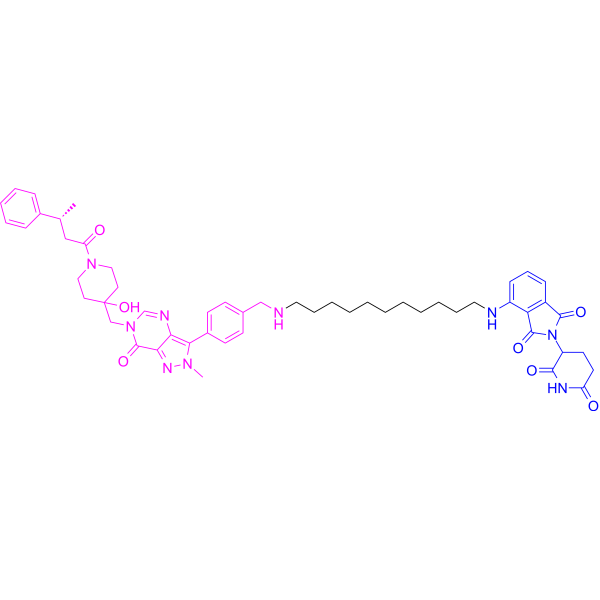
XM-U-14 is a selective PROTAC USP7 Degrader (DC50: 0.74 nM in inducing USP7 degradation in RS4;11 cell line). XM-U-14 upregulates the levels of p53 and p21. XM-U-14 also significantly inhibits acute lymphoblastic leukemia (ALL) cell growth (IC50: 0.5 nM and 8.3 nM for RS4;11 cells and Reh cells respectively). XM-U-14 induces apoptosis and cycle arrest. XM-U-14 inhibits tumor growth. (Blue: VHL ligand (HY-159465), Black: linker (HY-W539783); Pink: USP7 inhibitor (HY-159464)) .
loading...
    loading...
Cat. No.: HY-175359
USP7-IN-19 is a USP7 inhibitor. USP7-IN-19 can be used for synthesis of PROTAC USP7 Degrader-1 (HY-175358) .
loading...
    loading...
Cat. No.: HY-174301
CAS No.: 3052223-40-9
Research Areas:  

Cancer

USP7-IN-18 is a naphthalene derivative. USP7-IN-18 is a selective USP7 inhibitor (IC50 : 130.9 nM), with no or very weak inhibition of the other 8 DUBs including USP47. USP7-IN-18 specifically binds to the catalytic domain of USP7, blocking its deubiquitinase activity. USP7-IN-18 causes degradation of the oncogenic proteins MDM2 and DNMT1, and also degrades the novel target PCLAF. USP7-IN-18 activates the p53-p21 pathway. USP7-IN-18 exerts anti-tumor effects in colon cancer animal models and reshapes the tumor immune microenvironment. USP7-IN-18 achieves both direct cytotoxic and immune-synergistic anti-tumor actions.
loading...
    loading...
Cat. No.: HY-122646
CAS No.: 2196243-57-7
Research Areas:  

Cancer

USP7-IN-2 (compound 4) is a non-competitive USP7 inhibitor with an IC50 of 6 nM. USP7-IN-2 causes degradation of MDM2, stabilization of p53 and induction of p21 in multiple cell lines, and can be utilized in cancer research .
loading...
    loading...
Cat. No.: HY-124739
CAS No.: 1426544-54-8
Target:  

Deubiquitinase

Research Areas:  

Cancer

HBX 28258 is a selective USP7 inhibitor, with an IC50 of 22.6 μM. HBX 28258 can covalently binds to Cys223 located in the catalytic core of USP7, inhibits its deubiquitinating activity, promotes MDM2 protein degradation, and activates p53 .
loading...
    loading...
Cat. No.: HY-180793
CAS No.: 3056612-67-7
Target:  

PROTACs Deubiquitinase

Research Areas:  

Cancer

PROTAC USP7 Degrader-2 (Compound D16) is an efficient and selective USP7 PROTAC degrader with a DC50 of 1.91 μM (in TE-12 cells). PROTAC USP7 Degrader-2 inhibits the migration of upper gastrointestinal tract (UGI) cancer cells and shows relatively weak anti-proliferative activity. PROTAC USP7 Degrader-2 can be used in the research of metastatic upper gastrointestinal cancer.
loading...
    loading...
Cat. No.: HY-183942
CAS No.: 2196246-28-1
Research Areas:  

Cancer

USP7-IN-20 is a highly selective USP7 inhibitor that binds allosterically to the allosteric pocket of USP7 in a non-competitive and reversible manner. USP7-IN-20 downregulates MDM2 protein levels and stabilizes p53, thereby inducing p21 expression and enhancing the ubiquitin-dependent degradation of MDM2. USP7-IN-20 effectively binds endogenous USP7 to inhibit cancer cell proliferation, and also induces apoptosis by promoting the cleavage of PARP and caspase 3. USP7-IN-20 can be widely used in cancer-related basic and translational research.
loading...
    loading...
Cat. No.: HY-180826
USP7 ligand-2 is a target protein ligand that can be used for the synthesis of PROTACs, such as PROTAC USP7 Degrader-2 (HY-180793 .
loading...
    loading...
Cat. No.: HY-181288
CAS No.: 2906191-39-5
CCR9 ligand-Linker Conjugate 1 is a target protein ligand-linker conjugate containing a CCR9 ligand and a PROTAC linker, which recruits E3 ligases. USP7 Ligand-Linker Conjugates 1 can be used to synthesize PROTAC CCR9 Degrader 1 (HY-181287) .
loading...
    loading...
Cat. No.: HY-183078
CAS No.: 2009272-81-3
Target:  

Deubiquitinase

Research Areas:  

Cancer

P6620 is an orally active USP7 inhibitor. P6620 specifically binds to USP7 and disrupts its interaction with LRRC41. P6620 exhibits anticancer activity against hepatocellular carcinoma. P6620 enhances the antitumor effect of Lenvatinib (HY-10981) in xenograft mouse models. P6620 can be used for the research of hepatocellular carcinoma .
loading...
    loading...
  • 1

