17 Results for "

alizarin

" in MedChemExpress (MCE) Product Catalog:
Products (17)

17 Results for "alizarin" in MCE Product Catalog:

1
1 Cited Publications
Cat. No.: HY-N0563
CAS No.: 72-48-0
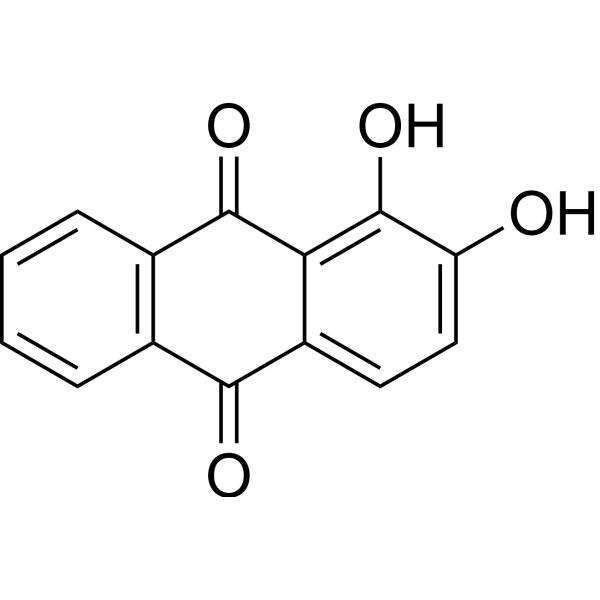
Alizarin is a natural dye. Alizarin can be extracted from the roots of madder plant. Alizarin activates AMPK and VEGFR2/eNOS pathway. Alizarin regulates PI3K/Akt and inhibits NF-κB pathway. Alizarin enhances CYP1A1 enzyme activity. Alizarin has protective effects on hypertension and vascular endothelial dysfunction. Alizarin has anti-tumor activity against multiple cancers including pancreatic cancer, breast cancer, osteosarcoma and liver cancer. Alizarin has been widely used as a pigment in textile fabrics and paintings .
loading...
    loading...
10
10 Publications Verification
Cat. No.: HY-120601
CAS No.: 130-22-3
Purity:  ≥95.0%
Synonyms: ARS sodium
Target:  

Fluorescent Dye

Research Areas:  

Others

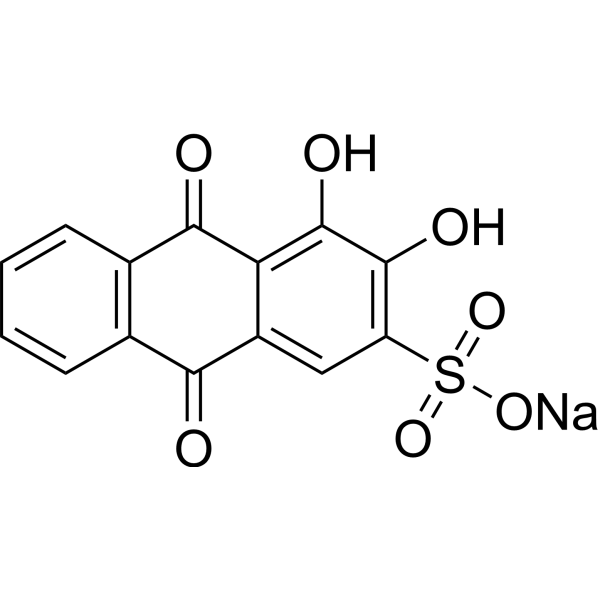
Alizarin Red S sodium is an anthraquinone derivative dye. When combined with cations such as calcium ions, the functional group of Alizarin Red S sodium can form a coordination bond with the cation through the oxygen atom to show orange-red fluorescence. Alizarin Red S sodium can be used for screening of calcium compounds in synovial fluid and detecting osteoblast differentiation, and can also be used for bone staining in mice. Excitation/emission wavelength: 500/570 nm .
loading...
    loading...
10
10 Publications Verification
Cat. No.: HY-120601A
CAS No.: 83-61-4
Synonyms: ARS
Target:  

Fluorescent Dye

Research Areas:  

Others

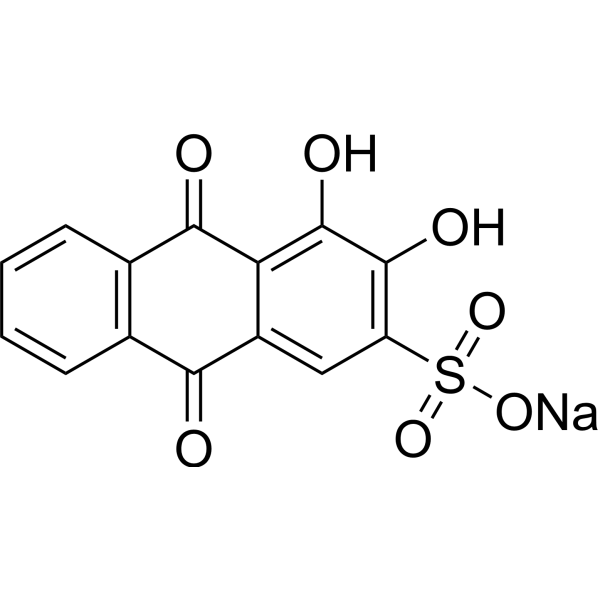
Alizarin Red S (ARS) is an anthraquinone derivative dye. When combined with cations such as calcium ions, the functional group of Alizarin Red S can form a coordination bond with the cation through the oxygen atom to show orange-red fluorescence. Alizarin Red S can be used for screening of calcium compounds in synovial fluid and detecting osteoblast differentiation, and can also be used for bone staining in mice. Excitation/emission wavelength: 500/570 nm .
loading...
    loading...
Cat. No.: HY-W110927
CAS No.: 130-22-3
Alizarin red S indicator (C.I. 58005) is a reductively active (quinone-based) anthraquinone dye that forms complexes with metal ions (such as zirconium, calcium) or boric acid to label calcium deposition and perform electrochemical sensing functions. Alizarin Red S undergoes reversible redox reactions (for electrochemical detection) and irreversible chelation (for bone staining). Alizarin Red S is mainly used in bone metabolism research (labeling mineralized tissue), sugar detection (boric acid-sugar competition system) and metal ion sensing (such as zirconium ion detection), and can be used in osteoporosis and metabolic disease research .
loading...
    loading...
Cat. No.: HY-121075
CAS No.: 3952-78-1
Purity:  ≥98.0%
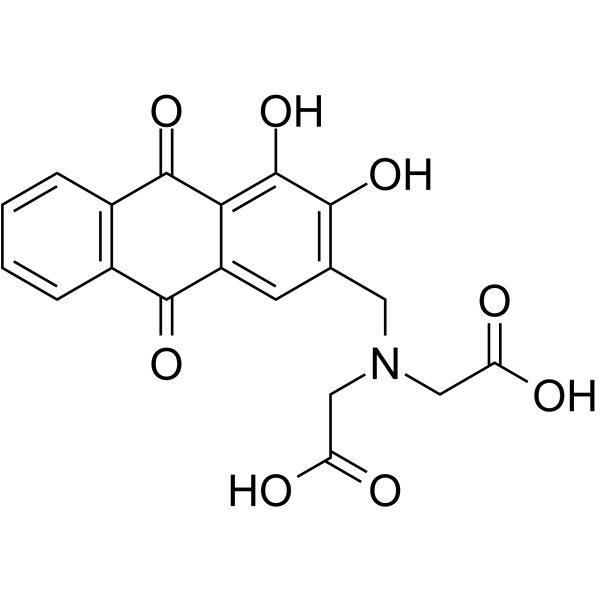
Alizarin complexone is a calcium-binding fluorescent dye. Alizarin complexone stains mineralized areas of bone by binding to calcium crystals. Alizarin complexone inhibits the reverse transcriptase activity of RAV-2, HIV-1, and RSV with IC50 values of 3.8 μg/mL, 45 μg/mL, and 100 μg/mL, respectively. Alizarin complexone exhibits antiviral activity against HIV-1 and RSV. Alizarin complexone delays RSV-induced tumor induction in chickens .
loading...
    loading...
Cat. No.: HY-N0563R
CAS No.: 72-48-0
Alizarin (Standard) is the analytical standard of Alizarin. This product is intended for research and analytical applications. Alizarin is a natural dye extracted from the roots of madder plant and has been widely used as a pigment in textile fabrics and paintings .
loading...
    loading...
Cat. No.: HY-D1175
CAS No.: 4403-90-1
Alizarin cyanin green F is an alizarin dye that reacts with calcium possibly via sulfonic acid and/or OH groups.
loading...
    loading...
Cat. No.: HY-D0235
CAS No.: 584-42-9
Alizarin yellow GG is a dye that exhibits corrosion inhibition effects on mild steel against concentrated H2SO4.
loading...
    loading...
Cat. No.: HY-W320523
CAS No.: 455303-00-1
ALizarin complexone dihydrate is the dehydrate of Alizarin complexone (HY-121075). Alizarin complexone is a calcium-binding fluorescent dye. Alizarin complexone stains mineralized areas of bone by binding to calcium crystals. Alizarin complexone inhibits the reverse transcriptase activity of RAV-2, HIV-1, and RSV with IC50 values of 3.8 μg/mL, 45 μg/mL, and 100 μg/mL, respectively. Alizarin complexone exhibits antiviral activity against HIV-1 and RSV. Alizarin complexone delays RSV-induced tumor induction in chickens .
loading...
    loading...
Cat. No.: HY-121075R
CAS No.: 3952-78-1
Alizarin complexone (Standard) is the analytical standard of Alizarin complexone (HY-121075). This product is intended for research and analytical applications. Alizarin complexone is a calcium-binding fluorescent dye. Alizarin complexone stains mineralized areas of bone by binding to calcium crystals. Alizarin complexone inhibits the reverse transcriptase activity of RAV-2, HIV-1, and RSV with IC50 values of 3.8 μg/mL, 45 μg/mL, and 100 μg/mL, respectively. Alizarin complexone exhibits antiviral activity against HIV-1 and RSV. Alizarin complexone delays RSV-induced tumor induction in chickens .
loading...
    loading...
Cat. No.: HY-D1170
CAS No.: 1836-22-2
Acid alizarin red B is a bright, scarlet, translucent red dye used for calcium determination.
loading...
    loading...
Cat. No.: HY-D0258
CAS No.: 1718-34-9
Alizarin Yellow R sodium is a multifunctional dye. Dyes are important tools in biological experiments. They can help researchers observe and analyze cell structures, track biomolecules, evaluate cell functions, distinguish cell types, detect biomolecules, study tissue pathology and monitor microorganisms. Their applications range from basic scientific research to clinical A wide range of diagnostics. Dyes are also widely used in traditional fields such as textile dyeing, as well as in emerging fields such as functional textile processing, food pigments and dye-sensitized solar cells.
loading...
    loading...
Cat. No.: HY-187153
CAS No.: 6003-11-8
Target:  

Topoisomerase

Research Areas:  

Metabolic Disease Cancer

Alizarin 2-methyl ether is a DNA topoisomerase inhibitor. Alizarin 2-methyl ether inhibits the relaxation of supercoiled DNA via DNA topoisomerase I and II. Alizarin 2-methyl ether promotes adipocyte differentiation by increasing lipid accumulation. Alizarin 2-methyl ether possesses antidiabetic and insulin-sensitizing properties. Alizarin 2-methyl ether can be used in research related to human colon cancer, P-388 lymphocytic leukemia and diabetes .
loading...
    loading...
Cat. No.: HY-DY2045
Target:  

Fluorescent Dye

Research Areas:  

Others

Alizarin Red S Staining Solution (2%, pH 4.2) is a 2% concentration, pH 4.2 anthraquinone dye (sodium alizarin sulfonate) that can be used for intercellular staining of corneal endothelial cell boundaries. Alizarin Red S Staining Solution (2%, pH 4.2) is an anthraquinone dye (sodium alizarin sulfonate) with an optimized pH of 4.2, which undergoes a dye-lake reaction with calcium and serves as an intercellular stain for corneal endothelial cell boundaries. Alizarin Red S Staining Solution (2%, pH 4.2) can be used for screening tests of calcium compounds in synovial fluid, detection of osteoblast differentiation, and staining detection of bone in mice. Excitation/emission wavelength: 500/570 nm .
loading...
    loading...
Cat. No.: HY-DY2044
Target:  

Fluorescent Dye

Research Areas:  

Others

Alizarin Red S Staining Solution (1%, pH 4.2) is an anthraquinone dye (sodium alizarinsulfonate) with an optimized pH of 4.2. It undergoes a dye-lake reaction with calcium and serves as an intercellular stain for the boundaries of corneal endothelial cells. Alizarin Red S Staining Solution (1%, pH 4.2) enables screening tests for calcium compounds in synovial fluid, detection of osteoblast differentiation, and staining detection of bone in mice. Excitation/emission wavelength: 500/570 nm .
loading...
    loading...
Cat. No.: HY-W718178
CAS No.: 152-84-1
Ruberythric acid is a natural product found in madder (Rubia tinctorum). Acid treatment induces hydrolysis of Ruberythric acid, producing pentose-containing sugar residues and alizarin. Ruberythric acid inhibits stimulus-induced phosphorylation of IKK, IκBα and p65 in the NF-κB pathway, regulates tight junction integrity, suppresses stimulus-induced MLCK activation and myosin light chain phosphorylation, reduces tight junction disruption associated with cytoskeletal contraction, alleviates stimulus-induced increase in intestinal permeability, and prevents stimulus-induced redistribution of tight junction proteins. Ruberythric acid forms red salts when dissolved in alkali and can be used as a dye. Ruberythric acid is applicable to research related to inflammatory bowel disease .
loading...
    loading...
Cat. No.: HY-N18677
CAS No.: 91845-24-8
Category:  

Extract

Target:  

Bacterial

Rubia cordifolia extract, derived from the madder plant, is valued for its anti-inflammatory, antioxidant, antibacterial, and blood-purifying properties. Active ingredients in Rubia cordifolia extract include anthraquinone compounds (such as alizarin and alizarin red), flavonoids, and tannins.
loading...
    loading...
  • 1

