1. Search Result
Search Result
Results for "

anaerobic microorganisms

" in MedChemExpress (MCE) Product Catalog:

10

Inhibitors & Agonists

4

Natural
Products

3

Isotope-Labeled Compounds

1

Oligonucleotides

Cat. No. Product Name Target Research Areas Chemical Structure
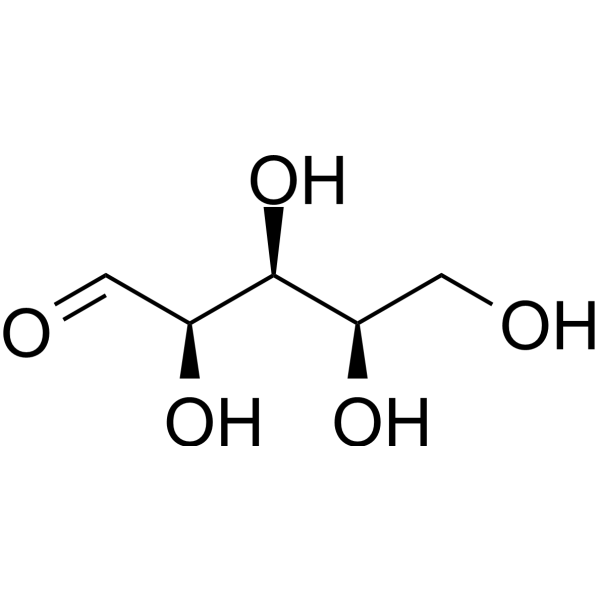
  • HY-N0537
    Xylose
    5 Publications Verification

    D-(+)-Xylose; (+)-Xylose; Wood sugar

    Environmental Pollutants Endogenous Metabolite Metabolic Disease
    Xylose (D-(+)-Xylose) is a natural pentose sugar that is catalyzed by xylose isomerase to form xylulose, which is a key step in the anaerobic ethanol fermentation of Xylose. Xylose can be used by microorganisms to produce fuels, chemicals, and bulk industrial enzymes. Xylose provides the substances and energy for cells, as a carbon source for the biosynthesis of high-value chemicals and biofuel. Xylose can be used to fully explore lignocellulose resources and provide a new direction for microbia fermentation .
    Xylose
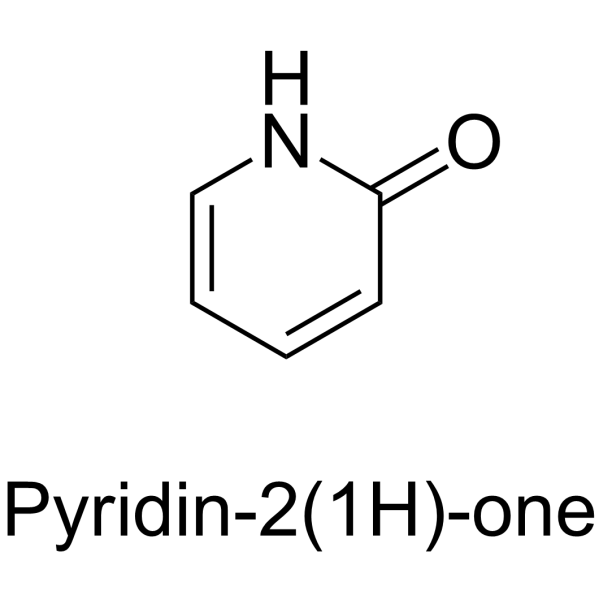
  • HY-Y0191

    2-Pyridone

    Endogenous Metabolite Bacterial Infection
    α-Pyridone (2-Pyridone) is an antibacterial agent that plays an important role in the field of biochemical research. α-Pyridone can serve as a scaffold compound to synthesize a variety of active compounds .
    α-Pyridone
  • HY-P2800

    Endogenous Metabolite Others
    Diaphorase, Recombinant microorganisms can be obtained from anaerobic sludge organisms. Diaphorase catalyzes biotransformation of hexahydro-1,3, 5-trinitro-1,3, 5-triazine (RDX) by denitrification .
    Diaphorase, Recombinant microorganisms
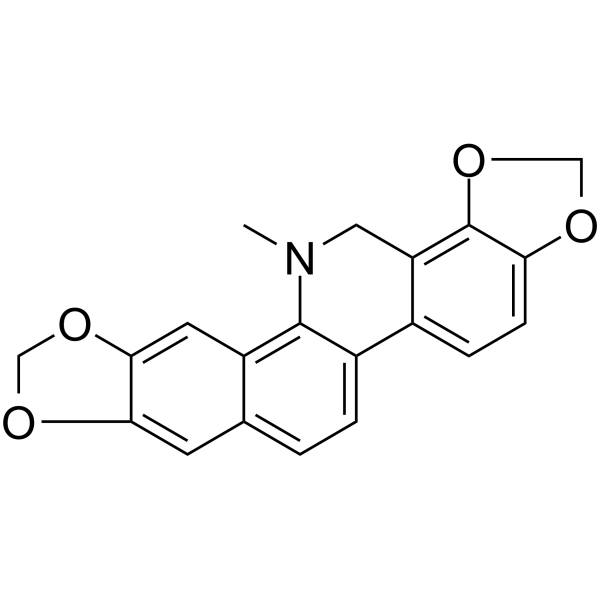
  • HY-N0902

    13,14-Dihydrosanguinarine

    Fungal Bacterial Interleukin Related Infection Inflammation/Immunology
    Dihydrosanguinarine (13,14-Dihydrosanguinarine) is an alkaloid with antibacterial and anti-inflammatory activities, and also an important precursor of Sanguinarine (HY-N0052). Dihydrosanguinarine targets and regulates the TNF/IL-17/PI3K signaling pathway, downregulates the levels of pro-inflammatory factors such as IL-17A, TNF-α and IL-6, upregulates the expression of TGF-β, inhibits myeloperoxidase activity, and regulates the transcription of multiple inflammation-related genes. Dihydrosanguinarine exhibits antibacterial activity against a variety of oral microorganisms. Dihydrosanguinarine can be used in research related to liver inflammation and oral flora dysbiosis .
    Dihydrosanguinarine
  • HY-W779019

    D-(+)-Xylose-13C5; (+)-Xylose-13C5; Wood sugar-13C5

    Isotope-Labeled Compounds Endogenous Metabolite Metabolic Disease
    Xylose- 13C5 (D-(+)-Xylose- 13C5) is 13C labeled Xylose. Xylose (D-(+)-Xylose) is a natural pentose sugar that is catalyzed by xylose isomerase to form xylulose, which is a key step in the anaerobic ethanol fermentation of Xylose. Xylose can be used by microorganisms to produce fuels, chemicals, and bulk industrial enzymes. Xylose provides the substances and energy for cells, as a carbon source for the biosynthesis of high-value chemicals and biofuel. Xylose can be used to fully explore lignocellulose resources and provide a new direction for microbia fermentation .
    Xylose-13C5
  • HY-N0537R

    D-(+)-Xylose (Standard); (+)-Xylose (Standard); Wood sugar (Standard)

    Reference Standards Endogenous Metabolite Metabolic Disease
    Xylose (Standard) (D-(+)-Xylose (Standard)) is the analytical standard of Xylose (HY-N0537). This product is intended for research and analytical applications. Xylose (D-(+)-Xylose) is a natural pentose sugar that is catalyzed by xylose isomerase to form xylulose, which is a key step in the anaerobic ethanol fermentation of Xylose. Xylose can be used by microorganisms to produce fuels, chemicals, and bulk industrial enzymes. Xylose provides the substances and energy for cells, as a carbon source for the biosynthesis of high-value chemicals and biofuel. Xylose can be used to fully explore lignocellulose resources and provide a new direction for microbia fermentation.
    Xylose (Standard)
  • HY-N0537S3

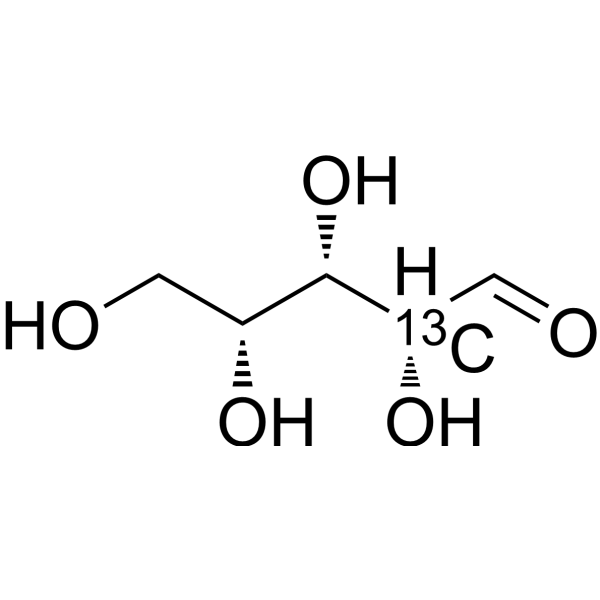
    D-(+)-Xylose-2-13C; (+)-Xylose-2-13C; Wood sugar-2-13C

    Isotope-Labeled Compounds Endogenous Metabolite Metabolic Disease
    Xylose-2- 13C (D-(+)-Xylose-2- 13C) is the 13C labeled Xylose (HY-N0537). Xylose (D-(+)-Xylose) is a natural pentose sugar that is catalyzed by xylose isomerase to form xylulose, which is a key step in the anaerobic ethanol fermentation of Xylose. Xylose can be used by microorganisms to produce fuels, chemicals, and bulk industrial enzymes. Xylose provides the substances and energy for cells, as a carbon source for the biosynthesis of high-value chemicals and biofuel. Xylose can be used to fully explore lignocellulose resources and provide a new direction for microbia fermentation .
    Xylose-2-13C
  • HY-W016758

    1-Butyl-3-methylimidazolium chloride

    Bacterial Infection
    [BMIM]Cl (1-butyl-3-methylimidazolium chloride) is an alkyl-imidazolium chloride compound and a persistent aquatic pollutant. [BMIM]Cl exhibits antimicrobial activity against S. aureus (MIC = 25 mM), E. coli (MIC = 50 mM), and P. aeruginosa (MIC = 100 mM). It possesses moderate membrane permeability and cytotoxicity, directly affecting microorganisms and mammalian cells at high concentrations, but can inhibit the function of complex ecosystems (e.g., anaerobic digestion) even at environmentally relevant low concentrations by disrupting microbial community structures. [BMIM]Cl can be used in research related to bacterial infections .
    [BMIM]Cl
  • HY-122288

    Bacterial Infection
    SC 28538 is a compound with antimicrobial activity. SC 28538 exerts its antimicrobial effect by reducing its nitro moiety in an anaerobic environment to form cytotoxic free radicals that can damage DNA and other key biomolecules of microorganisms .
    SC 28538
  • HY-W779018

    D-(+)-Xylose-13C2; (+)-Xylose-13C2; Wood sugar-13C2

    Isotope-Labeled Compounds Endogenous Metabolite Metabolic Disease
    Xylose- 13C2 (D-(+)-Xylose- 13C2) is the 13C-labeled Xylose. Xylose (D-(+)-Xylose) is a natural pentose sugar that is catalyzed by xylose isomerase to form xylulose, which is a key step in the anaerobic ethanol fermentation of Xylose. Xylose can be used by microorganisms to produce fuels, chemicals, and bulk industrial enzymes. Xylose provides the substances and energy for cells, as a carbon source for the biosynthesis of high-value chemicals and biofuel. Xylose can be used to fully explore lignocellulose resources and provide a new direction for microbia fermentation .
    Xylose-13C2

Inquiry Online

Your information is safe with us. * Required Fields.

Salutation


Country or Region *

Applicant Name *


Organization Name *

Department *


Email Address *


Product Name *

Cat. No.


Requested quantity *

Phone Number *


Remarks

Inquiry Online

Inquiry Information

Product Name:
Cat. No.:
Quantity:
MCE Japan Authorized Agent:

