9 Results for "

bioorthogonal copper-catalyzed azide-alkyne cycloaddition

" in MedChemExpress (MCE) Product Catalog:
Products (9)

9 Results for "bioorthogonal copper-catalyzed azide-alkyne cycloaddition" in MCE Product Catalog:

5
5 Cited Publications
製品番号: HY-133870
CAS 番号: 2454181-83-8
純度:  98.01%
別名: ITalk
Target:  

Fluorescent Dye

研究分野:  

Inflammation/Immunology

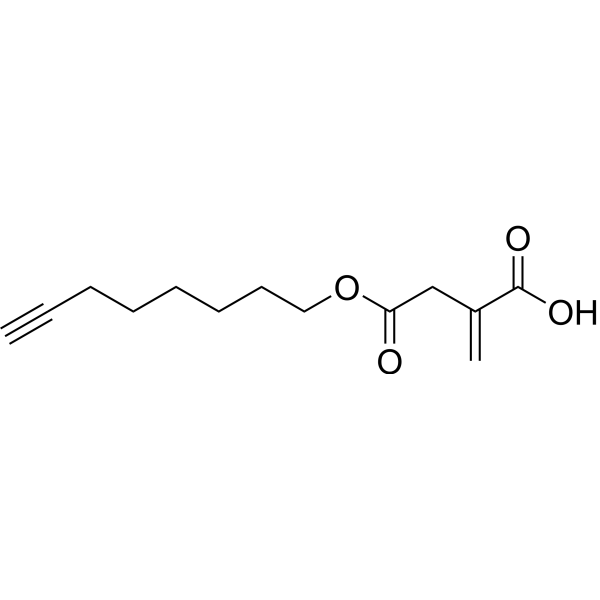
Itaconate-alkyne (ITalk) is a specific bioorthogonal probe for quantitative and site-specific chemoproteomic profiling of Itaconation in living cells. Itaconate-alkyne, a functional analogue of Itaconate, exhibits comparable antiinflammatory effect with Itaconate and enables the labeling of bona fide targets of Itaconate . Itaconate-alkyne is a click chemistry reagent, it contains an Alkyne group and can undergo copper-catalyzed azide-alkyne cycloaddition (CuAAc) with molecules containing Azide groups.
loading...
    loading...
製品番号: HY-D2113
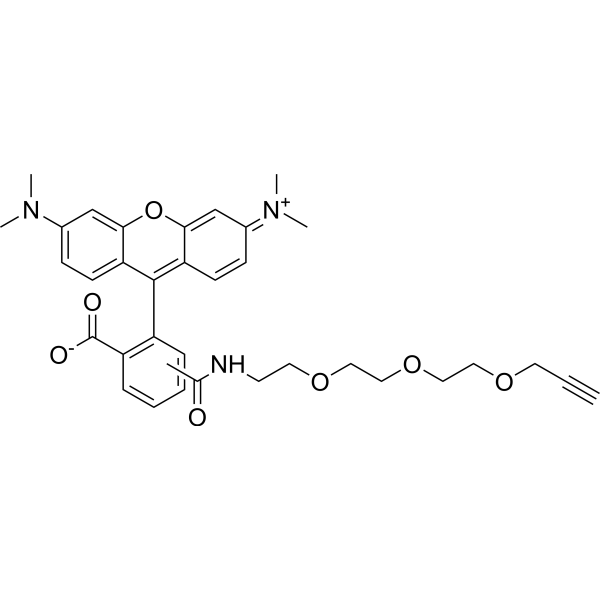
TAMRA-PEG3-Alkyne is a TAMRA dye derivative (HY-135640) containing three PEG units and can be applied for bioorthogonal labeling. TAMRA-PEG3-Alkyne bears alkyne groups capable of undergoing copper-catalyzed azide-alkyne cycloaddition (CuAAC) with azide-bearing molecules. TAMRA-PEG3-Alkyne has an excitation wavelength of approximately 547 nm and an emission wavelength of around 575 nm.
loading...
    loading...
製品番号: HY-151745
CAS 番号: 1993176-74-1
Target:  

ADC Linkers

研究分野:  

Others

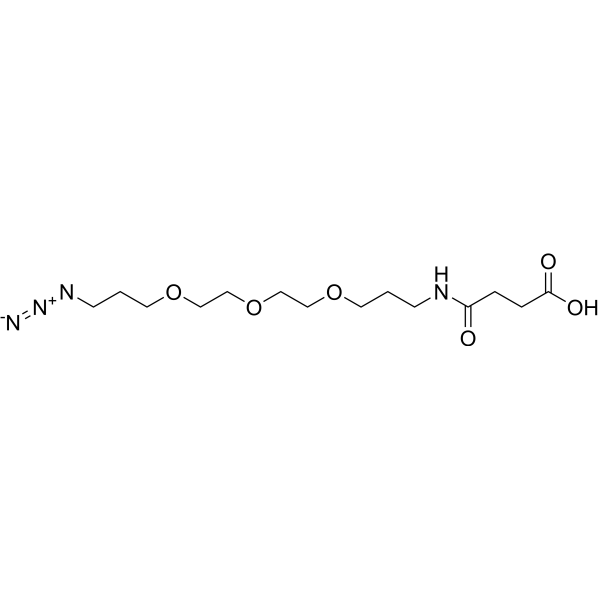
N3-TOTA-Suc is a click chemistry reagent containing an azide group. Click chemistry is a powerful chemical reaction with excellent bioorthogonality features: biocompatible, rapid and highly specific in biological environments . N3-TOTA-Suc is a click chemistry reagent, it contains an Azide group and can undergo copper-catalyzed azide-alkyne cycloaddition reaction (CuAAc) with molecules containing Alkyne groups. It can also undergo strain-promoted alkyne-azide cycloaddition (SPAAC) reactions with molecules containing DBCO or BCN groups.
loading...
    loading...
製品番号: HY-151749
CAS 番号: 1994300-35-4
Target:  

ADC Linkers

研究分野:  

Others

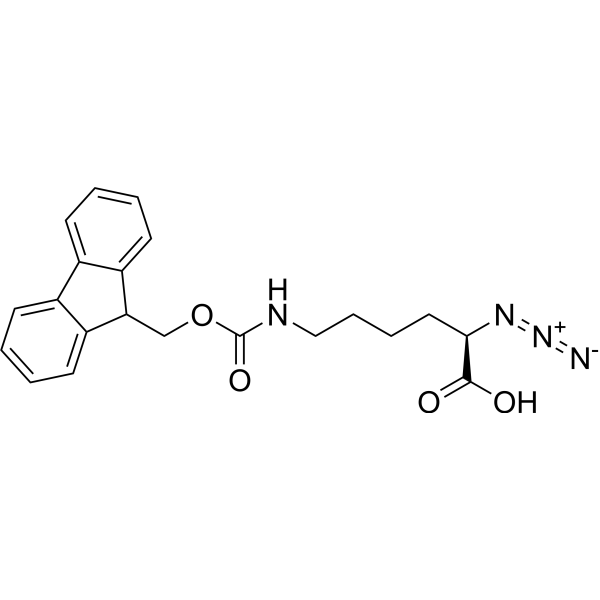
N3-D-Lys(Fmoc)-OH is a click chemistry reagent containing an azide group. Click chemistry is a powerful chemical reaction with excellent bioorthogonality features: biocompatible, rapid and highly specific in biological environments . N3-D-Lys(Fmoc)-OH is a click chemistry reagent, it contains an Azide group and can undergo copper-catalyzed azide-alkyne cycloaddition reaction (CuAAc) with molecules containing Alkyne groups. It can also undergo strain-promoted alkyne-azide cycloaddition (SPAAC) reactions with molecules containing DBCO or BCN groups.
loading...
    loading...
製品番号: HY-152901
CAS 番号: 2106868-12-4
Target:  

Fluorescent Dye

研究分野:  

Others

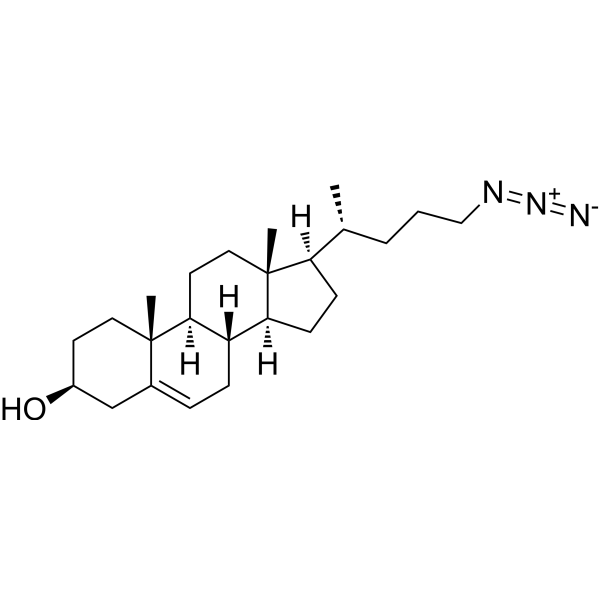
Chol-N3 is a bioorthogonal-based chol probe. Chol-N3 can combine with super-resolution fluorescence microscopy (SRM), providing direct visualization of nanoscale lipid heterogeneity in the cell surface of resting living cells . Chol-N3 is a click chemistry reagent, it contains an Azide group and can undergo copper-catalyzed azide-alkyne cycloaddition reaction (CuAAc) with molecules containing Alkyne groups. It can also undergo strain-promoted alkyne-azide cycloaddition (SPAAC) reactions with molecules containing DBCO or BCN groups.
loading...
    loading...
製品番号: HY-151679
CAS 番号: 1446511-14-3
Target:  

ADC Linkers

研究分野:  

Others

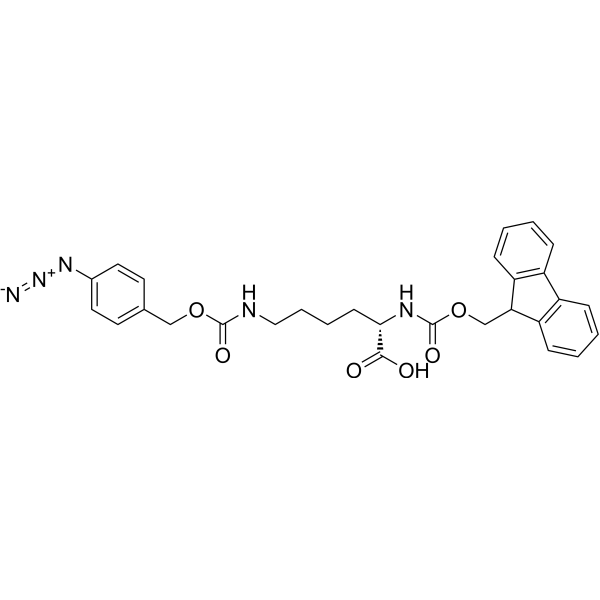
Fmoc-L-Lys(4-N3-Z)-OH is a click chemistry reagent containing an azide group. Fmoc-L-Lys(4-N3-Z)-OH acts as Lysine building-block for SPPS containing an Azide moiety as a bioorthogonal ligation handle, an infrared probe and a photo-affinity reagent. It can be decaged by trans-cyclooctenols via a strain-promoted 1,3-dipolar cycloaddition . Fmoc-L-Lys(4-N3-Z)-OH is a click chemistry reagent, it contains an Azide group and can undergo copper-catalyzed azide-alkyne cycloaddition reaction (CuAAc) with molecules containing Alkyne groups. It can also undergo strain-promoted alkyne-azide cycloaddition (SPAAC) reactions with molecules containing DBCO or BCN groups.
loading...
    loading...
製品番号: HY-155684
CAS 番号: 3058085-76-7
研究分野:  

Cancer

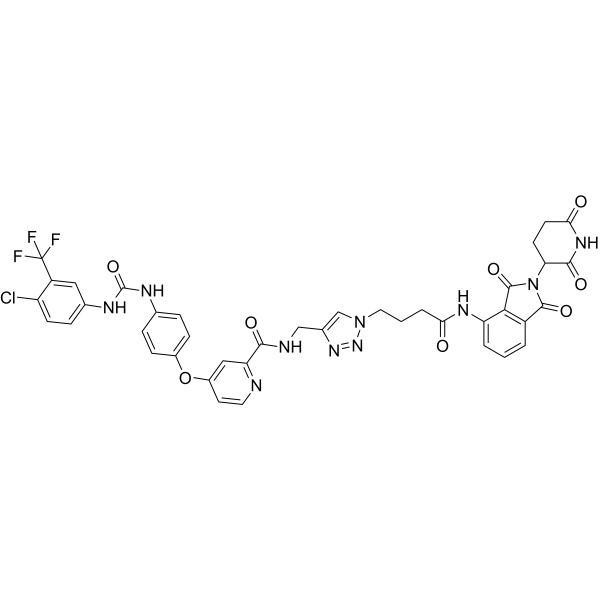
SA-PA is an intracellular self-assembling CRBN-recruiting PROTAC composed of an alkynylated Sorafenib precursor (SA) and an azidated Pomalidomide precursor (PA). SA-PA promotes the ubiquitination and proteasomal degradation of VEGFR-2, EphB4, and PDGFR-β, and exhibits inhibitory activity against U87 and A549 cell proliferation. SA-PA is used in cancer-related research, such as glioblastoma and non-small cell lung cancer .
loading...
    loading...
製品番号: HY-D3584
Target:  

Fluorescent Dye

研究分野:  

Others

AF647 Picolyl Azide is a far-red fluorescent probe used in bioorthogonal click chemistry. It reacts with terminal alkynes via copper-catalyzed azide-alkyne cycloaddition (CuAAC). The integrated picolyl group chelates copper, which speeds up the reaction and allows for lower copper concentrations to protect sensitive proteins (Ex/Em = 650/665 nm)[1].
loading...
    loading...
製品番号: HY-L258
437 compounds

In modern medicinal chemistry and chemical biology research, alkyne (-C≡C-) structures play an important role in click chemistry, bioorthogonal labeling, and the construction of functional molecules due to their unique linear geometry and high reactivity. In particular, driven by the development of copper-catalyzed azide-alkyne cycloaddition (CuAAC) and copper-free click reactions (SPAAC), terminal alkyne groups have become important “chemical handles” for building complex biomolecular systems.

The MCE Alkyne Compound Library contains 437 compounds designed for the construction of click chemistry reaction systems and the development of diverse functional molecules. In drug discovery, these structures serve as key reactive sites that can efficiently undergo click reactions with azide groups, enabling modular assembly of PROTAC molecules, construction of ADC linkers, and rapid synthesis of bioorthogonal labeling probes. In addition, alkyne groups exhibit high stability, mild reaction conditions, and excellent biocompatibility, allowing them to maintain reactivity in complex biological environments. This contributes to improved efficiency and controllability in drug development, making them indispensable chemical building blocks in modern drug design and functional molecular engineering.

