

9 Results for "

cationic α-helical peptide

" in MedChemExpress (MCE) Product Catalog:
Products (9)

9 Results for "cationic α-helical peptide" in MCE Product Catalog:

Cat. No.: HY-P5284
CAS No.: 1613231-49-4
Target:  

Inhibitory Antibodies

Research Areas:  

Others

RALA peptide is a cationic amphiphilic delivery agent targeting cell membranes, which forms nanoparticles through electrostatic interactions with anionic drugs. RALA peptide has pH-responsive binding properties, which can enhance the α-helical conformation in an acidic environment and destroy the endosomal membrane, promote the release of drugs into the cytoplasm, and exert efficient intracellular delivery activity. RALA peptide can be used in cancer research (enhancing the activity of bisphosphonates against prostate cancer and breast cancer cells) and bone tissue engineering (promoting osteoblast collagen deposition and extracellular matrix mineralization) .
loading...
    loading...
Cat. No.: HY-P5557
CAS No.: 1429184-62-2
Target:  

Bacterial Necroptosis

Research Areas:  

Infection Inflammation/Immunology

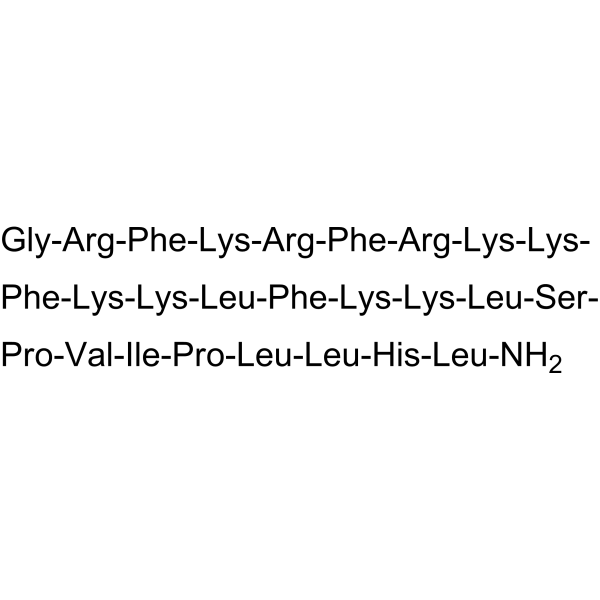
TP4 (Nile tilapia piscidin) is an orally active amphipathic α-helical cationic antimicrobial peptide. TP4 (Nile tilapia piscidin) exerts broad-spectrum bactericidal activity against Gram-positive and Gram-negative bacteria by disrupting cell membrane structures, and also exhibits certain hemolytic activity. TP4 (Nile tilapia piscidin) regulates the innate immune system and enhances the expression of lysozymes, cytokines and antioxidant enzymes to resist bacterial infection. TP4 (Nile tilapia piscidin) also stimulates the proliferation of keratinocytes and fibroblasts, and significantly promotes the healing of wounds infected with MRSA. TP4 (Nile tilapia piscidin) can be used in research related to bacterial infection, peritonitis, wound healing and other fields .
loading...
    loading...
Cat. No.: HY-P2170
CAS No.: 316805-65-9
Synonyms: XOMA-629
Target:  

Antibiotic Bacterial

Research Areas:  

Infection Inflammation/Immunology

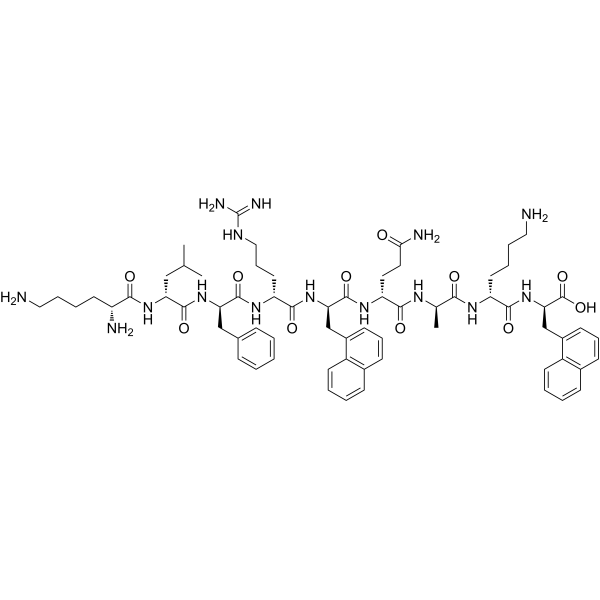
XMP-629 (XOMA-629), a cationic α-helical peptide, is a potent endotoxin inhibitor. XMP-629 exhibits broad-spectrum antimicrobial activity via an immunomodulatory mechanism. XOMA 629 has antimicrobial activity against Propionibacterium acnes, Staphylococcus aureus and Streptococcus pyogenesand .
loading...
    loading...
Cat. No.: HY-P5286
CAS No.: 184870-30-2
BMAP-27 is a cationic amphipathic α-helical antimicrobial peptide with anticancer activity. BMAP-27 disrupts the integrity and permeability of cell membranes, leading to the leakage of intracellular DNA, proteins and alkaline phosphatase. BMAP-27 increases intracellular ROS levels and reduces plasma endotoxin and TNF-α concentrations. BMAP-27 can be used in studies related to Salmonella infection, breast cancer, lung cancer and obstructive jaundice .
loading...
    loading...
Cat. No.: HY-P11169
CAS No.: 1001886-94-7
Target:  

Bacterial

Research Areas:  

Infection

Decoralin is a short cationic alpha-helical antimicrobial peptide that can be isolated from the venom of Oreumenes decorates wasps. Decoralin exhibits selective and rapid activity against bacteria by destroying membranes. Decoralin can be used for antimicrobial research .
loading...
    loading...
Cat. No.: HY-P11353
CAS No.: 117138-19-9
Research Areas:  

Infection Cancer

HA2 peptide is a potent pH-responsive fusion peptide derived from hemagglutinin (HA), corresponding to the N-terminal fusion peptide domain consisting of 23 amino acid residues of HIV-1 gp41 envelope glycoprotein. HA2 peptide adopts a random coil structure under physiological pH conditions; in acidic endosomes, protonation of carboxyl groups reduces negative charge, inducing a transition to an α-helical conformation that can fuse with and destabilize the endosomal membrane. After binding to membranes, the N-terminal and middle regions of HA2 peptide mainly adopt a β-strand conformation, while the C-terminal region remains unstructured. HA2 peptide induces lipid mixing and promotes aqueous content leakage from large unilamellar vesicles whose lipid composition matches that of HIV-1 viruses and target T cells. HA2 peptide is anionic and can bind to cationic peptides to achieve siRNA condensation. HA2 peptide can be used in studies related to cancer and human immunodeficiency virus (HIV) infection .
loading...
    loading...
Cat. No.: HY-P12121
CAS No.: 932013-61-1
Target:  

Bacterial

Research Areas:  

Infection Cancer

HB43 is a synthetic amphipathic cationic α-helical peptide, as well as an antibacterial/anticancer peptide. HB43 reduces the number of Methicillin (HY-121544)-resistant Staphylococcus aureus in biofilms in a dose-dependent manner. When loaded into chitosan nanoparticles, it achieves sustained release, and this effect is particularly pronounced under acidic conditions .
loading...
    loading...
Cat. No.: HY-P5286A
BMAP-27 acetate is a cationic amphipathic α-helical antimicrobial peptide with anticancer activity. BMAP-27 acetate disrupts the integrity and permeability of cell membranes, leading to the leakage of intracellular DNA, proteins and alkaline phosphatase. BMAP-27 acetate increases intracellular ROS levels and reduces plasma endotoxin and TNF-α concentrations. BMAP-27 acetate can be used in studies related to Salmonella infection, breast cancer, lung cancer and obstructive jaundice .
loading...
    loading...
Cat. No.: HY-P5289A
Target:  

Drug Intermediate

pre-BMAP-27 TFA is a precursor to BMAP-27 (HY-P5286). BMAP-27 is a cationic amphipathic α-helical antimicrobial peptide with anticancer activity. BMAP-27 disrupts the integrity and permeability of cell membranes, leading to the leakage of intracellular DNA, proteins and alkaline phosphatase. BMAP-27 increases intracellular ROS levels and reduces plasma endotoxin and TNF-α concentrations. BMAP-27 can be used in studies related to Salmonella infection, breast cancer, lung cancer and obstructive jaundice .
loading...
    loading...

