
15 Results for "

cotton plants

" in MedChemExpress (MCE) Product Catalog:
Products (15)

15 Results for "cotton plants" in MCE Product Catalog:

Cat. No.: HY-Y1058
CAS No.: 495-18-1
Synonyms: BHA
Target:  

Fungal

Research Areas:  

Infection

Benzohydroxamic acid (BHA) is a chitin deacetylase (CDA) inhibitor with significant antifungal activity. The Ki values of BHA against the CDAs of Verticillium dahliae and Puccinia striiformis f. sp. tritici are 8.31 μM and 9.83 μM, respectively. Benzohydroxamic acid can restore the defense responses of infected host plants, upregulate the expression of defense-related genes, and reduce the growth and reproduction of fungi in plants. Benzohydroxamic acid can be used in the research of the field of controlling agricultural fungal diseases, such as various plant fungal diseases caused by Verticillium dahliae, Puccinia striiformis and other fungi, like cotton wilt and wheat stripe rust .
loading...
    loading...
Cat. No.: HY-E70115
CAS No.: 134712-49-5
Target:  

Fungal Bacterial

Research Areas:  

Infection

Feruloyl esterase is a subclass of carboxylesterases that hydrolyzes the ester linkages between hydroxycinnamic acids and arabinoxylan/pectin polysaccharides in plant cell walls. Feruloyl esterase can hydrolyze ethyl ferulate to release ferulic acid, disrupt plant cell wall structure, promote fiber swelling, and facilitate cellulase hydrolysis. Feruloyl esterase synergizes with xylanase by removing ferulic acid side chains, thereby promoting efficient hydrolysis of xylan into monomers. Feruloyl esterase acts as a virulence factor for Verticillium dahliae VdFAE and Magnaporthe oryzae Fae1, facilitating host infection and colonization. Feruloyl esterase promotes the degradation of cotton GhDFR through binding to its NADPH domain, thereby inhibiting flavonoid-mediated innate immunity and inducing cell death in Nicotiana benthamiana. Feruloyl esterase can be used in studies related to verticillium wilt and rice blast .
loading...
    loading...
Cat. No.: HY-W017448
CAS No.: 24307-26-4
Synonyms: N,N-Dimethylpiperidinium chloride; PIX
Mepiquat chloride (N,N-Dimethylpiperidinium chloride) is a systemic plant growth regulator. Mepiquat chloride reduces the activity of RuBP carboxylase. Mepiquat chloride decreases plant height, total length of vegetative and fruiting branches, and total leaf area of cotton. Mepiquat chloride reduces the net photosynthetic rate of cotton leaves. Mepiquat chloride promotes starch accumulation in cotton leaves without altering sucrose content .
loading...
    loading...
Cat. No.: HY-126386A
CAS No.: 9032-75-1
Research Areas:  

Others

Pectinase, aspergillus aculeatus is a pectin-degrading enzyme with the activity of catalyzing the decomposition of pectin into galacturonic acid. Pectinase, aspergillus aculeatus can be applied in a variety of industrial fields, including juice extraction and clarification, vegetable oil extraction, wine clarification, cocoa and coffee fermentation, paper bleaching, plant fiber degumming, cotton bioscouring, bioenergy production, wastewater treatment, and use as a poultry feed additive to reduce feed viscosity .
loading...
    loading...
Cat. No.: HY-W017448R
CAS No.: 24307-26-4
Synonyms: N,N-Dimethylpiperidinium chloride (Standard); PIX (Standard)
Mepiquat chloride (Standard) (N,N-Dimethylpiperidinium chloride (Standard)) is the analytical standard of Mepiquat chloride (HY-W017448). This product is intended for research and analytical applications. Mepiquat chloride (N,N-Dimethylpiperidinium chloride) is a systemic plant growth regulator. Mepiquat chloride reduces the activity of RuBP carboxylase. Mepiquat chloride decreases plant height, total length of vegetative and fruiting branches, and total leaf area of cotton. Mepiquat chloride reduces the net photosynthetic rate of cotton leaves. Mepiquat chloride promotes starch accumulation in cotton leaves without altering sucrose content .
loading...
    loading...
Cat. No.: HY-W758396
Synonyms: N,N-Dimethylpiperidinium-d16 chloride; PIX-d16
Mepiquat-d16 chloride (N,N-Dimethylpiperidinium-d16 chloride) is the deuterated-labeled Mepiquat chloride (HY-W017448). Mepiquat chloride (N,N-Dimethylpiperidinium chloride) is a systemic plant growth regulator. Mepiquat chloride reduces the activity of RuBP carboxylase. Mepiquat chloride decreases plant height, total length of vegetative and fruiting branches, and total leaf area of cotton. Mepiquat chloride reduces the net photosynthetic rate of cotton leaves. Mepiquat chloride promotes starch accumulation in cotton leaves without altering sucrose content .
loading...
    loading...
Cat. No.: HY-118217
CAS No.: 113136-77-9
Purity:  99.91%
Synonyms: RPA90946
Research Areas:  

Others

Cyclanilide (RPA90946) serves as a plant growth regulator that is applied to cotton during various growth stages.
loading...
    loading...
Cat. No.: HY-125511
CAS No.: 128252-98-2
Target:  

Fungal

Chaetoviridin A exhibits antifungal activity against several plants pathogen, inhibits growth of Verticillium dahliae through cell necrosis and mycelial deformation, and thus improves sensitivity of V. dahliae to stress, increases the emergence rate and plant height of cotton .
loading...
    loading...
Cat. No.: HY-118217R
CAS No.: 113136-77-9
Synonyms: RPA90946 (Standard)
Research Areas:  

Others

Cyclanilide (Standard) is the analytical standard of Cyclanilide. This product is intended for research and analytical applications. Cyclanilide (RPA90946) serves as a plant growth regulator that is applied to cotton during various growth stages.
loading...
    loading...
Cat. No.: HY-136560
CAS No.: 13924-15-7
Target:  

Drug Metabolite

Research Areas:  

Others

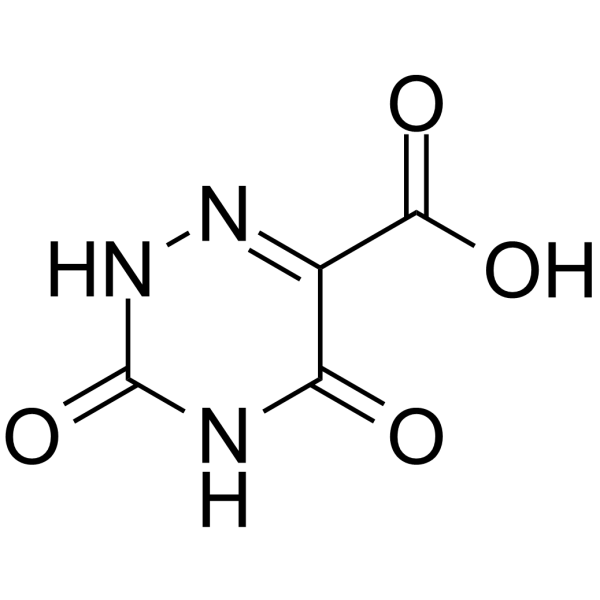
6-Azathymine acid is a metabolite of Pymetrozine. Pymetrozine is active against plant-sucking insects, such as aphids and whiteflies in vegetables, cotton, field crops and fruits and affects the nervous regulation of feeding behavior .
loading...
    loading...
Cat. No.: HY-W747529
CAS No.: 117337-19-6
Target:  

Herbicide

Research Areas:  

Others

Fluthiacet-methyl is an isoxazole herbicide and also a protoporphyrinogen oxidase (Protox) inhibitor. Fluthiacet-methyl inhibits chlorophyll biosynthesis in cotyledons of velvetleaf and cotton. Fluthiacet-methyl induces electrolyte leakage in cotyledons of sensitive plants such as velvetleaf and cotton. Fluthiacet-methyl induces the accumulation of protoporphyrin IX in cotton cotyledons .
loading...
    loading...
Cat. No.: HY-W587665
CAS No.: 2496-92-6
Target:  

Insecticide

Research Areas:  

Infection

Demeton-S sulfoxide is a systemic insecticide. When Demeton-S sulfoxide is topically applied to cotton stems, it is absorbed and transported to cotton leaves, whereas its penetration and diffusion capabilities are limited when it is topically applied to young lemon leaves .
loading...
    loading...
Cat. No.: HY-133010R
CAS No.: 75504-34-6
Research Areas:  

Cancer

Cyclanilide (Standard) is the analytical standard of Cyclanilide. This product is intended for research and analytical applications. Cyclanilide (RPA90946) serves as a plant growth regulator that is applied to cotton during various growth stages.
loading...
    loading...
Cat. No.: HY-187659
CAS No.: 38725-95-0
Research Areas:  

Others

Diethatyl is a pre-planting and pre-emergence herbicide, which is a metabolite of diethatyl-ethyl. Diethatyl reduces competition by inhibiting weed growth, and is mainly used to control annual grass weeds, broadleaf weeds and Cyperus rotundus in crop fields such as sugar beet, spinach and cotton. Diethatyl can be used in research related to agricultural weed control .
loading...
    loading...
Cat. No.: HY-E70115A
Target:  

Fungal Bacterial

Research Areas:  

Infection

Feruloyl esterase, Acetivibrio cellulolyticus is a subclass of carboxylesterases that hydrolyzes the ester linkages between hydroxycinnamic acids and arabinoxylan/pectin polysaccharides in plant cell walls. Feruloyl esterase, Acetivibrio cellulolyticus can hydrolyze ethyl ferulate to release ferulic acid, disrupt plant cell wall structure, promote fiber swelling, and facilitate cellulase hydrolysis. Feruloyl esterase, Acetivibrio cellulolyticus synergizes with xylanase by removing ferulic acid side chains, thereby promoting efficient hydrolysis of xylan into monomers. Feruloyl esterase, Acetivibrio cellulolyticus acts as a virulence factor for Verticillium dahliae VdFAE and Magnaporthe oryzae Fae1, facilitating host infection and colonization. Feruloyl esterase, Acetivibrio cellulolyticus promotes the degradation of cotton GhDFR through binding to its NADPH domain, thereby inhibiting flavonoid-mediated innate immunity and inducing cell death in Nicotiana benthamiana. Feruloyl esterase, Acetivibrio cellulolyticus can be used in studies related to verticillium wilt and rice blast .
loading...
    loading...
  • 1

