18 Results for "

crosslinked networks

" in MedChemExpress (MCE) Product Catalog:
Products (18)

18 Results for "crosslinked networks" in MCE Product Catalog:

Cat. No.: HY-129630
CAS No.: 53-02-1
Purity:  99.91%
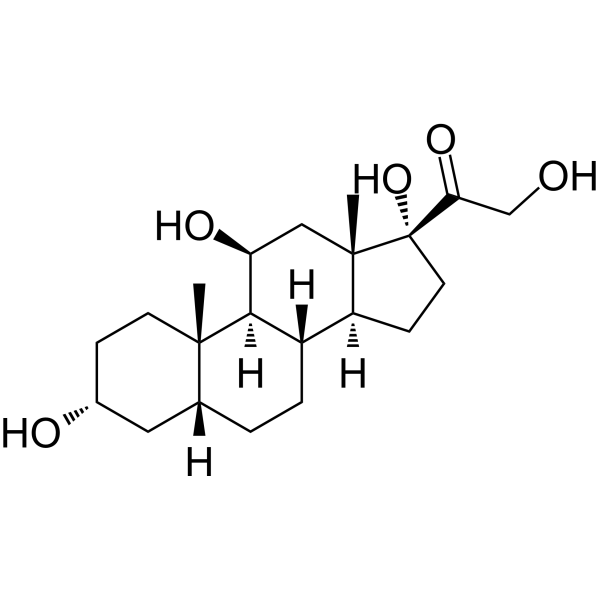
Tetrahydrocortisol is a metabolite of Hydrocortisone (HY-N0583) that fails to activate glucocorticoid receptor. Tetrahydrocortisol inhibits Dexamethasone (HY-14648)-induced formation of cross-linked actin networks. Tetrahydrocortisol acts as a synergist to enhance the activity of anticancer agents. Tetrahydrocortisol can be used in the research of primary open-angle glaucoma, ocular hypertension, lung cancer and breast cancer .
loading...
    loading...
Cat. No.: HY-109536B
CAS No.: 68333-79-9
Research Areas:  

Others

Ammonium polyphosphate, n<20, water solubility>90 g/100 mL is a class of inorganic polyphosphate polymers that chelate metal ions. Ammonium polyphosphate, n<20, water solubility>90 g/100 mL is used as a raw material for agricultural chelated slow-release phosphorus fertilizers, and also serves as a reactive crosslinking component and flame retardant component in bio-based wood bio-adhesives. Ammonium polyphosphate, n<20, water solubility>90 g/100 mL is also used in research related to pH buffer reagents .
loading...
    loading...
Cat. No.: HY-172380A
PCL-PEG-PCL diacrylate (MW 800) is an amphiphilic triblock copolymer composed of PEG and two polycaprolactones (PCL). PCL-PEG-PCL diacrylate (MW 800) can be cross-linked by free radical polymerization and/or photopolymerization to form a cross-linked hydrogel network .
loading...
    loading...
Cat. No.: HY-156045C
CAS No.: 9041-36-5
Cross-linked dextran G 200 is a hydrophilic gel based on molecular size exclusion and targeted macromolecular separation. Cross-linked dextran G 200 works through the gel permeation mechanism, and the cross-linked structure forms a three-dimensional network with a specific pore size, achieving separation based on the molecular hydrodynamic volume. Cross-linked dextran G 200 can be used to adjust the osmotic solute distribution coefficient and the ability to maintain osmotic equilibrium, such as in gel filtration chromatography for purification and analysis of biomacromolecules such as proteins and nucleic acids . Cross-linked dextran G 200 can also be used as a gel filtration filler (particle size range: 40-120 μm; globular protein separation range: 5-600 kDa) .
loading...
    loading...
Cat. No.: HY-156045B
CAS No.: 12774-36-6
Cross-linked dextran G 150 is a hydrophilic gel based on molecular size exclusion and targeted for the separation of macromolecules. Cross-linked dextran G 150 functions through the gel permeation mechanism, where the cross-linked structure forms a three-dimensional network with specific pore diameters, achieving separation based on the molecular volumetric flow. Cross-linked dextran G 150 can be used to regulate the distribution coefficient of permeating solutes and maintain the permeation balance, such as in gel filtration chromatography for the purification and analysis of biological macromolecules like proteins and nucleic acids. Cross-linked dextran G 150 can also be used as a gel filtration filler (particle size range: 40-120 μm; spherical protein separation range: 5-300 kDa) .
loading...
    loading...
Cat. No.: HY-172380
PCL-PEG-PCL diacrylate (MW 800) is an amphiphilic triblock copolymer composed of PEG and two polycaprolactones (PCL). PCL-PEG-PCL diacrylate (MW 800) can be cross-linked by free radical polymerization and/or photopolymerization to form a cross-linked hydrogel network .
loading...
    loading...
Cat. No.: HY-Y0425
CAS No.: 623-27-8
Terephthalaldehyde is a crosslinking agent. Terephthalaldehyde forms a crosslinked structure inside the gelatin matrix by forming Schiff base imines with the amino groups of gelatin, thereby constructing a three-dimensional network. Terephthalaldehyde improves the hydrophobicity of the gelatin matrix, delays water vapor penetration and enhances the liquid water resistance of gelatin films. Terephthalaldehyde can be used as a crosslinking agent to prepare crosslinked chitosan hydrogel (CAAT) via ultrasound-induced synthesis. Terephthalaldehyde helps CAAT hydrogels selectively adsorb anionic dyes from aqueous media, including multi-component systems containing cationic dyes. Terephthalaldehyde serves as a starting material for the synthesis of bis-heterocyclic compounds (including bis-thiazole and bis-triazolopyrimidine compounds) .
loading...
    loading...
Cat. No.: HY-129630S
Purity:  99.19%
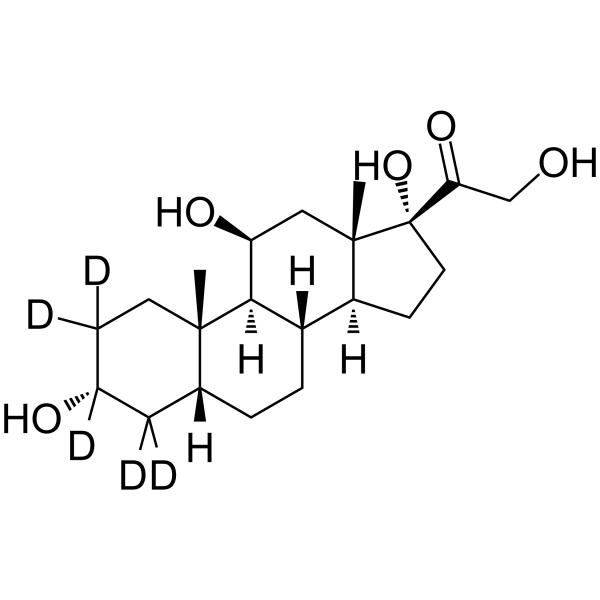
Tetrahydrocortisol-d5 is the deuterium labeled Tetrahydrocortisol. Tetrahydrocortisol is a metabolite of Hydrocortisone (HY-N0583) that fails to activate glucocorticoid receptor. Tetrahydrocortisol inhibits Dexamethasone (HY-14648)-induced formation of cross-linked actin networks. Tetrahydrocortisol acts as a synergist to enhance the activity of anticancer agents. Tetrahydrocortisol can be used in the research of primary open-angle glaucoma, ocular hypertension, lung cancer and breast cancer .
loading...
    loading...
Cat. No.: HY-W110540D
CAS No.: 25852-47-5
Poly(ethylene glycol) dimethacrylate (MW 2000) is a photopolymerizable poly(ethylene glycol)-based macromer and biocompatible crosslinking agent with a molecular weight of approximately 2000. Poly(ethylene glycol) dimethacrylate (MW 2000) can form photopolymerized hydrogels. Poly(ethylene glycol) dimethacrylate (MW 2000) can be used for research on tissue engineering and drug delivery .
loading...
    loading...
Cat. No.: HY-W763546A
CAS No.: 26403-72-5
Poly (ethylene glycol) diglycidyl ether (MW 500) is a crosslinker with epoxy functional groups at both ends . Poly (ethylene glycol) diglycidyl ether (MW 500) undergoes epoxy ring-opening reactions with the amino groups of ε-polylysine and the hydroxyl groups of hyaluronic acid to form a crosslinked network. Poly (ethylene glycol) diglycidyl ether (MW 500) helps endow materials with procoagulant, antibacterial and wound-healing properties .
loading...
    loading...
Cat. No.: HY-W110540
CAS No.: 25852-47-5
Poly(ethylene glycol) dimethacrylate (MW 550) is a photopolymerizable poly(ethylene glycol)-based macromer and biocompatible crosslinking agent with a molecular weight of approximately 550. Poly(ethylene glycol) dimethacrylate (MW 550) can form photopolymerized hydrogels. Poly(ethylene glycol) dimethacrylate (MW 550) can be used for research on tissue engineering and drug delivery .
loading...
    loading...
Cat. No.: HY-W110540A
CAS No.: 25852-47-5
Poly(ethylene glycol) dimethacrylate (MW 750) is a photopolymerizable poly(ethylene glycol)-based macromer and biocompatible crosslinking agent with a molecular weight of approximately 750. Poly(ethylene glycol) dimethacrylate (MW 750) can form photopolymerized hydrogels. Poly(ethylene glycol) dimethacrylate (MW 750) can be used for research on tissue engineering and drug delivery .
loading...
    loading...
Cat. No.: HY-W110540C
CAS No.: 25852-47-5
Poly(ethylene glycol) dimethacrylate (MW 1000) is a photopolymerizable poly(ethylene glycol)-based macromer and biocompatible crosslinking agent with a molecular weight of approximately 1000. Poly(ethylene glycol) dimethacrylate (MW 1000) can form photopolymerized hydrogels. Poly(ethylene glycol) dimethacrylate (MW 1000) can be used for research on tissue engineering and drug delivery .
loading...
    loading...
Cat. No.: HY-W110540H
CAS No.: 25852-47-5
Poly(ethylene glycol) dimethacrylate (MW 3400) is a photopolymerizable poly(ethylene glycol)-based macromer and biocompatible crosslinking agent with a molecular weight of approximately 3400. Poly(ethylene glycol) dimethacrylate (MW 3400) can form photopolymerized hydrogels. Poly(ethylene glycol) dimethacrylate (MW 3400) can be used for research on tissue engineering and drug delivery .
loading...
    loading...
Cat. No.: HY-W110540K
CAS No.: 25852-47-5
Poly(ethylene glycol) dimethacrylate (MW 10000) is a photopolymerizable poly(ethylene glycol)-based macromer and biocompatible crosslinking agent with a molecular weight of approximately 10000. Poly(ethylene glycol) dimethacrylate (MW 10000) can form photopolymerized hydrogels. Poly(ethylene glycol) dimethacrylate (MW 10000) can be used for research on tissue engineering and drug delivery .
loading...
    loading...
Cat. No.: HY-W110540L
CAS No.: 25852-47-5
Poly(ethylene glycol) dimethacrylate (MW 20000) is a photopolymerizable poly(ethylene glycol)-based macromer and biocompatible crosslinking agent with a molecular weight of approximately 20000. Poly(ethylene glycol) dimethacrylate (MW 20000) can form photopolymerized hydrogels. Poly(ethylene glycol) dimethacrylate (MW 20000) can be used for research on tissue engineering and drug delivery .
loading...
    loading...
Cat. No.: HY-W110540I
CAS No.: 25852-47-5
Poly(ethylene glycol) dimethacrylate (MW 4000) is a photopolymerizable poly(ethylene glycol)-based macromer and biocompatible crosslinking agent with a molecular weight of approximately 4000. Poly(ethylene glycol) dimethacrylate (MW 4000) can form photopolymerized hydrogels. Poly(ethylene glycol) dimethacrylate (MW 4000) can be used for research on tissue engineering and drug delivery .
loading...
    loading...
Cat. No.: HY-W110540J
CAS No.: 25852-47-5
Poly(ethylene glycol) dimethacrylate (MW 6000) is a photopolymerizable poly(ethylene glycol)-based macromer and biocompatible crosslinking agent with a molecular weight of approximately 6000. Poly(ethylene glycol) dimethacrylate (MW 6000) can form photopolymerized hydrogels. Poly(ethylene glycol) dimethacrylate (MW 6000) can be used for research on tissue engineering and drug delivery .
loading...
    loading...
  • 1

