1. Search Result
Search Result
Results for "

epileptic mice

" in MedChemExpress (MCE) Product Catalog:

7

Inhibitors & Agonists

2

Fluorescent Dyes

1

Isotope-Labeled Compounds

Cat. No. Product Name Target Research Areas Chemical Structure
  • HY-W017540
    Cyclocreatine
    1 Publications Verification

    ATP Synthase Cardiovascular Disease Neurological Disease Metabolic Disease Cancer
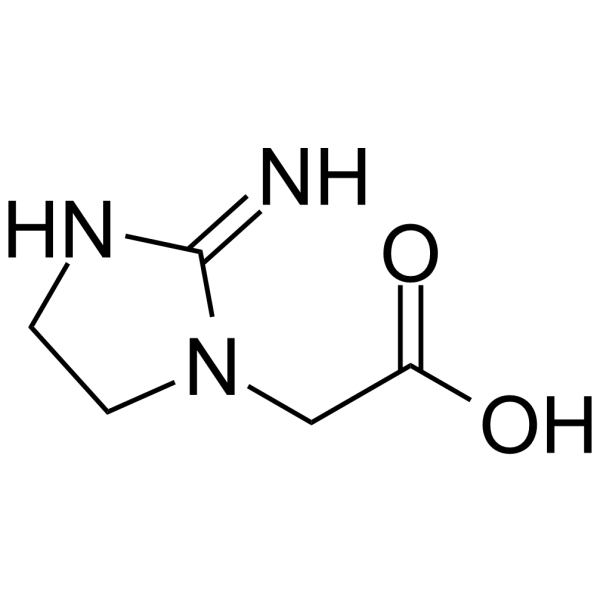
    Cyclocreatine, a creatine analogue, acts as a brain-penetrant and potent bioenergetic protective agent by providing high levels of ATP. Cyclocreatine can be phosphorylated and dephosphorylated by creatine kinases. Cyclocreatine suppresses creatine metabolism ameliorating the cognitive, autistic and epileptic phenotype in a mouse model of creatine transporter defciency. Cyclocreatine protects against ischemic injury and enhances cardiac recovery during early reperfusion in dogs and rats. Cyclocreatine decreases plaque-adjacent neuronal dystrophy in TREM2-deficient mice with amyloid-β pathology. Cyclocreatine is proming for research of ischemic heart disease, cardiovascular diseases, Alzheimer’s disease and other neurodegenerative diseases associated with microglial dysfunction, prostate cancer .
    Cyclocreatine
  • HY-D2481

    APG-2 (TMA)

    Fluorescent Dye Neurological Disease
    Asante potassium green-2 (APG-2) TMA is a cell-impermeable K + (potassium ion) fluorescent indicator that produces a fluorescent response to changes in extracellular potassium ion concentration. Its excitation/emission maxima are 525/545 nm , respectively.
    Asante potassium green-2 (TMA)
  • HY-W017540R

    Reference Standards ATP Synthase Cardiovascular Disease Neurological Disease Metabolic Disease Cancer
    Cyclocreatine, a creatine analogue, acts as a brain-penetrant and potent bioenergetic protective agent by providing high levels of ATP. Cyclocreatine can be phosphorylated and dephosphorylated by creatine kinases. Cyclocreatine suppresses creatine metabolism ameliorating the cognitive, autistic and epileptic phenotype in a mouse model of creatine transporter defciency. Cyclocreatine protects against ischemic injury and enhances cardiac recovery during early reperfusion in dogs and rats. Cyclocreatine decreases plaque-adjacent neuronal dystrophy in TREM2-deficient mice with amyloid-β pathology. Cyclocreatine is proming for research of ischemic heart disease, cardiovascular diseases, Alzheimer’s disease and other neurodegenerative diseases associated with microglial dysfunction, prostate cancer .
    Cyclocreatine (Standard)
  • HY-175340

    Potassium Channel TSPO Neurological Disease
    Kv7.2/Kv7.3 activator-3 (GRT-X) is an orally active Kv7.2/Kv7.3 and TSPO activator. Kv7.2/Kv7.3 activator-3 activates Kv7.2/Kv7.3, Kv7.4, and Kv7.5 with EC50 values of 0.37, 2.06, and 0.75 μM, respectively, and binds to TSPO with Ki values of 0.07 μM (rat membrane) and 4.60 μM (human U-118 MG cells). Kv7.2/Kv7.3 activator-3 prevents motor neuron degeneration in mice and humans conditioned by ALS/FTD astrocytes. Kv7.2/Kv7.3 activator-3 stimulates dorsal root ganglion axonal growth through TSPO and Kv7.2/3 activation. Kv7.2/Kv7.3 activator-3 has anti-epileptic effects in epileptic seizure models. Kv7.2/Kv7.3 activator-3 reduces pain hypersensitivity in patients with diabetic neuropathy, promotes neuronal survival and regeneration after cervical neuropathy in rats, and accelerates the recovery of normal function of sensory and motor neurons .
    Kv7.2/Kv7.3 activator-3
  • HY-W017540S

    Isotope-Labeled Compounds ATP Synthase Cardiovascular Disease Neurological Disease Metabolic Disease Cancer
    Cyclocreatine- 13C3 is the 13C-labeled Cyclocreatine (HY-W017540). Cyclocreatine, a creatine analogue, acts as a brain-penetrant and potent bioenergetic protective agent by providing high levels of ATP. Cyclocreatine can be phosphorylated and dephosphorylated by creatine kinases. Cyclocreatine suppresses creatine metabolism ameliorating the cognitive, autistic and epileptic phenotype in a mouse model of creatine transporter defciency. Cyclocreatine protects against ischemic injury and enhances cardiac recovery during early reperfusion in dogs and rats. Cyclocreatine decreases plaque-adjacent neuronal dystrophy in TREM2-deficient mice with amyloid-β pathology. Cyclocreatine is proming for research of ischemic heart disease, cardiovascular diseases, Alzheimer’s disease and other neurodegenerative diseases associated with microglial dysfunction, prostate cancer .
    Cyclocreatine-13C3
  • HY-182459

    HCN Channel Neurological Disease
    Org 34167 freebase is a blood-brain barrier permeable HCN channel modulator. Org 34167 freebase possesses high Caco-2 cell permeability. Org 34167 freebase modulates HCN channel function to alter activation properties and suppress neuronal hyperexcitability. Org 34167 freebase induces tremors in mice at specific doses. Org 34167 freebase acts as a research tool for studies on developmental and epileptic encephalopathies as well as depression .
    Org 34167 (freebase)
  • HY-D3224

    Fluorescent Dye Neurological Disease
    HCP is a two-photon fluorescent probe capable of crossing the blood-brain barrier, which is specifically designed for real-time detection of hypochlorous acid (HClO/ClO -) produced by myeloperoxidase (MPO). Chlorination of the quinoline skeleton of HCP generates HCP-Cl, which eliminates intramolecular charge transfer (ICT) quenching and thereby produces fluorescence. HCP is suitable for in vivo dynamic imaging of HClO in the brains of epileptic mice and high-throughput screening of antiepileptic drugs (HCP-Cl: Ex/Em = 800 nm/495 nm) .
    HCP

Inquiry Online

Your information is safe with us. * Required Fields.

Salutation


Country or Region *

Applicant Name *


Organization Name *

Department *


Email Address *


Product Name *

Cat. No.


Requested quantity *

Phone Number *


Remarks

Inquiry Online

Inquiry Information

Product Name:
Cat. No.:
Quantity:
MCE Japan Authorized Agent:

