



58 Results for "

ethanolamides

" in MedChemExpress (MCE) Product Catalog:
Products (58)

58 Results for "ethanolamides" in MCE Product Catalog:

1
1 Cited Publications
Cat. No.: HY-P1103
CAS No.: 1030384-98-5
Target:  

CXCR

Research Areas:  

Cancer

CTCE-9908 is a potent and selective CXCR4 antagonist. CTCE-9908 induces mitotic catastrophe, cytotoxicity and inhibits migration in CXCR4-expressing ovarian cancer cells .
loading...
    loading...
Cat. No.: HY-P4070
CAS No.: 1188379-43-2
Target:  

Insulin Receptor

Research Areas:  

Metabolic Disease

Insulin icodec is an Insulin (HY-P0035) analog that strongly but reversibly binds to albumin. Insulin icodec has long plasma half-life. Insulin icodec modulates insulin receptor activity, controls blood glucose levels, reduces HbA1c levels, and binds reversibly to human serum albumin. Insulin icodec can be used for the research of type 2 diabetes mellitus .
loading...
    loading...
Cat. No.: HY-112747
CAS No.: 97281-51-1
Synonyms: LPI; PE (soy)
Target:  

Phospholipase

Research Areas:  

Infection

Soy PE (LPI) is the most abundant phospholipid in prokaryotes and the second most abundant found in the membrane of mammalian, plant, and yeast cells, comprising approximately 25% of total mammalian phospholipids. In the brain, phosphatidylethanolamine comprises almost half of the total phospholipids. It is synthesized mainly through the cytidine diphosphate-ethanolamine and phosphatidylserine decarboxylation pathways, which occur in the endoplasmic reticulum (ER) and mitochondrial membranes, respectively. It is a precursor in the synthesis of phosphatidylcholine and arachidonoyl ethanolamide and is a source of ethanolamine used in various cellular functions. In E.coli, phosphatidylethanolamine deficiency prevents proper assembly of lactose permease, suggesting a role as a lipid chaperone. It is a cofactor in the propagation of prions in vitro and can convert recombinant mammalian proteins into infectious molecules even in the absence of RNA. This product contains phosphatidylethanolamine molecular species with variable fatty acyl chain lengths at the sn-1 and sn-2 positions .
loading...
    loading...
Cat. No.: HY-113421
CAS No.: 68171-52-8
Purity:  ≥98.0%
Synonyms: Linoleic acid monoethanolamide
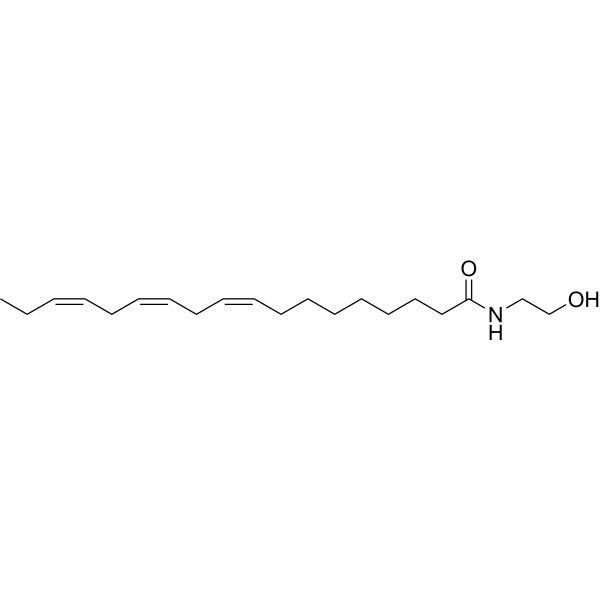
Linoleoyl ethanolamide (Linoleic acid monoethanolamide) is classified as a fatty acid ethanolamide. Linoleoyl ethanolamide only weakly binds G-protein-coupled cannabinoid receptors of type-1(CB1)and CB2 receptors, and inhibits the binding of [3H]CP-55,940 with Kis of 10 and 25 μM, respectively. Linoleoyl ethanolamide is 4-fold less potent than anandamide at causing catalepsy in mice and it does not prolong sleep time .
loading...
    loading...
Cat. No.: HY-113070
CAS No.: 150314-34-4
Purity:  ≥99.0%
Dihomo-γ-Linolenoyl Ethanolamide, an endocannabinoid, is a cannabinoid (CB) receptor agonist with Kis of 857 nM and 598 nM for human recombinant CB1 and CB2 receptors, respectively .
loading...
    loading...
Cat. No.: HY-120968
CAS No.: 94421-69-9
Purity:  98.00%
Synonyms: N-(2-Hydroxyethyl)-eicosanamide
Target:  

Apoptosis

Research Areas:  

Metabolic Disease

Arachidoyl Ethanolamide (N-(2-hydroxyethyl)-eicosanamide) is an ester product.
loading...
    loading...
Cat. No.: HY-113421S
CAS No.: 1451194-69-6
Linoleoyl ethanolamide-d4 is a deuterated labeled Linoleoyl ethanolamide . Linoleoyl ethanolamide (Linoleic acid monoethanolamide) is classified as a fatty acid ethanolamide. Linoleoyl ethanolamide only weakly binds G-protein-coupled cannabinoid receptors of type-1(CB1)and CB2 receptors, and inhibits the binding of [3H]CP-55,940 with Kis of 10 and 25 μM, respectively. Linoleoyl ethanolamide is 4-fold less potent than anandamide at causing catalepsy in mice and it does not prolong sleep time .
loading...
    loading...
Cat. No.: HY-124089
CAS No.: 109001-03-8
Target:  

Cannabinoid Receptor

Research Areas:  

Metabolic Disease

Eicosapentaenoyl ethanolamide, an omega-3 fatty acid, is one of N-acylethanolamines (NAEs). Eicosapentaenoyl ethanolamide is cannabinoid CB1/CB2 receptor agonist. Eicosapentaenoyl ethanolamide acts as a metabolic signal. Eicosapentaenoyl ethanolamide inhibits dietary restriction (DR)-induced lifespan extension in wild type animals and suppresses lifespan extension in a TOR pathway mutant .
loading...
    loading...
Cat. No.: HY-157833
CAS No.: 53832-59-0
Heptadecanoyl ethanolamide is an endogenous cannabinoid. Heptadecanoyl ethanolamide is a synthetic analog of PEA which incorporates an odd-numbered (17-carbon) fatty acid chain .
loading...
    loading...
Cat. No.: HY-127061
CAS No.: 94421-67-7
Purity:  99.77%
Synonyms: POEA
Target:  

Endogenous Metabolite

Research Areas:  

Others

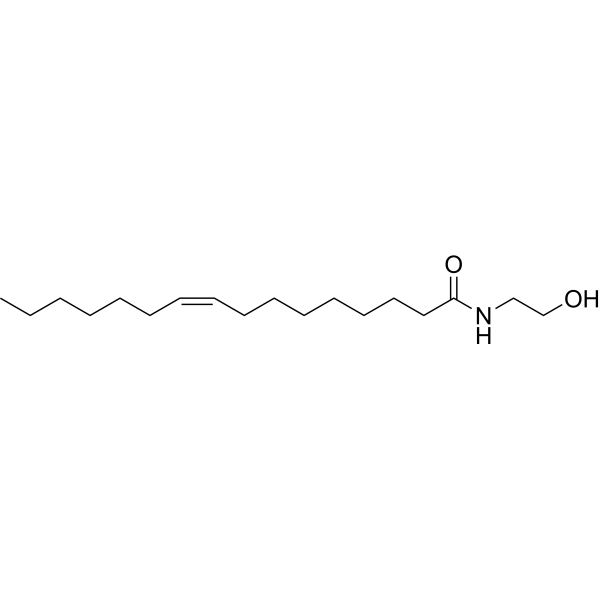
Palmitoleoyl ethanolamide (POEA) is an endogenous fatty amide with biological activity .
loading...
    loading...
Cat. No.: HY-134173
CAS No.: 183323-26-4
Research Areas:  

Neurological Disease

Arachidonoyl ethanolamide phosphate, an endocannabinoid, is an endogenous ligand for cannabinoid receptors in the central nervous system (CB1 subtype) and peripheral immune cells (CB2 subtype) .
loading...
    loading...
Cat. No.: HY-112528
CAS No.: 100575-09-5
Synonyms: GP-NPEA
Target:  

Endogenous Metabolite

Research Areas:  

Metabolic Disease

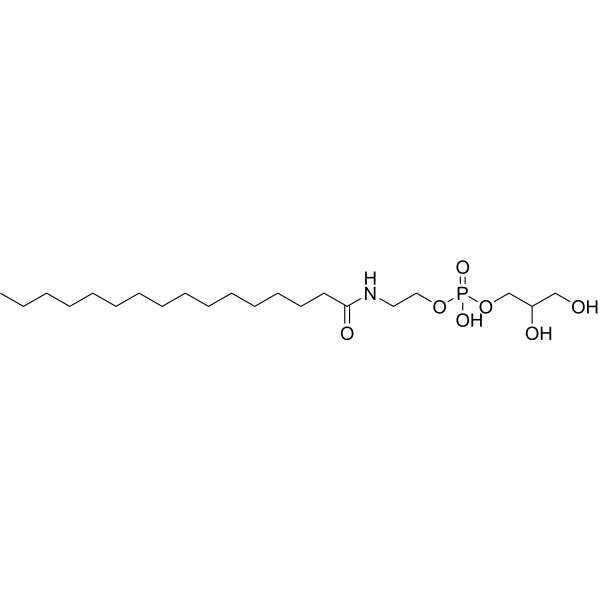
Glycerophospho-N-palmitoyl ethanolamine (GP-NPEA) is a metabolic precursor of palmitoyl ethanolamide PEA (HY-157829). Glycerophospho-N-palmitoyl ethanolamine decreases in the cortex of CUMS rats, which may be related to a disorder in the endocannabinoid system arising after the onset of depression .
loading...
    loading...
Cat. No.: HY-157829
CAS No.: 179951-56-5
Purity:  ≥99.0%
Synonyms: Me-PEA
Target:  

Endogenous Metabolite

Research Areas:  

Cancer

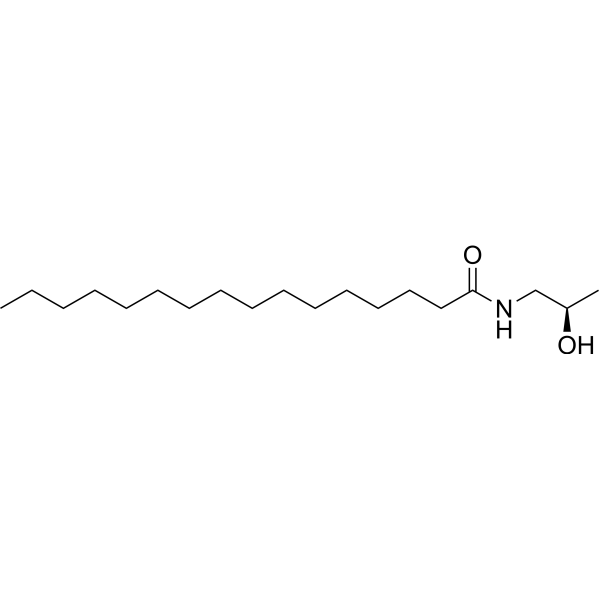
(R)-Palmitoyl-(2-methyl)ethanolamide (Me-PEA) is a competitive inhibitor of [3 H]-AEA metabolism with a Ki value of 6.6 μM .
loading...
    loading...
Cat. No.: HY-130660
CAS No.: 353787-70-9
Synonyms: Prostamide F2α
Research Areas:  

Endocrinology

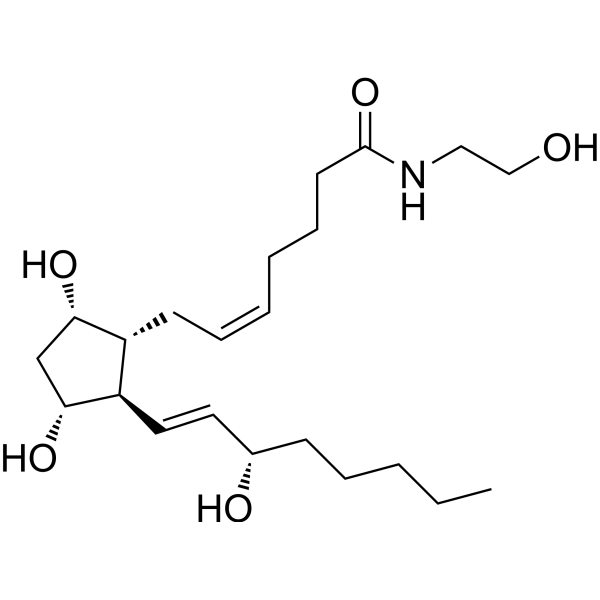
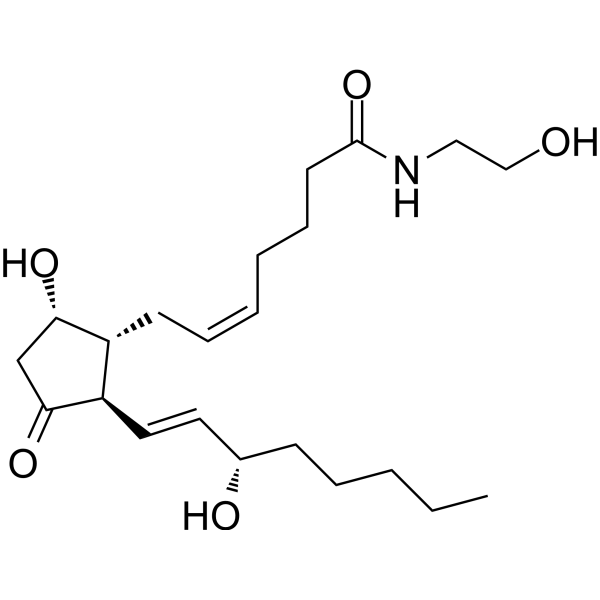
Prostaglandin F2α ethanolamide (Prostamide F2α) is an ethanolamide-like G protein-coupled receptor. Prostaglandin F2α is also a luteinizing hormone in sheep and may be a nociceptive mediator in the spinal cord .
loading...
    loading...
Cat. No.: HY-W747573
CAS No.: 57086-93-8
Synonyms: 18:3 NAE; α-Linolenoyl ethanolamide
Target:  

TRP Channel

Research Areas:  

Neurological Disease

N-Linolenoylethanolamine (18:3 NAE) is an endocannabinoid. N-Linolenoylethanolamine is a vanillin receptor (TRPV1) agonist .
loading...
    loading...
Cat. No.: HY-113264
CAS No.: 398138-28-8
Target:  

Apoptosis

Research Areas:  

Cancer

PGD2 ethanolamide is the COX-2 dependent metabolite of Anandamide that induces apoptosis in colorectal carcinoma (CRC) cells .
loading...
    loading...
Cat. No.: HY-118816
CAS No.: 714966-38-8
Synonyms: 11-epi PGF2α-EA; 11β-PGF2α-EA; 11β-Prostamide F2α
Target:  

Drug Metabolite

Research Areas:  

Metabolic Disease

11β-Prostaglandin F2α ethanolamide (11β-PGF2α-EA) is the theoretical hepatic metabolite of PGD2-EA, produced during COX-2 metabolism of the endogenous cannabinoid AEA which is found in brain, liver, and other mammalian tissues.1 AEA can be used directly by COX-2 and specific PG synthase to produce ethanolamide congeners of the classical PGs. PGD2-EA is formed in activated RAW 264.7 cells treated with AEA.
loading...
    loading...
Cat. No.: HY-172568
(±)5(6)-EET Ethanolamide is a metabolite of Anandamide (HY-10863) generated via oxidation by cytochrome P450 enzymes. (±)5(6)-EET Ethanolamide is also a selective cannabinoid receptor 2 (CB2) agonist. (±)5(6)-EET Ethanolamide has Ki values of 11.4 μM and 8.9 nM for human CB1 and CB2, respectively . (±)5(6)-EET Ethanolamide can be used in research on immunomodulation and neuroinflammation .
loading...
    loading...
Cat. No.: HY-138971
CAS No.: 2123491-23-4
Synonyms: 17,18-EEQ-EA; (±)17,18-EEQ-ethanolamide; (±)17(18)-EpETE-EA
Target:  

Interleukin Related

Research Areas:  

Others

(±)17(18)-EpETE-ethanolamide (17,18-EEQ-EA) (compound 17) is an ω-3 endocannabinoid epoxide with cytokine modulation in neuroinflammation studies, antiangiogenic effects in vascular endothelial cells, and vasodilatory effects on coronary arteries.
loading...
    loading...
Cat. No.: HY-P1103A
Target:  

CXCR

Research Areas:  

Cancer

CTCE-9908 TFA is a potent and selective CXCR4 antagonist. CTCE-9908 TFA induces mitotic catastrophe, cytotoxicity and inhibits migration in CXCR4-expressing ovarian cancer cells .
loading...
    loading...

