
9 Results for "

histone H4 peptide

" in MedChemExpress (MCE) Product Catalog:
Products (9)

9 Results for "histone H4 peptide" in MCE Product Catalog:

Cat. No.: HY-P11551
CAS No.: 852904-28-0
Research Areas:  

Cancer

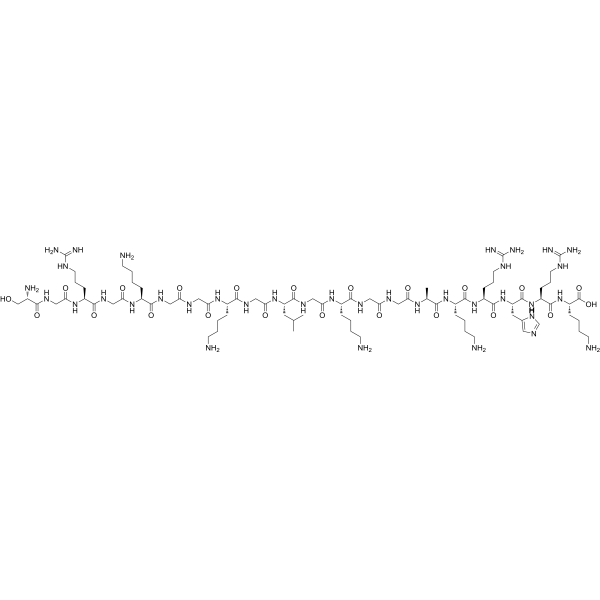
Histone H4 peptide is a peptide that interacts with hNatD. Histone H4 peptide exhibits polar interactions with hNatD. Histone H4 peptide can be used in lung cancer research .
loading...
    loading...
Cat. No.: HY-P1958
CAS No.: 667899-73-2
Research Areas:  

Others

Histone H4 (2-21) is a substrate peptide derived from the N-terminal region of histone H4, which serves as an acyl acceptor for lysine acetyltransferases of the MYST family (KAT). Histone H4 (2-21) participates in enzymatic reactions together with acyl-coenzyme A (acyl-CoA, and undergoes lysine acetylation and propionylation modifications catalyzed by KATs such as MOF. The apparent Km of Histone H4 (2-21) for MOF is 788.8 μM, while in the picNuA4 catalytic system, the Km and Kd values of the H4 peptide are 192 μM and 251 μM, respectively. Histone H4 (2-21) can be used in studies related to histone post-translational modifications, epigenetic regulation, and lysine acylation .
loading...
    loading...
Cat. No.: HY-P11724
CAS No.: 374899-66-8
Research Areas:  

Others

Histone H4 peptide substrate (1-21) is a PAD4 peptide substrate. Histone H4 peptide substrate (1-21) serves as a substrate for the PAD4-catalyzed hydrolytic deimination of arginine residues, producing citrulline and ammonia .
loading...
    loading...
Cat. No.: HY-P4614
CAS No.: 2022956-65-4
Target:  

Inhibitory Antibodies

Research Areas:  

Others

(Lys(Ac)5,8,12,16)-Histone H4 (1-25)-Gly-Ser-Gly-Ser-Lys(biotinyl) is a polypeptide that can be found by peptide screening. Peptide screening is a research tool that pools active peptides primarily by immunoassay. Peptide screening can be used for protein interaction, functional analysis, epitope screening, especially in the field of agent research and development .
loading...
    loading...
Cat. No.: HY-P10570
CAS No.: 2042178-19-6
Research Areas:  

Cancer

[Nle20] H4 peptide (16−23) is a peptide with strong inhibitory activity against histone methyltransferase SETD8 (Kd=0.14 μM), which inhibits SETD8's methylation of histone H4 by competing with SETD8's substrate binding site. [Nle20] H4 peptide (16−23) can be used as a lead compound for anticancer therapy .
loading...
    loading...
Cat. No.: HY-P2178
CAS No.: 157618-75-2
Target:  

HDAC

Research Areas:  

Cancer

Dihydrochlamydocin analog-1 (compound 2) is a Chlamydocin (HY-115761) analogue that inhibits histone H4 peptide deacetylation with IC50 of 30 nM .
loading...
    loading...
Cat. No.: HY-P4616
CAS No.: 2022956-66-5
Target:  

Inhibitory Antibodies

Research Areas:  

Others

(Lys(Ac)12)-Histone H4 (1-21)-Gly-Gly-Lys(biotinyl) is a polypeptide that can be found by peptide screening. Peptide screening is a research tool that pools active peptides primarily by immunoassay. Peptide screening can be used for protein interaction, functional analysis, epitope screening, especially in the field of agent research and development .
loading...
    loading...
Cat. No.: HY-P11824
Research Areas:  

Cancer

CoA-C2-SGRGK-cCPP is a NatD (NAA40) bisubstrate inhibitor with an IC50 of 78 nM and a Ki of 39 nM. CoA-C2-SGRGK-cCPP competitively targets the peptide substrate binding site and noncompetitively targets the CoA binding site of NatD to block acetyltransferase activity. CoA-C2-SGRGK-cCPP reduces cellular Nα-acetylation on histone H4, modulates EMT marker expression. CoA-C2-SGRGK-cCPP can be used for the research of non-small cell lung cancer .
loading...
    loading...
Cat. No.: HY-CE00983A
Synonyms: 4-Pentynoyl-CoA TFA
4-Pentynoyl-Coenzyme A (4-Pentynoyl-CoA) TFA is an analog of the natural substrate acetyl-CoA (Acetyl-CoA) (HY-114293). 4-Pentynoyl-Coenzyme A TFA can replace acetyl-CoA to be recognized and utilized by lysine acetyltransferases such as p300. 4-Pentynoyl-Coenzyme A TFA can be conjugated to azide probes carrying fluorescent groups (e.g., Rhodamine-azide) or biotin (Biotin-azide) via Cu (I)-catalyzed azide-alkyne cycloaddition (CuAAC) .
loading...
    loading...