7 Results for "

methionine synthetase

" in MedChemExpress (MCE) Product Catalog:
Products (7)

7 Results for "methionine synthetase" in MCE Product Catalog:

7
7 Cited Publications
Cat. No.: HY-B1692
CAS No.: 15985-39-4
Synonyms: MSX; MSO
Target:  

Glutaminase

Research Areas:  

Neurological Disease

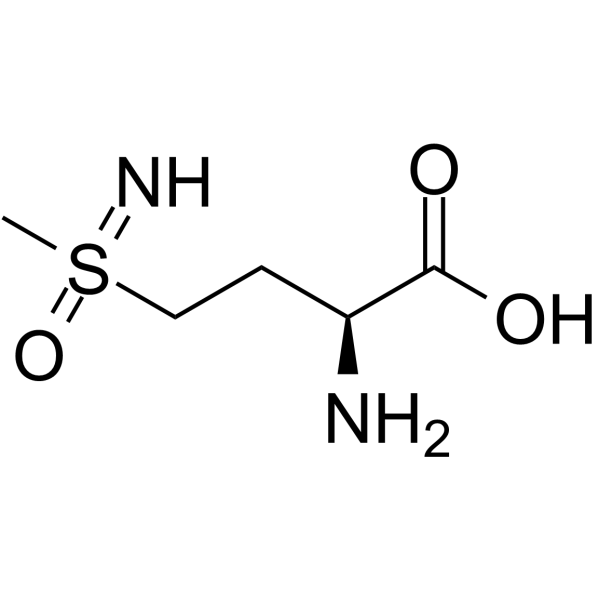
L-Methionine-DL-sulfoximine (MSX; MSO), a highly specific and irreversible inhibitor of Glutamine synthetase (GS), is also a potent convulsant which metabolically and morphologically primarily affects astroglia. L-Methionine-DL-sulfoximine has been employed to inhibit the Gln-dependent ammonia-stimulated neuronal toxicity in vitro, potentiating Gln deficit-dependent depression. L-Methionine-DL-sulfoximine tremendously increases the rate of release of fixed nitrogen in cyanobacteria. L-Methionine-DL-sulfoximine is a promising candidate for research in biofertilizers and convulsive seizures (CS) .
loading...
    loading...
2
2 Cited Publications
Cat. No.: HY-W338140
CAS No.: 1982-67-8
Synonyms: 2-Amino-4-(S-methylsulfonimidoyl)butanoic acid
Target:  

Endogenous Metabolite

Research Areas:  

Neurological Disease

Methionine sulfoximine (2-Amino-4-(S-methylsulfonimidoyl)butanoic acid) is an irreversible inhibitor of glutamine synthetase with convulsive effects. Methionine sulfoximine is able to affect the metabolism of glutamate and glutamine, which may provide important insights in neurobiological research. Methionine sulfoximine has also been used to study mechanisms related to epilepsy and its inhibitory potential .
loading...
    loading...
Cat. No.: HY-131033
CAS No.: 1454334-76-9
Purity:  ≥98.0%
Research Areas:  

Others

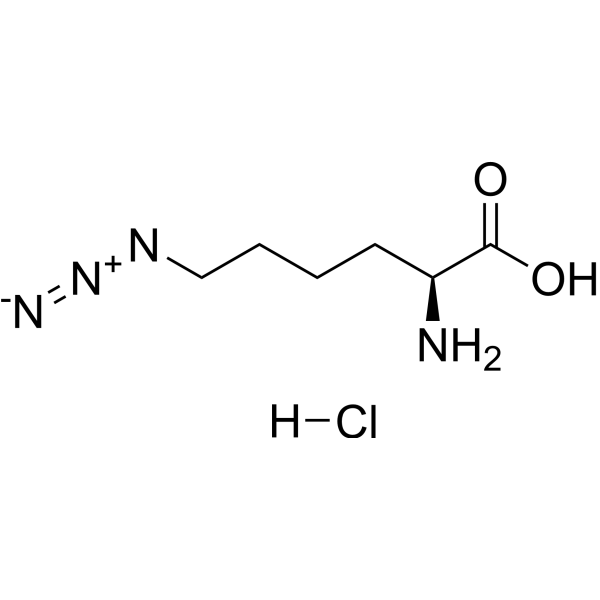
L-Azidonorleucine hydrochloride, an unnatural amino acid, is A Methionine surrogate. L-Azidonorleucine hydrochloride can be used to label mammalian cell proteins and identify a diverse set of methionyl-tRNA synthetase (MetRS) mutants . L-Azidonorleucine (hydrochloride) is a click chemistry reagent, it contains an Azide group and can undergo copper-catalyzed azide-alkyne cycloaddition reaction (CuAAc) with molecules containing Alkyne groups. It can also undergo strain-promoted alkyne-azide cycloaddition (SPAAC) reactions with molecules containing DBCO or BCN groups.
loading...
    loading...
Cat. No.: HY-W016256
CAS No.: 16120-92-6
Target:  

Bacterial

Research Areas:  

Infection

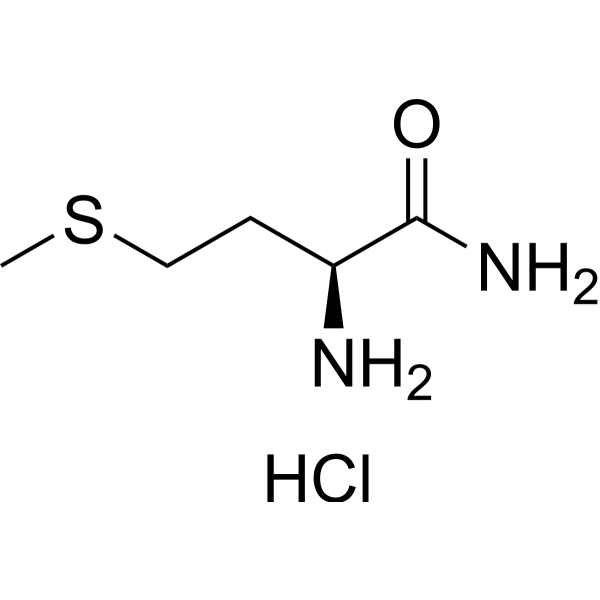
L-Methioninamide hydrochloride, a Methionine analogue, is Methionyl-tRNA synthetase inhibitor .
loading...
    loading...
Cat. No.: HY-P704383
Purity:  ≥ 85%, as determined by reducing SDS-PAGE.
Synonyms: MAT1A; methionine Adenosyltransferase I, Alpha; methionine Adenosyltransferase 1A; methionine Adenosyltransferase 1; MAT-I/III; AdoMet Synthase 1; MATA1; MAT 1; S-Adenosylmethionine Synthase Isoform Type-1; S-Adenosylmethionine synthetase; methionine Adenosyltransferase I/III; methionine Adenosyltransferase; SAMS1; AdoMet synthetase 1; SAMS; AMS1; MAT
Species:  
Human
Source:  
E. coli
loading...
    loading...
Cat. No.: HY-B1692R
CAS No.: 15985-39-4
Synonyms: MSX (Standard); MSO (Standard)
L-Methionine-DL-sulfoximine (Standard) is the analytical standard of L-Methionine-DL-sulfoximine (HY-B1692). This product is intended for research and analytical applications. L-Methionine-DL-sulfoximine (MSX; MSO), a highly specific and irreversible inhibitor of Glutamine synthetase (GS), is also a potent convulsant which metabolically and morphologically primarily affects astroglia. L-Methionine-DL-sulfoximine has been employed to inhibit the Gln-dependent ammonia-stimulated neuronal toxicity in vitro, potentiating Gln deficit-dependent depression. L-Methionine-DL-sulfoximine tremendously increases the rate of release of fixed nitrogen in cyanobacteria. L-Methionine-DL-sulfoximine is a promising candidate for research in biofertilizers and convulsive seizures (CS) .
loading...
    loading...
Cat. No.: HY-119143
CAS No.: 32093-09-7
CB 3703 is an inhibitor of thymidylate synthase (TS) and dihydrofolate reductase (DHFR). CB 3703 has an IC50 of 0.25 μM against rat TS, a Ki of 0.47 μM against mouse TS, an IC50 of 6.8 nM against rat DHFR, and a Ki of 0.6 pM against mouse DHFR. CB 3703 is transported via the reduced folate pathway, has a short plasma half-life, and can prolong the survival of tumor-bearing mice. CB 3703 can be used in the research of L1210 ascites tumors .
loading...
    loading...

