9 Results for "

nucleophilic centers

" in MedChemExpress (MCE) Product Catalog:
Products (9)

9 Results for "nucleophilic centers" in MCE Product Catalog:

3
3 Cited Publications
Cat. No.: HY-B1200
CAS No.: 51-15-0
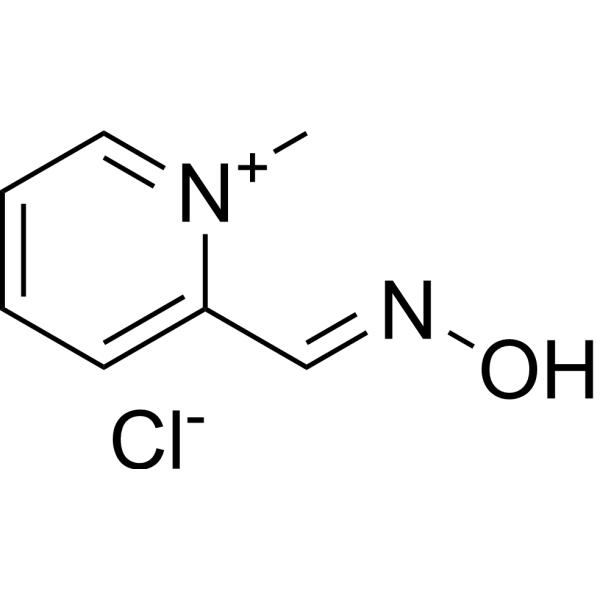
Synonyms: 2-PAM chloride
Target:  

Cholinesterase (ChE)

Research Areas:  

Neurological Disease

Pralidoxime chloride is a potent reactivator of acetylcholinesterase (AChE). Pralidoxime chloride reactivates nerve agent-inhibited AChE via direct nucleophilic attack by the oxime moiety on the phosphorus center of the bound nerve agent. Pralidoxime chloride is an antidote for organophosphate poisoning .
loading...
    loading...
Cat. No.: HY-B1738A
CAS No.: 94-63-3
Target:  

Cholinesterase (ChE)

Research Areas:  

Neurological Disease

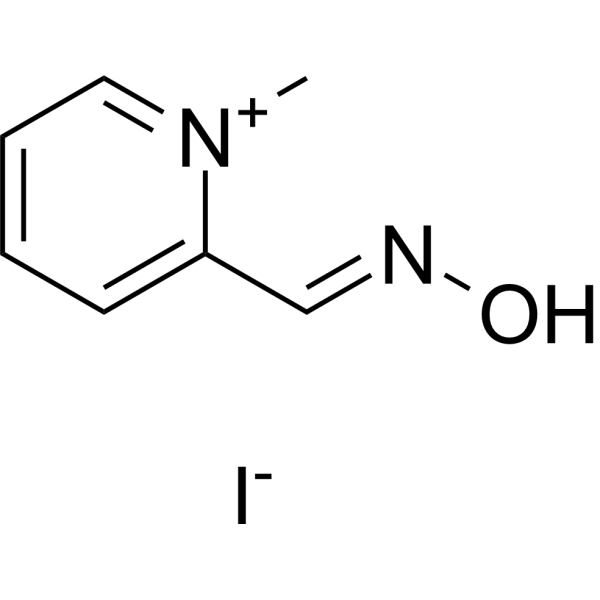
Pralidoxime iodide is a potent reactivator of acetylcholinesterase (AChE). Pralidoxime iodide reactivates nerve agent-inhibited AChE via direct nucleophilic attack by the oxime moiety on the phosphorus center of the bound nerve agent. Pralidoxime iodide is an antidote for organophosphate poisoning .
loading...
    loading...
Cat. No.: HY-W011985
CAS No.: 14975-30-5
Research Areas:  

Others

H-Arg-NH2 hydrochloride is a nucleophilic reagent. H-Arg-NH2 hydrochloride can be used in experiments related to the detection of enzyme activity centers .
loading...
    loading...
Cat. No.: HY-B1738
CAS No.: 6735-59-7
Target:  

Cholinesterase (ChE)

Research Areas:  

Neurological Disease

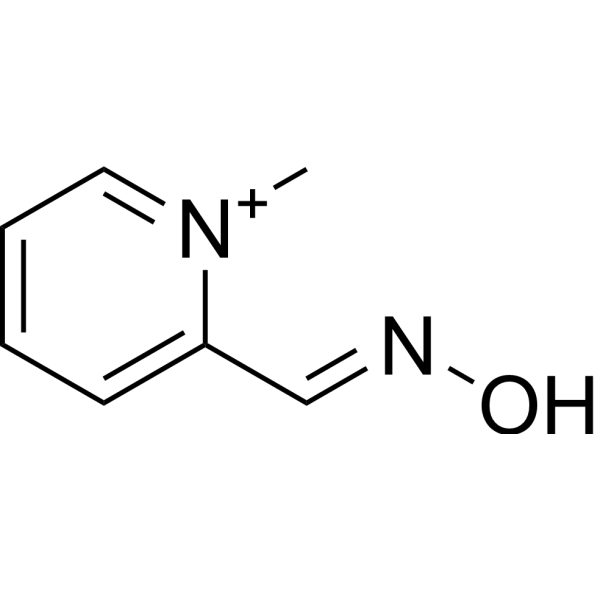
Pralidoxime is a potent reactivator of acetylcholinesterase (AChE). Pralidoxime reactivates nerve agent-inhibited AChE via direct nucleophilic attack by the oxime moiety on the phosphorus center of the bound nerve agent. Pralidoxime is an antidote for organophosphate poisoning .
loading...
    loading...
Cat. No.: HY-B1200R
CAS No.: 51-15-0
Synonyms: 2-PAM chloride (Standard)
Pralidoxime (chloride) (Standard) is the analytical standard of Pralidoxime (chloride). This product is intended for research and analytical applications. Pralidoxime chloride is a potent reactivator of acetylcholinesterase (AChE). Pralidoxime chloride reactivates nerve agent-inhibited AChE via direct nucleophilic attack by the oxime moiety on the phosphorus center of the bound nerve agent. Pralidoxime chloride is an antidote for organophosphate poisoning .
loading...
    loading...
Cat. No.: HY-B1738B
CAS No.: 154-97-2
Target:  

Cholinesterase (ChE)

Research Areas:  

Neurological Disease

Pralidoxime methanesulfonate is a potent reactivator of acetylcholinesterase (AChE). Pralidoxime methanesulfonate reactivates nerve agent-inhibited AChE via direct nucleophilic attack by the oxime moiety on the phosphorus center of the bound nerve agent. Pralidoxime methanesulfonate is an antidote for organophosphate poisoning .
loading...
    loading...
Cat. No.: HY-B1738AR
CAS No.: 94-63-3
Pralidoxime (iodide) (Standard) is the analytical standard of Pralidoxime (iodide). This product is intended for research and analytical applications. Pralidoxime iodide is a potent reactivator of acetylcholinesterase (AChE). Pralidoxime iodide reactivates nerve agent-inhibited AChE via direct nucleophilic attack by the oxime moiety on the phosphorus center of the bound nerve agent. Pralidoxime iodide is an antidote for organophosphate poisoning .
loading...
    loading...
Cat. No.: HY-W1057999
CAS No.: 104149-14-6
Research Areas:  

Cancer

Bromofosfamide is a prodrug-type alkylating agent and also an analog of Ifosfamide (HY-17419). Bromofosfamide exhibits potent in vivo anti-tumor activity against lymphoid leukemia and can be used for the research of lymphoid leukemia .
loading...
    loading...
Cat. No.: HY-D3133
CAS No.: 2410296-16-9
Target:  

Fluorescent Dye

Research Areas:  

Others

HS-CyBz is a Fluorescent probe for H₂S detection, enabling ratiometric optical/photoacoustic dual-modality in/ex vivo imaging. Its detection mechanism relies on nucleophilic substitution of its benzoic ester group by HS⁻, which releases an enolic meso-hydroxyltricarboheptamethine cyanine that then undergoes keto-enol tautomerization to form Cy-ketone; this tautomerization causes distinct shifts in absorption and emission spectra, producing a ratiometric response that reduces interferences from tissue scattering, autofluorescence, and probe concentration. In its initial state, HS-CyBz has an excitation wavelength of 595 nm, with emission bands centered at 805 nm (main) and 630 nm (minor); upon reaction with H₂S, the 805 nm emission band decreases while the 630 nm band drastically increases, and its absorption spectrum shows a sharp band at 775 nm and a shoulder band at 708 nm, which decrease upon H₂S reaction with a minor increase at 850 nm and an isosbestic point at 825 nm. For in vivo optical imaging, excitation at 560 nm is used with emission channels at 620 nm and 790 nm, while in vivo photoacoustic imaging uses excitation at 775 nm and 825 nm. The detection limit of HS-CyBz for H₂S is 0.5 μM, and it shows high selectivity, with only H₂S inducing a distinct enhancement of the emission ratio F₆₃₀/F₈₀₅ and PA ratio PA₈₂₅/PA₇₇₅, while other biochemical species including cations, anions, reactive oxygen species, biothiols, and carboxylesterase trigger only minor changes and do not interfere with H₂S sensing. Tail intravenous injection of HS-CyBz leads to accumulation in the liver of mice, and it can be used to verify endogenous H₂S upregulation triggered by S-adenosyl-L-methionine via ratiometric optical/photoacoustic imaging .
loading...
    loading...

