
10 Results for "

oxygen exposure

" in MedChemExpress (MCE) Product Catalog:
Products (10)

10 Results for "oxygen exposure" in MCE Product Catalog:

7
7 Cited Publications
Cat. No.: HY-D1063
CAS No.: 207399-07-3
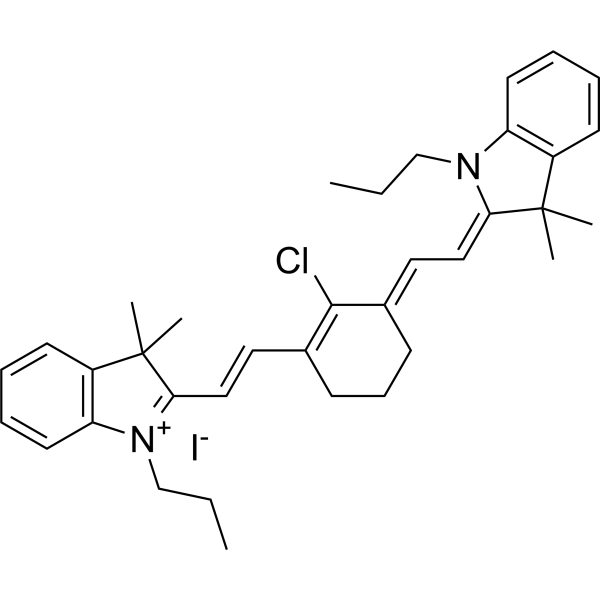
IR-780 is a near-infrared fluorescent probe for in vivo imaging of tumor cells. IR-780 is transported into tumor cells via OATPs and ABCB10, with uptake dependent on glycolytic activity and plasma membrane potential. IR-780 preferentially accumulates in tumor cell mitochondria, including those of drug-resistant cancer cells, without chemical conjugation. IR-780 generates reactive oxygen species (ROS), induces hyperthermia and apoptosis, inhibits tumor growth and recurrence, and modulates HSP70 expression upon ultrasound or 808 nm laser exposure. IR-780 acts as a sonosensitizer, photodynamic and photothermal agent, and drug delivery carrier, with low acute imaging-dose toxicity and rapid vital organ clearance. IR-780 can be used for the research of cancer, such as breast cancer, lung cancer, and non-small cell lung cancer (NSCLC) .
loading...
    loading...
Cat. No.: HY-128431
CAS No.: 11097-69-1
Arochlor 1254 is a polychlorinated biphenyl (PCB) mixture with biphenyl and 54% chlorine. Aroclor 1254 reduced cell viability and induced overproduction of intracellular reactive oxygen species in a dose-dependent manner. Arochlor 1254 exposure reduces calcium homeostasis, osteoblast differentiation and bone formation .
loading...
    loading...
Cat. No.: HY-158189
CAS No.: 3030629-73-0
TPP-Ce6 is a mitochondria-targeted photosensitizer formed by the ester bond conjugation of chlorophyll e6 (Ce6) with triphenylphosphine (TPP). Under light irradiation or ultrasound exposure, TPP-Ce6 generates reactive oxygen species, induces cell apoptosis, and triggers immunogenic cell death. TPP-Ce6 can serve as a component of carrier-free co-delivery systems, undergo enzyme-induced self-assembly within tumors, and modulate tumor hypoxia. TPP-Ce6 is applicable to research on breast cancer and glioblastoma .
loading...
    loading...
Cat. No.: HY-157053
Research Areas:  

Cancer

[Ru(dppn)2phen](PF6)2 (compound 4) is a polypyridylruthenium compound used in photodynamic therapy (PDT). [Ru(dppn)2phen](PF6)2 is normally nontoxic under dark conditions and induces mitochondrial respiratory damage upon light exposure. [Ru(dppn)2phen](PF6)2 exhibits high levels of singlet oxygen quantum yield and phototoxicity against cancer cells .
loading...
    loading...
Cat. No.: HY-162944
CAS No.: 3031762-97-4
Research Areas:  

Cancer

NA-Ir is a Ferroptosis inducer. NA-Ir targets mitochondrial DNA (mtDNA) and activates the cGAS-STING pathway to induce ferritinophagy (Autophagy), while also generating reactive oxygen species (ROS) through photodynamic therapy (PDT), depleting glutathione (GSH), and downregulating glutathione peroxidase 4 (GPX4), thereby triggering lipid peroxidation and Ferroptosis. NA-Ir exhibits higher anticancer activity under light exposure and selectively inhibits cancer cells with high H2S levels .
loading...
    loading...
Cat. No.: HY-W747910A
CAS No.: 19971-73-4
Target:  

Drug Metabolite

Research Areas:  

Inflammation/Immunology

S584 dihydrochloride is a catechol metabolite of the oral-effective Piribedil (HY-12707), with anti-lipid peroxidation activity. S584 dihydrochloride significantly inhibits lipid peroxidation in rat synaptosomes under basal conditions and Fe³⁺ stimulation. S584 dihydrochloride significantly antagonizes the increase in thiobarbituric acid reactive substances (TBARS) in the brains of mice exposed to high oxygen and under normal air conditions .
loading...
    loading...
Cat. No.: HY-N19700
CAS No.: 124986-26-1
Calphostin D is a protein kinase C (Protein Kinase, PKC) inhibitor with an IC50 of 6.4 μM. Calphostin D achieves selective inhibition by interacting with the unique C1 regulatory domain of PKC. As a photosensitizer, Calphostin D generates reactive oxygen species upon exposure to light. Calphostin D can be used in cancer-related research .
loading...
    loading...
Cat. No.: HY-W026930
CAS No.: 82-05-3
Benzanthrone is an immunotoxic, pro-inflammatory Photosensitizer. Benzanthrone upregulates iNOS, COX-2 and inflammatory cytokines; activates ERK1/2, p38, JNK, AP-1 and NF-κB; inhibits Nrf2; and induces oxidative stress and DNA damage. Upon radiation exposure, Benzanthrone generates singlet oxygen and superoxide anion radicals, induces photohemolysis and lipid peroxidation, and alters the levels of skin xenobiotic enzymes. Benzanthrone exhibits differential genotoxicity in different cell lines. Benzanthrone possesses skin tumor-initiating and promoting activities. Benzanthrone can be used in skin tumor-related studies .
loading...
    loading...
Cat. No.: HY-DY2047
Research Areas:  

Infection

Phosphotungstic Acid Negative Staining Solution (3%, pH 7.0) is an electron microscopy negative stain. Phosphotungstic Acid Negative Staining Solution (3%, pH 7.0) forms an electron-dense background around samples, enabling the imaging of viruses, bacterial, macromolecules and organelles .
loading...
    loading...
Cat. No.: HY-111989
CAS No.: 103923-27-9
Target:  

Bacterial Fungal

Research Areas:  

Infection Inflammation/Immunology

Pirtenidine free base is a broad-spectrum antibacterial and anti-plaque agent. Pirtenidine free base exhibits bactericidal activity against oral plaque bacteria in vitro and inhibits plaque formation. Pirtenidine free base inhibits the growth, budding, germ tube formation and buccal epithelial cell adhesion of Candida albicans and Saccharomyces cerevisiae, reduces the oxygen uptake rate of yeast, and impairs mitochondrial respiratory function. Pirtenidine free base disrupts the integrity of fungal cell wall and membrane, leading to cytoplasmic leakage, cell shrinkage, and lysis. Pirtenidine free base binds tightly to mucosal surfaces in vivo with low systemic exposure. Pirtenidine free base can be used in studies related to dental plaque, fungal infections and oral candidiasis .
loading...
    loading...

