1. Search Result
Search Result
Results for "

p53 ubiquitination

" in MedChemExpress (MCE) Product Catalog:

14

Inhibitors & Agonists

3

Natural
Products

Targets Recommended:
Cat. No. Product Name Target Research Areas Chemical Structure
  • HY-N0527
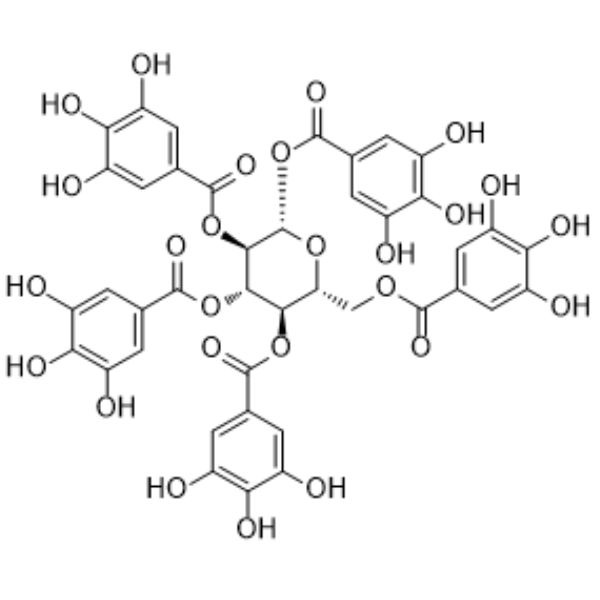
    Pentagalloylglucose
    10+ Cited Publications

    Penta-O-galloyl-β-D-glucose; 1,2,3,4,6-Pentagalloyl glucose

    JAK Keap1-Nrf2 Apoptosis β-catenin Reactive Oxygen Species (ROS) E1/E2/E3 Enzyme Neurological Disease Inflammation/Immunology Cancer
    Pentagalloylglucose (Penta-O-galloyl-β-D-glucose) is an orally active gallic tannin compound and an inducer of apoptosis and autophagy. Pentagalloglucose induces cell apoptosis and autophagy through the GSK3β/β-catenin pathway. Pentagalloylglucose inhibits UBE2T-mediated p53 ubiquitination, upregulates p53, downregulates RRM1/RRM2 in pancreatic cancer organoids. Pentagalloglucose has antioxidant, anti mutagenic, anti-inflammatory, anticonvulsant, cardioprotective, anti allergic, cholesterol lowering, and anti-tumor activities .
    Pentagalloylglucose
  • HY-110088
    SCH529074
    3 Publications Verification

    MDM-2/p53 Cancer
    SCH529074 is a potent and orally active p53 activator. SCH529074 binds specifically and conformation-dependently to p53 DBD ( DNA binding domain) with a Ki of 1-2 μM in a saturable manner. SCH529074 restores mutant p53 function and interrupts HDM2-mediated ubiquitination of wild Type p53. SCH529074 can be used for the study of non-small-cell lung carcinoma (NSCLC) .
    SCH529074
  • HY-158684

    PROTACs MDM-2/p53 Apoptosis Cancer
    YX-02-030 is a VHL-dependent MDM2 PROTAC degrader with a Kd of 35 nM. YX-02-030 recruits the VHL E3 ligase to form a ternary complex, leading to ubiquitination and proteasome-mediated degradation of MDM2. YX-02-030 inhibits MDM2-p53 and VHL-HIF1α binding with IC50 values of 63 and 1350 nM. YX-02-030 activates TAp73, upregulates p53 family target genes and induces apoptosis. YX-02-030 demonstrates on-target efficacy in TNBC xenograft-bearing mice, extending survival without normal cell toxicity .
    YX-02-030
  • HY-128841
    PROTAC MDM2 Degrader-2
    1 Publications Verification

    PROTACs MDM-2/p53 E1/E2/E3 Enzyme Cancer
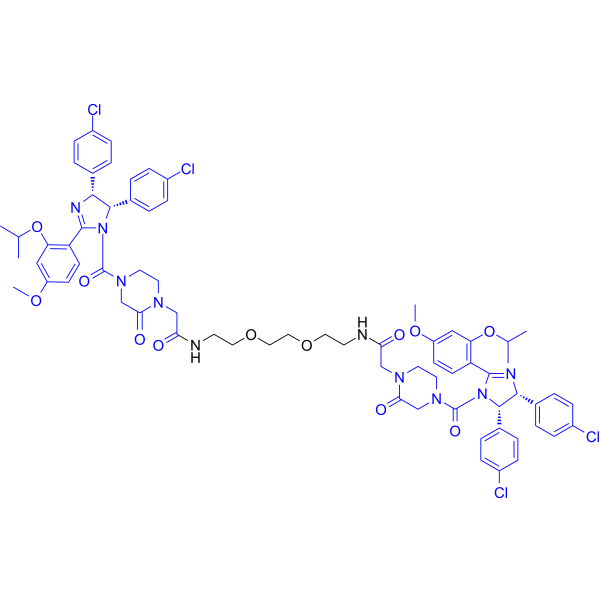
    PROTAC MDM2 Degrader-2 is an MDM2 PROTAC degrader. PROTAC MDM2 Degrader-2 can induce the self-ubiquitination and degradation of MDM2, thereby upregulating the level of p53 protein. PROTAC MDM2 Degrader-2 has anti-tumor activity and can be used in the study of cancer . (Blue: MDM2 ligand (HY-128836); Black: linker (HY-128833))
    PROTAC MDM2 Degrader-2
  • HY-N0857
    Deoxyandrographolide
    1 Publications Verification

    GLUT HDAC Virus Protease PI3K AMPK Akt Histone Demethylase MDM-2/p53 IFNAR Reactive Oxygen Species (ROS) Infection Metabolic Disease Inflammation/Immunology
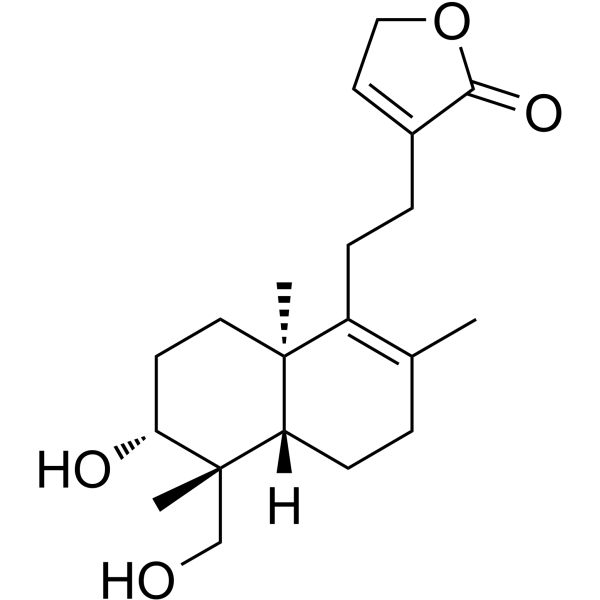
    Deoxyandrographolide is an orally active lactone found in the Andrographis paniculata Nees. Deoxyandrographolide shows a KD of 38.4 μM of HDAC1. Deoxyandrographolide enhances GLUT4 plasma membrane translocation, activates PI3K and AMPK-dependent signaling pathways, suppresses fasting blood glucose, serum insulin, triglycerides, and LDL-cholesterol levels. Deoxyandrographolide enhances HDAC1 expression via inhibited ubiquitination degradation, represses H3K4me3, improves chromosome stability, and restrains aging biomarkers p16, p21, γH2A.X, p53 and ROS production. Deoxyandrographolide interacts with Foot-and-Mouth Disease Virus 3Cpro active site, inhibits protease and IFN-antagonist activity, derepresses ISG expression, and inhibits viral replication. Deoxyandrographolide can be used for the researches of type 2 diabetes mellitus, vascular senescence and virus infection .
    Deoxyandrographolide
  • HY-148106

    Ligands for E3 Ligase Cancer
    MEL23 is a MDM2 E3 ligase inhibitor that blocks the E3 ligase activity of the MDM2-MDMX complex. MEL23 inhibits Mdm2 and p53 ubiquitination in cells, reduce viability of cells with wild-type p53. MEL23 stabilizes MDM2 via a mechanism independent of p53 transcription .
    MEL23
  • HY-170900

    PROTACs Epigenetic Reader Domain c-Myc MDM-2/p53 Neurological Disease Cancer
    SJ44236 is a BET PROTAC degrader with activity against BRD2, BRD3 and BRD4 (DC50 = 127 pM). SJ44236 induces ubiquitination and proteasomal degradation by forming a ternary complex with BET proteins and CRBN-DDB1. SJ44236 downregulates c-Myc, upregulates p53 and reduces cancer cell viability. SJ44236 can be used for the research of leukemia and medulloblastoma .
    SJ44236
  • HY-124070

    MDM-2/p53 Cancer
    ISA 27 is a small-molecule MDM2-p53 protein-protein interaction inhibitor. ISA 27 inhibits MDM2-mediated p53 ubiquitination and degradation. ISA 27 is promising for research of p53-mutant solid tumors (e.g., thyroid, breast cancer) .
    ISA 27
  • HY-N0527R

    Penta-O-galloyl-β-D-glucose (Standard); 1,2,3,4,6-Pentagalloyl glucose (Standard)

    Reference Standards JAK Keap1-Nrf2 Apoptosis β-catenin Reactive Oxygen Species (ROS) Neurological Disease Inflammation/Immunology Cancer
    Pentagalloylglucose (Standard) is the analytical standard of Pentagalloylglucose. This product is intended for research and analytical applications. Pentagalloylglucose (Penta-O-galloyl-β-D-glucose) is an orally active gallic tannin compound and an inducer of apoptosis and autophagy. Pentagalloglucose induces cell apoptosis and autophagy through the GSK3β/β-catenin pathway. Pentagalloylglucose inhibits UBE2T-mediated p53 ubiquitination, upregulates p53, downregulates RRM1/RRM2 in pancreatic cancer organoids. Pentagalloglucose has antioxidant, anti mutagenic, anti-inflammatory, anticonvulsant, cardioprotective, anti allergic, cholesterol lowering, and anti-tumor activities .
    Pentagalloylglucose (Standard)
  • HY-176457

    Small Interfering RNA (siRNA) MDM-2/p53 PROTACs Cancer
    ZS3-046 is a TAF1 PROTAC degrader. ZS3-046 promotes the ubiquitination and degradation of TAF1. ZS3-046 activates p53 and induces apoptosis in acute myeloid leukemia (AML) cells. ZS3-046 has antitumor activity in an AML tumor xenograft mouse model. (Target protein ligand (HY-176467); CRBN ligase (HY-41547); Linker (HY-176469); CRBN ligase + Linker (HY-176470)) .
    ZS3-046
  • HY-131667

    MDM-2/p53 E1/E2/E3 Enzyme Cancer
    Hdm2 E3 ligase inhibitor 1 (Compound 1) is a reversible inhibitor for Hdm2 (an E3 ubiquitin ligase)-mediated ubiquitination of the p53 protein with an IC50 of 12.7 μM. Hdm2 E3 ligase inhibitor 1 binds Hdm2, blocks Hdm2-catalyzed ubiquitin transfer from preligated Ub-Ubc4 to p53, inhibits p53 ubiquitination, stabilizes p53 protein in tumor cell and exhibits antitumor efficacy .
    Hdm2 E3 ligase inhibitor 1
  • HY-18658B

    NVP-HDM201 succinate; HDM201 succinate

    MDM-2/p53 Cancer
    Siremadlin (NVP-HDM201) succinate is an MDM2 inhibitor and cell cycle regulator. Siremadlin succinate blocks the p53-binding pocket of MDM2, inhibits MDM2-mediated ubiquitination and degradation of p53, thereby activating the p53 pathway in p53 wild-type cells. Siremadlin succinate can be used in the research of cutaneous melanoma .
    Siremadlin succinate
  • HY-182623

    MDM-2/p53 Cancer
    WB214 is an MDM2 and GSPT1 degrader with human MDM2 Ki >10 μM. WB214 induces a neo-interaction between MDM2 and the cereblon E3 ligase complex, triggering MDM2 ubiquitination, proteasomal degradation, and bystander p53 degradation, and does not bind MDM2’s p53 binding region. WB214 induces GSPT1 degradation, and exhibits anti-proliferative activity in leukemia cells. WB214 can be used for the research of leukemia .
    WB214
  • HY-W174480

    Drug Derivative Others
    5-deazaflavin is a flavin analogue with redox activity. 5-deazaflavin is a photocatalyst in biological redox systems .
    5-Deazaflavin

Inquiry Online

Your information is safe with us. * Required Fields.

Salutation


Country or Region *

Applicant Name *


Organization Name *

Department *


Email Address *


Product Name *

Cat. No.


Requested quantity *

Phone Number *


Remarks

Inquiry Online

Inquiry Information

Product Name:
Cat. No.:
Quantity:
MCE Japan Authorized Agent:

