8 Results for "

phytopathogenic bacteria

" in MedChemExpress (MCE) Product Catalog:
Products (8)

8 Results for "phytopathogenic bacteria" in MCE Product Catalog:

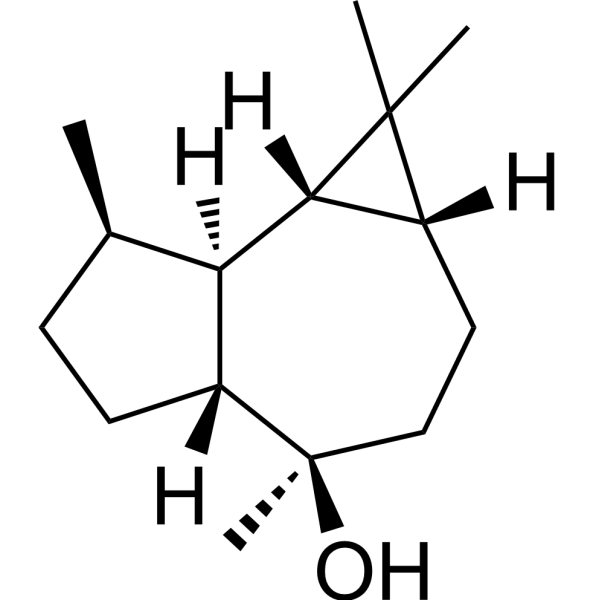
Cat. No.: HY-N8389
CAS No.: 489-41-8
Globulol is a terpenoid metabolite and Antimicrobial agent. Globulol can be isolated from Alpinia oxyphylla Miq. Globulol binds to PAK4, reduces the expression level of PAK4 in cancer cells, decreases the phosphorylation of AKT, and downregulates the expressions of STAT3, phosphorylated STAT3, and PD-L1. Globulol promotes the secretion of CCL4 by cancer cells. Globulol reduces the viability and proliferation ability of cancer cells, induces G0/G1 cell cycle arrest and Apoptosis in cancer cells, and inhibits cancer cell migration and the integrity of 3D tumor spheres. Globulol enhances the relevant effects of anti-PD-1 agents in the cancer cell microenvironment. Globulol exhibits anticancer activity against liver cancer. Globulol inhibits the mycelial growth of phytopathogenic fungi and the growth of phytopathogenic bacteria. Globulol can be used in studies related to hepatocellular carcinoma .
loading...
    loading...
Cat. No.: HY-122448A
CAS No.: 71831-00-0
(Rac)-Sativan is an isoflavanoid with a broad spectrum of antimicrobial activity against bacteria and phytopathogenic fungi. (Rac)-Sativan exhibits antituberculosis activity against Mycobacterium tuberculosis H37Rv, with MIC values of 50 µg/mL .
loading...
    loading...
Cat. No.: HY-N19815
CAS No.: 1853217-91-0
Synonyms: Aspergilol E
Target:  

Bacterial Fungal

Gibellulin A is a natural antimicrobial agent. Gibellulin A inhibits the growth of aquatic bacteria, human pathogenic bacteria and phytopathogenic fungi.Gibellulin A can be used for the research of bacterial and fungal infections .
loading...
    loading...
Cat. No.: HY-N18435
CAS No.: 6649-76-9
Komaroidine is a bactericidal agent. Komaroidine induces reactive oxygen species (ROS) bursts in bacterial cells, disrupts antioxidant enzyme function and redox homeostasis, increases membrane permeability, and triggers bacterial apoptosis. Komaroidine suppresses bacterial burden within infected plant tissues.Komaroidine exhibits broad-spectrum antibacterial activity against phytopathogenic bacteria including Xanthomonas oryzae pv. oryzae, Xanthomonas axonopodis pv. citri, and Pseudomonas syringae pv. actinidiae. Komaroidine can be used for the research of rice bacterial leaf blight .
loading...
    loading...
Cat. No.: HY-N17440
CAS No.: 15127-94-3
2-Methoxyjuglone, a naphthoquinone, is an apoptosis inducer. 2-Methoxyjuglone activates caspase-9 and caspase-3 via the mitochondrial cytochrome c-dependent intrinsic apoptosis cascade. 2-Methoxyjuglone increases pro-apoptotic Bax levels, decreases anti-apoptotic Bcl-2 levels, and promotes mitochondrial cytochrome c release. 2-Methoxyjuglone induces apoptosis morphological features, early apoptosis, S-phase and G2/M-phase cell cycle arrest, and DNA double-strand breaks. 2-Methoxyjuglone exerts activity against Gram-positive bacteria, pathogenic fungi, and phytopathogenic fungi. 2-Methoxyjuglone can be used for the research of hepatocellular carcinoma, osteosarcoma, colon adenocarcinoma, breast cancer, fungal infection, bacterial infection .
loading...
    loading...
Cat. No.: HY-W718262
CAS No.: 49608-51-7
Synonyms: (Rac)-CGP 52547
Research Areas:  

Infection Cancer

Dihydroaeruginoic acid ((Rac)-CGP 52547), an antifungal antibiotic, is a thiazoline iron chelator. Dihydroaeruginoic acid is the condensation product of salicylate and one cysteine residue. Dihydroaeruginoic acid chelates Fe(III), inhibits DNA replication via ribonucleotide reductase, induces G1/S cell cycle block, reduces leukemia cell clonogenic viability. Dihydroaeruginoic acid inhibits phytopathogenic fungi and bacteria, suppresses Candida albicans development, and inhibits Agrobacterium tumefaciens biofilm formation via extracellular iron sequestration. Dihydroaeruginoic acid can be used for the research of phytopathogenic fungal and bacterial infections, and leukemia .
loading...
    loading...
Cat. No.: HY-N19903
CAS No.: 2243140-21-6
Verticilatin is a prenylated diaryl ether derived from phytopathogenic fungi, acting as an antibacterial agent and biofilm inhibitor. Verticilatin exhibits no direct growth inhibitory activity against Gram-negative bacteria. Verticilatin effectively inhibits the growth of Gram-positive strains, including methicillin-sensitive/resistant Staphylococcus aureus and Enterococcus faecalis, and reduces the biofilm-forming ability of Gram-negative Stenotrophomonas maltophilia. Verticilatin can be used for infections caused by the aforementioned Gram-positive bacteria and biofilm infections caused by Stenotrophomonas maltophilia .
loading...
    loading...
Cat. No.: HY-N19735
CAS No.: 144678-18-2
MS-347a is an inhibitor of myosin light chain kinase (MLCK) and protein kinase C (PKC), with IC50 values of 9.2 μM, 31 μM and 16 μM against calmodulin-dependent MLCK, calmodulin-independent MLCK and PKC, respectively. MS-347a binds to the catalytic domain of MLCK and blocks both calmodulin-dependent and calmodulin-independent MLCK activity. MS-347a inhibits the growth of drug-sensitive fission yeast and multiple ascomycete phytopathogenic fungi. MS-347a exhibits fungicidal activity against a variety of phytopathogenic fungi and protective activity against Magnaporthe oryzae in rice seedlings. MS-347a shows antibacterial activity against specific Gram-positive bacteria and Proteus vulgaris. MS-347a can be used in studies related to rice blast, bacterial infections and phytopathogenic fungal diseases .
loading...
    loading...

